Showing posts with label landing gear. Show all posts

Thursday, December 6, 2007

PLANE PARTS part II: LANDING GEAR

WHERE 757 MEETS GROUND, EVIDENCE MATCHES OFFICIAL PLANE
Adam Larson
Caustic Logic / The Frustrating Fraud
January 8 2007
last updated 12/9/07


The TLC Wheel
The picture at left was taken by an unknown photographer on September 12 and shown in a The Learning Channel documentary. The location is in the Pentagon’s A-E Drive, at the far end of the plane’s trajectory between rinds B and C, just outside the curious 'punch-out' exit hole. It’s of a wheel rim generally thought to be from Flight 77. No missile I know of uses landing gear with wheels, but smaller planes do, and debate has raged over whether or not this is the precisely and verifiably a 757’s wheel or from something smaller.

Karl Schwarz, among his information that was “hand-delivered to New York Attorney General Eliot Spitzer,” decided the wheel is “the type made by B.F. Goodrich in their aerospace division. They also made the wheels for the 757 but a simple proportional check of width versus diameter will easily show that the below photo is not of a wheel hub from a 757 [...] This radius being about the same as the width of the wheel hub is also another clue that the 757 story is a Bush Lie." To clue us in on the truth, he noted that this looks like an A3 Skywarrior wheel - if it had the wrong wheels. "This is the type of wheel hub one would expect to find as one of the two rear wheels on an A-3 refitted with current equipment rather than equipment that is no longer being manufactured." [source]

Schwarz’s radius/width wheel analysis was apparently passed on by Dylan Avery in Loose Change first edition and then misinterpreted by the debunkers at “Internet Detectives” as radius/diameter: “I'm not sure what [Avery] means by this, as all circular objects have a diameter twice their radius.” [2] Anyway, in comparing the same images Avery used, which the Detectives considered good enough, we see clearly that the rim width/hub radius at left (red/blue) is about exactly the tire width/hub radius at right - the radius/width of the C Ring rim matches that of a 757.

Another point I recall seeing made at LetsRoll 911 was the difference in the holes placed radially around the center mount. Both seem to have a symmetrical arrangement but a differing number – the Pentagon rim with eight, the intact gear sporting ten, it seems. This is not so odd though, as Russell Pickering found out with some research, the 757-200 series (which Flight 77 was) uses precisely two different types interchangably - "one with 10 slots and one with 8." It's hard to say which type FLight 77 was equipped with, since, as Pickering found, "airlines are not obligated to use the same rim and gear manufacturer on a particular aircraft.” [source] My guess is it had eight holes. In fact the debunkers at Aerospaceweb.org found a photo showing the very craft in question - tail number N644AA - sporting main gear wheels with eight slots, just like the one that wound up in the drive. If it was planted, it was done right. But where are the other seven main gear wheels? Or the two nose gear wheels?

More Wheels
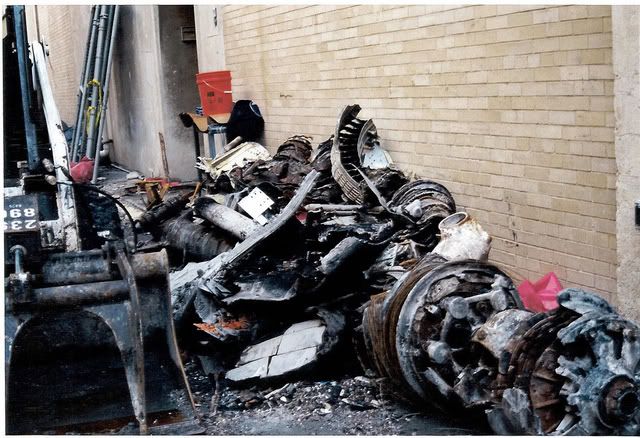
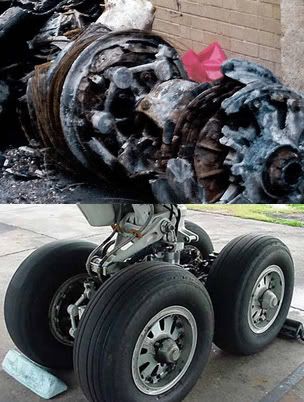
Above is a photo first published back in September. I first found it at the Loose Change Forum (halfway down page), posted by LCF member Digest, who had just re-deployed, to Iraq I would guess. Additional details remain hazy, but it would seem to be in the A-E Drive as well, and shows some apparent engine parts as well as a glimpse of the main gear strut (which I'll discuss in a moment) and a main gear wheel assembly with two battered wheels attached that seem to match the TLC wheel. Compare this with the main gear seen on a 757 (left).


The Strut(s)
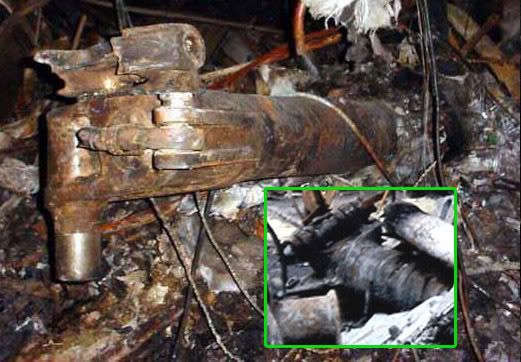
Then we can see what had once attached this wheel to the plane, a massive hydraullic leg found in the C Ring just inside the exit hole – not far from the wheel. This appears to be one of two main landing gear struts. Pickering wasn’t at first sure of the size of this clearly hydraulic artifact. He speculated it might be something from inside the building, like “the cylinder from a trash compactor,” but noted “if it could be proven that it was from an aircraft other than a 757 [that] would obviously be significant.” The inset is from the photo above - it bears the same hallmarks, and could be either the same strut or its counterpart.
Then he located another photo that clarified the scale of the thing, filling much of a room, as seen above, and compared this shot with a photo of a 757 landing gear in the shop, which Pickering obtained and I’ve superimposed for human scale. Taken together, these led Pickering to conclude “it must be a landing gear,” and its trunion link layout and other clues strongly suggesting a 757's. [source] Some scientists interviewed for the Dutch TV program Zembla were shown these photos [video link - 1:50 mark] and decided it was likely from a 757.

Whatever the merits of the too-small wheel analysis, after reviewing this massive, fundamental, and highly likely 757 part buried in the wreckage, any further discussion of the precise type of wheel at the end of it would now seem doubly ludicrous. All the HTB people have left now is the contention that these photos were stage-managed, the parts planted, or complete CGI forgeries. And they probably will make that case, if they bother acknowledging this evidence at all, as well as that the wheel in the forgeries is far too small. But for those who rely exclusively on evidence like Loose Change, Pentagon Strike, In Plane Site, or Painful Deceptions, the solution is simple - they will never be confronted with the landing gear photo, which was excluded from all these in-depth videos for some reason.

The Tire/Gear At Impact

Additionally, a single large tire - or at least half of one - was seen in the A-E Drive, in close proximity to the wheel found there. It is not pristine, but relatively intact for having passed through 300 feet of building. Perhaps this has to with being shielded by the rest of the plane. Of all eyewitness reports, only Noel Sepulveda recalls the landing gear down before the plane impacted. Other witnesses specifically report the landig gear was NOT extended at impact. William Lagasse: "The 757’s flaps were not deployed and the landing gear was retracted." [fifteen corroborating accounts compiled by Arabesque], and so remained safely tucked within the plane's underside, presumably until the fusealge came apart around it.

What We've Seen
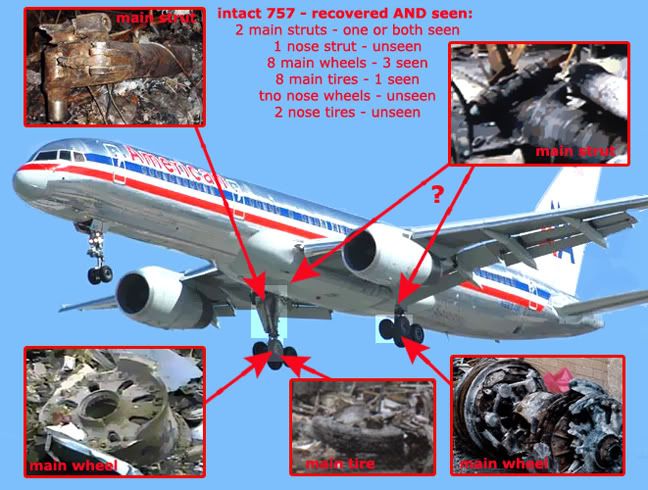
What we've seen is actuall a decent percentage of the landing gear, mostly just inside and outside the 'punch-out' hole which was semi-officially caused by some unspecified part of the Landing gear. One massive main strut apparently came to rest inside this opening, perhaps the same one was later photographed outside in the drive, along with the two wheel segment, which may well have been pulled out from inside. All of the gear we can identify as likely exiting the building on its own is that lone piddly wheel and tire, photographed from the beginning on the pile of rubble fanning out from the hole. The rest of the gear not shown on this page, if it was there at all, was buried somewhere inside that high-security installation and not publicly shown yet to my knowledge. One sobering possibility that should be considered is whether perhaps the smaller, unseen nose gear had detached early on, in its folded and dense postion, and buried itself nearly intact in a victim's torso. Would this photo be released if so? I actually hope not.


Sources:
[1] Schwarz, Karl W. B. “Pop goes the Bush mythology bubble Part 5: Exploding the myth of the Bushes as an all-American family.” Online Journal, via www.karlschwarz.com/02-02-05_Schwarz.pdf
[2] “Loose Change, section two: The Wheel Hub.” Internet Detectives. http://internetdetectives.biz/case/loose-change-2#the-wheel-hub

Monday, August 6, 2007

PUNCH-OUT HOLE “EXPLAINED” BY OFFICIAL ACCOUNTS

PUNCH-OUT HOLE “EXPLAINED” BY OFFICIAL ACCOUNTS
Adam Larson / Caustic Logic
The Frustrating Fraud
July 22 2007
Last updated/edited July 25


Official Dodginess:
How exactly Flight 77's trajectory through the building wound up giving us the exit hole we’ve seen is left a bit vague in the official record. The American Society of Civil Engineers' Pentagon Building Performance Report shows a photo of the hole but gives no adequate explanation. Its terse summary: "there was a hole in the east wall of Ring C, emerging into AE Drive, between column lines 5 and 7 in Wedge 2. The wall failure was approximately 310 ft from where the fuselage of the aircraft entered the west wall of the building," [1] The Arlington County After Action Report noted “the damage extended all the way through the inner wall of the C Ring, a distance of approximately 285 feet,” and showed a photo of the hole captioned “penetration through the inner wall of the Pentagon’s C Ring.” [2] An account of FEMA Urban Search and Rescue shoring/bracing of the building is the most detailed of these three reports. It explains that "a nine foot diameter exit hole was created in the wall of C ring and the remainder of the debris from the impact ended up in the alley between C ring and B ring known as A & E Drive," and elsewhere shows a photo of the "'exit wound' where the plane debris exited the C ring." [3]

These three reports, a few early press conferences, published eyewitness accounts, and a handful of photos constitutes the body of evidence on this hole. While it’s been widely seen and commented on, it has not yet been explained with any useful precision, and contradictory theories dominate to an unsettling degree.

Impact Energy Waves?
In October 2004, the National Geographic Channel program Seconds from Disaster proposed a novel theory by which shockwave pressure from the impact cause the punch-out hole. By this model, plane debris and heavy, exploding jet fuel, perhaps along with explosions of things in the building, gave off shockwaves that reverberated and crossed through the building’s first floor. Having no other exit point, these somehow directed themselves and whatever was in front of them to focus on that precise spot, punching the neat 9x11’ hole we’ve seen. [4] While this explains both the improvised exit and the lack of any major evident airplane parts, the official story has generally maintained it was physically caused by the plane, or some part of it, though which part has been widely contested.

Engine?
Military District of Washington’s news service reported two weeks after the attack, mentioning that “an aircraft engine punched the hole out […] on the inside wall of the second ring of the Pentagon." [5] Though the quote has been widely republished, no other official sources support this claim. No debris seen there looks like engine debris.The piece’s author got the “second ring” part wrong (whether one counts A-E or E-A, C is the third ring), so maybe identifying an engine was an error as well.

Fuselage/Nosecone?
As widely noted, Pentagon renovation spokesman Lee Evey explained implausibly during a September 15 press conference “the nose of the plane just barely broke through the inside of the C ring, so it was extending into A-E Drive a little bit. So that's the extent of penetration of the aircraft." [6] As Killtown wondered “how could the fragile nose of Flight 77 penetrate all the way through 3 reinforced concrete/steel hardened rings and punched out a hole through the inside wall of Ring C and leave no evidence of itself outside the punch-out hole?” [7] This seems unlikely, even given that the “hardened” walls from impact to exit really totaled only 22” of unreinforced brick and limestone [link forthcoming], but spanned between by about fifty damaged support columns and only one plane fuselage to absorb the other end of these blows.

What survived this was not precisely the nose cone, but more likely some element(s) of the nosecone assembly – landing gear, landing gear door, cockpit panel or cargo door – some tattered portion of the forward fuselage. As Jim Hoffman explained, in such an impact, “only the parts of the aircraft with the greatest density and total mass, such as the lower third of the fuselage, could be expected to penetrate far into the building. That part also has a small frontal profile - approximately the size of the punch-out hole.” [8] Of course there is no piece of debris anywhere near the size of the hole seen in any of the available photos, but the illustration is helpful. The fuselage had a lot of mass, tens of tons, and though it was under great stress, it didn’t simply disappear on impact.

Landing Gear?
It stands to reason that as the plane disintegrated, the densest parts of aircraft wound up at the deepest point of penetration. For example, the flight data recorder from the tail end of the plane was reportedly found just inside the punch-out hole. [9] The heavier elements from the front end would also come to rest around this point. The book Debunking 9/11 Myths identified the landing gear. The book cited Paul F. Mlakar, ASCE team leader and lead author of the Performance Report, who “saw the landing gear with his own eyes” during his early onsite inspections, for its explanation that:

“The hole was not made by an engine or the nose of Flight 77 pushing through the building’s interior - or a missile - but by the crashing jet’s landing gear, which was ejected beyond the bulk of the wreckage. […] As one of the heaviest and most dense parts of the plane, the landing gear flew farther than any other item in the wreckage and was responsible for puncturing the wall in Ring C.” [10]

Other photos and accounts seem to back this up by recalling or even showing a wheel, a tire, and even a massive landing gear strut, near the hole. But there are some serious problems with this theory as well, like the ASCE’s own Performance Report not identifying this alleged hole-puncher as such, which noted that "the landing gear" (all three sets?) were in fact found inside the building, hardly the best place to be after exiting through the hole into the AE Drive. [13] These questions will be summarized more fully in a [separate post].

ASCE and FBI Secrecy
Mlakar's ASCE study team “went to great lengths of detail down to individual columns” in the plane’s path, Russell Pickering noted, providing their own photos and personal damage assessment of nearly all of them. Yet they danced around the cause of the punch-out, as Pickering wrote, offering “not a single explanation for the exit hole.” [14] The three columns nearest the breeched wall - 1N-North, 3N-North, and 5N-North - remained un-photographed and listed in the report as “damaged per FBI.” [15] Pickering suspects falsification of the status of these three columns to hide inexplicably severe impairment. [16]

He speculated that “the building team […] weren't allowed back at the exit hole for some reason," and noted how "they indicated in the report why they didn't have photos of those columns and who gave them the damage report on the columns - the FBI.” The one photo they published of the exit hole itself was not one of their own, but also credited to the FBI, further indicating this area had special investigative significance to the bureau, although this could have many possible reasons. [17]photo of the hole used by the ASCE, credited to the FBI (lower right, very small print.) [18]
---
Sources: forthcoming
[1] Mlakar, Paul F., Donald O. Dusenberry, James R. Harris, Gerald Haynes, Long T. Phan, and Mete Sozen. “The Pentagon Building Performance Report.” American Society of Civil Engineers. January 2003. ISBN 0-7844-0638-3. Page 28. PDF download link
[2] Arlington County After-Action Report. on the Response to the September 11 Terrorist Attack on the Pentagon. PDF downloaded from http://www.arlingtonva.us/Departments/Fire/edu/about/FireEduAboutAfterReport.aspx. The report bears no publisher or copyright info – it was compiled by Arlington County and Titan Systems Corporation, and released July 2002 according to this story: Weiger, Pam. “Pentagon report: After-action.” NFPA Journal. Nov/Dec 2002. http://findarticles.com/p/articles/mi_qa3737/is_200211/ai_n9114927/pg_1
[3] Titus, Leo J. Jr., P.E./Virginia Task Force One Urban Search & Rescue Team. “A Review of the Temporary Shoring Used to Stabilize the Pentagon After the Terrorist Attacks of September 11th, 2001.” May 3, 2002. Pages 9, 12. PDF download link: http://www.aesvn.org/resources/Pentagon-Shoring.pdf
[4] Seconds From Disaster – season one episode 12 “Pentagon 9-11.” National Geographic Channel. First Aired October 26 2004 http://en.wikipedia.org/wiki/Seconds_From_Disaster
http://channel.nationalgeographic.com/channel/seconds/episodes.html
[5] Military District of Washington. Press Release. (9/26/01) original url: http://www.mdw.army.mil/news/Commentary-Remembering_the_honored_dead.html. Accessed at: http://www.snopes.com/rumors/pentagon.htm
[6]