Adam Larson / Caustic Logic
The Frustrating Fraud
November 20 2007
pretty much final Nov 21 3 pm
In the interest of critical thought regarding fakery of the Pentagon plane impact, I’d like to address the massive fireball unleashed when the plane *supposedly* struck the building. This was reportedly unleashed from the exploding fuel tanks of the 757 that impacted at a 39 degree angle traveling 530 mph or more. By the laws of physics, the motion of the expanding fireball would be determined by some combination of its general expansion (in all directions,) the forward momentum it retained from its flight there, and the angle of deflection and as such should spread across much of the building face, especially to the left (north) of impact, pressing against limestone and glass alike on its way. It would also have some tendency to rise and roll forward over the facade, igniting the roofing materials.
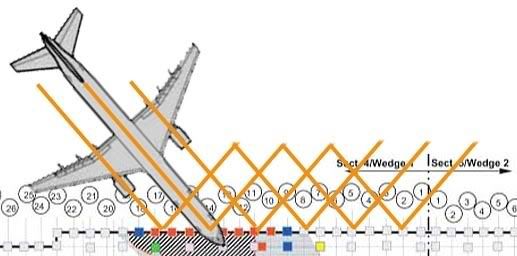
If there was a staged overflight with on-the-ground explosives and pyrotechnics used to create the fireball, it would either somehow have to mimic this pattern, or reveal the deception with inconsistencies. Ignoring for the moment the likelihood of this fakery, let’s look at some of the evidence of this event and its aftermath; whether it was stage-managed or simply crashed into, what does the building and the scene reveal about what actually happened?
The Crappy Video Evidence
First, let’s look at the famous and much-questioned CCTV security gate video of the attack. These choppy sequences of images (video at one frame per second) were captured by two cameras near each other at a security post just north of the supposed crash site. They show the plane (in black or white, depending on how one sees it) for one frame, about 600 feet from the cameras and closing at an oblique angle, less than a second before a bright flash at impact in the next frame, followed by a surging orange fireball that engulfs the building (below). That seems to make sense. The silhouetted structure is the heliport tower. Note this for later.

Note the deflagration's apparently triangular or conical shape, peaking just to the left of the building edge. I’ve seen this taken as a static, Christmas tree-shaped mass of fire, rising straight up from an epicenter in the building – as if the upper floors weren’t there, proof of obviously bad photo-editing. Another explanation is that the incandescent mass is rolling forward with plane’s momentum – from right to left of course and also somewhat towards the camera, if the ‘official’ trajectory is any clue. And a third possibility is that it was Photoshopped right to look like it should, which would look the same as the second option.
 If the blast originated within, as a flyover would indicate - and the video were honest – I feel it would look something more like this (at left): an apparent fuel explosion (I'm not sure) inside the building five minutes after impact radiating out from the first and second floor impact wound. What we see here is indeed consistent with a fireball rolling forward with plane’s momentum – from right to left of course and also somewhat towards the camera (see below). The glowing mass spreads along the façade to the area behind the heliport – it’s certainly difficult to imagine any inside-the building incendiary package actually doing this.
 Debris movement as seen in the video is another clue; some fragments hurtling out and ahead of the fireball seem to move backwards, but the larger pieces go forward, and presumably towards the camera, another clue of its overall momentum. As so many have said before, of course, this controlled video footage would have been easy to doctor, and so we're left with the old question - is it live or Memorex?
Post-Attack Photos
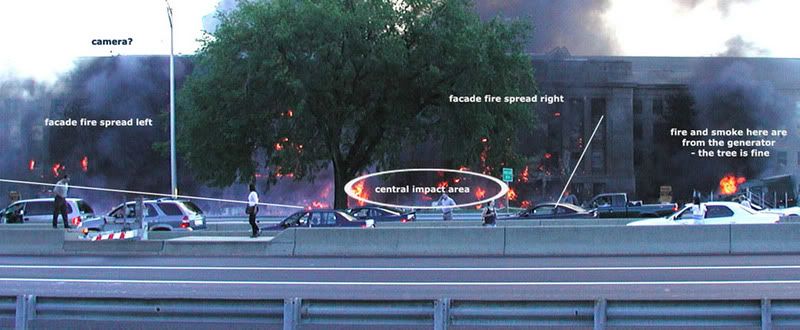
For whatever reason, photographs of the scene are not as often accused of fakery, but in fact they are easier to doctor. But ignoring the pit of paranoia that opens, here is a photo of façade burns after the impact and collapse, taken from an angle similar to the gate cameras. In fact, the cameras are in and in front of the small foreground buildings. The taller structure between them is the heliport/fire station. Compare the burn area to the left of the collapse zone to the narrower area to its right (not so clear in this shot). Also note for reference the security camera in about the middle of the wide left area.

This face-on early shot taken by Steve Riskus shows the area before the collapse, just minutes after the impact. Already we see that even after the fireball has passed, there are rectangular patches of fire that has somehow gotten inside of widows, and much further to the left than to the right (heliport cropped off the left side). This is yet more evidence of a fluid combusting with forward momentum consistent with a path from the southwest combined with expected deflection angle.
Upper Floor Fires
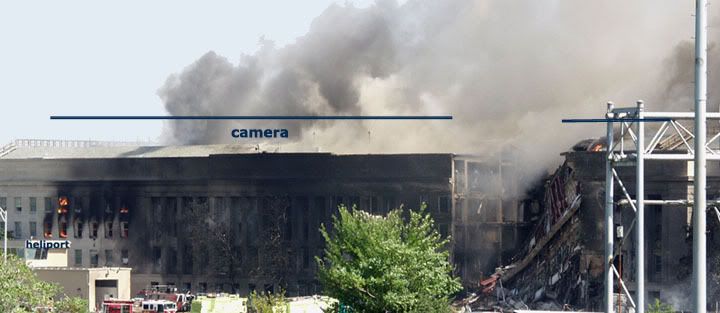
And in this picture, again after the collapse, note the same asymmetry and also the fires flaring out from inside on upper left, some of those that raged and smoldered inside for over a day. I’m not certain of the official take but would guess these are believed to be caused by the impact fireball breaking out windows in the un-renovated wedge two, and entering the upper floors though these breaches.
ASCE, Pentagon Building Performance Report, 2002:
“Clearly, some of the fuel on the aircraft at impact did not enter the building, either because it was in those portions of the wings that were severed by the impact with the facade or with objects just outside of the building, or because it was deflected away from the building upon impact with the facade; that fuel burned outside the building in the initial fireball.” [p 41] "Windows that had not been upgraded generally were broken for several hundred feet to the north of the impact point." [p 28] "A large fireball engulfed the exterior of the building in the impact area.Interior fires began immediately." [p 20]
These observations of the ASCE would support the theory that these upper floor fires far from impact were injected by this possible engineered inferno. The following passage however is confusing: "Most of the original windows in a vast area of Wedge 2 were broken after the fire was extinguished. It is probable that some of these windows were broken by the fire or by firefighting efforts rather than by the effects of the impact." [p 44] This gives little clue of just how the fires got started behind these intact windows. With the fire unable to spread laterally through walls from the actual wing impact points, let alone up through floor slabs, it seems likely the fire came in from outside.
The Running Eyewitness Evidence
The rolling deflagration was reported by eyewitnesses, including Fort Myer firefighters Alan Wallace, Mark Skipper, and Dennis Young, close enough to have to run for their lives as it billowed towards them. On duty at the Pentagon’s heliport (which has a mini-fire station beneath it and an on-site engine, ‘foam tender 161’), Wallace and Skipper were outside the station, inspecting 161 they had just parked against the Pentagon’s outer wall. As Newsweek reported:
“The two looked up and saw an airplane. It was about 25 feet off the ground and just 200 yards away -- the length of two football fields. They had heard about the WTC disaster and had little doubt what was coming next. "Let's go," Wallace yelled. Both men ran. Wallace hadn't gotten far when the plane hit. "I hadn't even reached the back of the van when I felt the fireball. I felt the blast," he says. He hit the blacktop near the left rear tire of the van and quickly shimmied underneath. "I remember feeling pressure, a lot of heat," he says. He crawled toward the front of the van, then emerged to see Skipper out in the field, still standing. "Everything is on fire. The grass is on fire. The building is on fire. The firehouse is on fire," Wallace recalls. "There was fire everywhere. Areas of the blacktop were on fire." [source: "Washington's Heroes - On the ground at the Pentagon on Sept. 11," Newsweek, 9/28/01. http://www.ratical.org/ratville/CAH/F77penta04.html]
Wallace’s account is interesting in that his image of its trajectory and altitude indicated imminent impact; and being so close to its said impact location, he’d have the perfect vantage point to see it work its flyover magic, (80 feet off the ground minimum to pass over). But being so close to its anticipated impact point from 25 feet up and 600 feet away, he was running with his eyes pointing away from it at the time. At any rate, it’s a good thing they ran instead of standing and fighting the fire like men. It would have won. This is Foam 161 afterwards, at the spot they were standing when the plane first came into view.
 Jon Culberson photo, Smithsonian
 By the flyover hypothesis championed by some, however, this palpable pressurized explosion was not the effect of impact, but something engineered beneath the steeply pitching plane.
The Challenge
The usual proposal for non-plane damage is a truck bomb out front, or bombs inside the building. Any number of explosive materials could be used – including a jet fuel element to simulate a 757 strike – and different mechanisms employed to create the angle of the engineered fireball. Who knows, huh?
Well, for people who claim something to that effect actually happened, it would be useful to have some guesses at hand. So I challenge Craig and Aldo of the Citizen’s Investigation-ish Thing to offer a plausible method for how this was all faked. An unseen incendiary catapult hidden behind the generator to hurl a fireball against the wall as the explosives blew outward? I seriously challenge them – describe the least Rube-Goldberg-esque contirivance, the least exotic weaponry they feel may have been actually used. Diagrams, specifications, numbers, guesses as specific as they’re willing to get. Brainstorm on it. People are watching.
Simply branding it as another point that could be done any number of ways will not suffice. Sure, they’re investigating people with theoretically unlimited power and they’ve said before they don’t need to explain how, since their witnesses prove this was all staged somehow. While that presumption remains contested, if this fireball fakery was another of the many points of deception, it had to happen in some way, by some mechanism, or it wouldn’t happen. Columns can be bombed. Poles can be clipped or torched down and hidden. Fences can be torn down. Generators can be pushed, etc. But what on earth could hurl a fireball like that against the façade of the Pentagon? I’d love to see any guess as to what, other than a crashing jetliner, it could have been? Or failing that another tap dance routine will suffice.
I'm not trying to push this as some smoking gun debunking either, just a good point to offer a firm challenge on. And Aldo, you aren’t banned here. Feel free to comment.


