Showing posts with label collapse. Show all posts

Friday, February 8, 2008

RIGHT WING DAMAGE CONTINUITY

RIGHT WING DAMAGE CONTINUITY
Adam Larson / Caustic Logic
The Frustrating Fraud
February 10 2008


Citizen Investigative Team’s number one claim to fame is of course their trailblazing eyewitness account verification, proving a north-of-the-Citgo flyover of the Pentagon. But garnering less attention is their groundbreaking work on exploring the ‘smoking gun’ physical evidence there was no impact from any airliner. Besides the witnesses, and before they were known of at all, CIT felt they had a strong anti-crash case, based on research into the ‘anomolous’ physical evidence at the site of the anomalous (alleged) impact of a 757 into the Pentagon.

Among the prime points they have made and that I’ve so far addressed is the presence of Column 14AA on the second floor, and the lack of foundation damage. The next claim I will examine and answer to the best of my ability is “why is there no continuity to the "wing damage" when it tilted up its right wing? It looks as if the facade simply fell off in this section.” This question was posted along with the two above and several others at Above Top Secret.com, and illustrated with these two high-res Jason Ingersoll photos:
The area shown here is just south of the main impact hole, the first and second floors of the section just upgraded to withstand bomb blasts. In the middle span there is much visible damage: a windowless panel recently backed with 10” of steel-reinforce concrete, intact but missing most facing and partially scooped-out. Perhaps most odd is another panel of presumably the same type right below it entirely gone, along with two weaker window/door panels just to the right of these. Some limestone facing is removed from the frame to the right of that, but at the left and right are areas of little or no visible damage, labeled in red “no wing.” On first blush this might seem like pretty anomalous damage, considering the alleged wing impact angle (see below); put simply, there’s too much damage on the first floor, and apparently not enough on the second.

The photo below is overlaid with a light grid representing the intact structural frame. Intact panels within the grid are lightened as well, whereas removed or intensely damaged panels are left un-tinted. The partial plane outline is based on the ASCE’s graphics, layered to scale and outlined. Areas shaded red are where the problem is, those marked ‘no wing’ above.
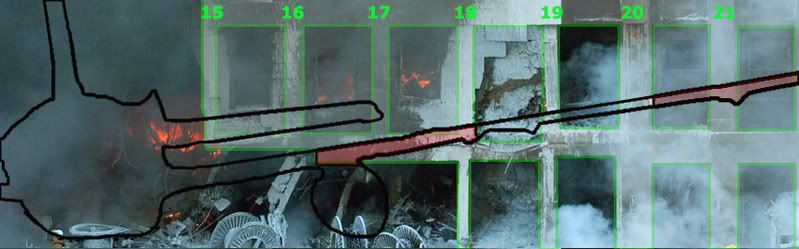
Considering how much continuity of damage there should be, we need to consider many factors, like these:
1) The strength of the wing at various point in optimal conditions
2) Actual wings strength/integrity after impacting light poles, generator, etc.
3) The mass and speed behind the wing (with the fuselage already shredding inside)
4) By the alleged impact angle, the entire right wing would have impacted near-simultaneously
4) Portions of the building impacted – horizontal resistance (floor slab) vs. vertical resistance (columns, wall panels, windows)
5) The possibility of other projectiles (cargo trailers, equipment, etc) and/or the deflagration plume of a pre-impact wing explosion contributing to the extra damage on the ground floor.

Considering these, one red area is near the wing’s mid-point just over and south of the engine. This is a very strong part of the wing, but it met the floor slab at a shallow angle – near parallel - with at least ten feet of it hitting edgewise either the slab or the very bases of the columns anchored to it above. At this point, the building wins and shows no immediately visible scars. The other problem area is nearer the wing’s tip, a weaker point, meeting ordinary columns and façade, if the outer wing was even still attached at that point. The wall south of CL 20 shows nary a sign of impact, so apparently building wins there as well, which somehow doesn’t surprise me.

But further in on the wing, which was after all attached to a barreling 90-ton jetliner at about 460 kts, there should have been some instant damage to the frame. Countering this CIT point at the forums, I’ve previously used the following two images of the damaged panel between columns 18 and 19, cropped from Jocelyn Agustino hish-res photos taken – yes, I’m aware - about a week after the event: The missing brick has a linear edge with a certain slope relative to horizontal. The concrete backing damage has its own similar overall slope. The slab and column damage as well exhibit a similar but shallower slope. The damage is manifested at different heights due to the nature of the materials, their order in layering, etc., but all share a moderate right-high slope that is consistent with the alleged wing tilt of the 757 at impact.
Seen from something of a side view, as above, it’s clearly visible that the columns are disjointed, with the upper floor’s lower ends apparently buckled inward, or the lower ones outward, it’s not entirely clear. Referring to this area of damage, the ASCE’s Pentagon Building Performance Report noted:

“Just above the second-floor slab, the exterior columns on column lines 18 and 19 exhibited aligning gashes that seem to indicate impact by the right wing of the aircraft [...] An area of broken limestone of the facade over the exterior column on column line 20 also aligned with these gashes.” [p 27/28 - emph mine]

Referring to these photos presented as evidence, and apparently missing the majority of information in them, Ranke said “the damage does NOT match a "wing". […] A single broken column does not match a "wing" and does not have to have been fabricated on purpose to match a wing.” He decided I was “incorrectly or deceptively trying to attribute damage to the "plane" that did not exist immediately after the violent event,” rather than to the collapse or some other later event. [source]

In fact, noting the lack of all this damage visible before the collapse, I attribute it to a chain of events unlocked by the plane’s impact. Let’s look at a different kind of continuity of wing damage - continuity through time. At impact the initial damage would be done in a tiny fraction of a second. Some of this – the missing and damaged panels - was externally visible. There would also be damage, especially along the stronger frame, that would be internal and less visible.

Considering both obvious and possibly latent damage, let’s look at a sequence of pictures from the morning of 9/11, at different points between 9:38 and 10:15 or so. In Steve Riskus’ photo at left, taken about one minute after impact, CL18 is framed by magenta markers and a line of fire just to its right. This long-shot is too unclear on its own, but compared to the Darryl Donley photo at center and taken at least five minutes after, it shows a flaming seam at its far right that matches, if more dimly. The Ingersoll shot at right was taken several minutes later and after a coating of fire retardant foam. While the facing is broken fairly clean on the column edge, the “no plane” damage area to the left of that remains unchanged; the column and its facing remain - counter-intuitively - intact.
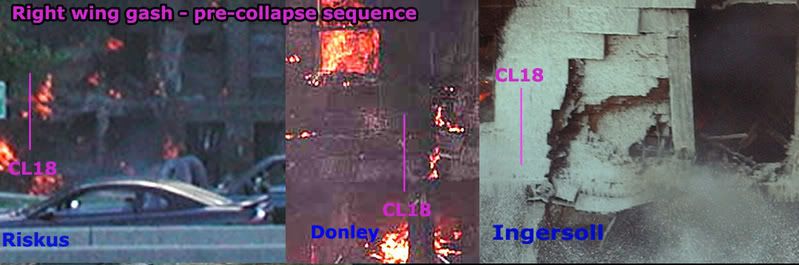
At lower left in the top photo below, note a major crack in the horizontal frame just to the left of column 18. I speculate that at this point, the area there is holding together by weight and habit, but ready to shear, crumble, and scatter along the fault lines introduced by the big thud at 9:38, waiting for a further violent event to trigger the fractures into rifts.
Then the collapse, immediately after which the bottom shot was taken. The facing around the damaged panel has fallen away, but the brick and concrete backing remain about the same. Below that, something has left the whole corner of the frame above and left of column 18 missing, presumably in the pile large of rubble that formed at the foot of the collapsed zone. Perhaps it was some massive pressure that has stripped away the top of that column, exposing re-bar. Although the separation came after the collapse, the point of give is right about there in the red zone of ‘no plane damage.’ And I’m pretty sure column 19 on the right also shows its later damage at this point, and even before collapse, though that’s less clear. Coincidence? If there was no continuity of wing damage, then why is there no continuity of the column here?


Referring to Augustino's post-shoring photos of the alleged wing gash, Ranke told Above Top Secret.com member Dark Blue Sky, in no uncertain terms:

“You can't use a post collapse photo if you are trying to assert it was from the alleged impact. Catherder used the same image for the same reason and it's deceived many 10's of thousands of people. Please don't help. There is nothing possible about the damage to the Pentagon in relation to a 757 impact.” [source]

Referring to a blurrier version of the bottom post-collapse shot above that clearly shows the breach of column 18, Ranke furter explained “it's quite clear that even after the collapse the left column was not completely breeched as it was after supports were added days later.” [source] Wrong. It might have been worse by the time of Augustino's photos, but it could only be less clear here due to being a head-on shot. The top of the column’s casing is gone, the corner of the frame is gone, lengths of rebar are exposed, and column 19 seems to have its damage as well, visible even before the collapse.

In summary then, all things considered, the answer to CIT’s original question is that there is about as much continuity to the right wing damage as there should be, which is little that was plainly visible after impact, but more that revealed itself after the collapse. And again I'm only left wondering if they really misread the evidence this wrong or are just pretending to have done so.

Friday, November 9, 2007

THE ELASTIC TIMELINE

PENTAGON ATTACK TIMELINE QUESTIONS PART 1: THE ELASTIC TIMELINE
Adam Larson / Caustic Logic
The Frustrating Fraud
Nov 9 2007, 11pm
hopefully final update 11/13 1pm


An 18-Minute Error
Recently I had the minor pleasure of witnessing a notable timeline alteration regarding the collapse of the damaged Pentagon section. Still reported in some spots as occurring at 10:50 am EDT, it has generally been placed (9/11 Commission, ASCE, etc.) almost an hour earlier, at 9:57. But it turns out numerous better sources converge on a collapse time of 10:15 am – an 18 minute difference only sorted out by 9/11 researchers six years later. Notable mention in updating this must be give to Russell Pickering and LCF member Honway, whose work with time-stamped video provided evidence that unlocked the timeline mystery and soon more buried evidence was found. I’m now comfortable stating the collapse happened at 10:15, with earlier reports referring in confusion to an order issued to firefighters to evacuate the area in anticipation of collapse.

A 5-Minute Error
Not that such minutiae was or is very important to most, but a similar shift had happened with the more important impact time attributed to Flight 77, but that story changed five minutes backward and did so early in the game. Despite CNN having first broadcast about an explosion at the Pentagon at 9:39, in the days after the attack, the essential official story was an impact at 9:43 and generally taken as fact. Some examples: 9:40 graphic - 9:45 graphic - 9:43 CNN - 9:43 Patriotic site - 9:43 Christian Science Monitor - 9:43 CBS - 9:43 still repeated in 2007 - Etc…

It was only on September 18, a week after the attack, that NORAD announced a revised crash time of 0937(estimated) [1]. It’s not clear what this was based on, but NORAD were suspected by some of fudging it back to minimize the delay of defense indicative of a stand-down. However Col. Alan Scott, a NORAD officer active on 9/11, told the 9/11 Commission in May 2003 the time was shifted first due to an “entry camera for the parking lot, which happened to be oriented towards the Pentagon at the time of impact, and the recorded time is 9:37. And that's why the timeline went from 9:43 to 9:37, because it is the best documented evidence for the impact time that we have.” [2]. He also noted “it took about two weeks” to find this footage, so NORAD’s source as of 9/18 might have been something else. The 9/11 Commission accepting this time is often cited as evidence it was a lie, but one also supported by the Flight Data Recorder, the last frame of data at 9:37:45 (alternately rounded to 9:37 or 9:38). The radar record (see below) also supports this time, as do the NORAD tapes, and other points to be addressed in part 4.

9:43 Event Evidence Addressed
I spent a long time digging for all reports I could find for reasons 9:43 was first offered as Flight 77's crash time, and found almost no evidence at all directly indicating it. One possible exception is longtime CT researcher,founder of 9/11 Citizen's Watch, and DC resident John Judge, who later offered Paul Thompson ’the Flight 77 timeline’: “a 9:41 crash time into the Pentagon. I still say it was later, but certainly not at the 9:37 NORAD claims (and shouldn't they know?). I put it at 9:43 earliest, 9:48 latest, but maybe my clock is off. I did hear it hit and looked at the time.” [4] Earlier he'd explained that from his home in DC, 1/2 mile away, he heard a blast loud enough to shake his windows. [3]

A secondary explosion, like the ones widely reported by ear-witnesses, is one likely explanation for Judge's timeline. A few examples: “Two explosions, a few minutes apart, prompted me to start walking.” “Those fleeing the building heard a loud secondary explosion about 10 min. after the initial impact.” “secondary and third-order explosions started going off. One of them was a fire department car exploding.” On-site news reporters and others compiled by Arabesque back this up. At least one powerful blast with erupting fireball was photographed by Daryl Donley within a few minutes of the attack (above - note this fireball is erupting as the area is already damaged and smoldering. Ralph Olmholt found a source somewhere indicating "jetting flame from an underground utility bunker, presumably a broken gas main" was said to be responsible for Donnely's "dramatic picture," a theory he doesn't seem to buy. [4]

This harrowing account by survivor Kevin Shaeffer, originally published in Shipmate magazine, and re-posted 9/11/02 at Citizen Smash/Indepundit, seems to support the original time:

“In a flash, at exactly 9:43 a.m., the entire Command Center exploded in a gigantic orange fireball and I felt myself being slammed to the deck by a massive and thunderous shock wave. It felt to me as if the blast started with the outer wall facing my backside, blowing me forward toward Commander Dunn’s desk. I never lost consciousness, and though the entire space was pitch black, I immediately sensed that I was on fire.” [5]

I'm not enough of an explosives expert to say if an orange fireball moving inward in the building and igniting him is indicative of any type of explosives package, but it does fit the profile of jet fuel hurtling inward. So this would seem more likely to be the initial impact than the 9:43 blast of what seems to be burning fuel moving outward. Whether he was watching the actual time and had seen it turn to 9:43 just before the event, or filled it in later based on the flawed initial reports is not clear.

It could be the loudest explosion was the one at 9:43, louder than the crash itself – loud enough it shook Judge’s windows a half-mile away – while for whatever reason he didn’t hear the earlier crash. Other DC residents may have heard the same thing, triggering a rash of calls taken as the most likely point just due to this noise factor - it was likely flawed intelligence echo chambered in the initial confusion that got the first timeline off by five minutes. It was probably not a sinister cover-up.

Or was it a cover-up? If the secondary explosion were, for example, engineered for some reason, as some have speculated, there would be reason for them to say that was the hijacked jet crashing. Hmmm.... Discussion at the Loose Change Forum was inconclusive on the cause of the explosions, although member Honway provided this highly relevant screen cature:
Gaffney’s 9:43 Cover-Up Evidence
Another possible reason for a cover-up has been offered by Mark Gaffney, a noted environmental and peace activist and published expert and author on ‘Gnostic Secrets.’ He wrote a seminal piece posted at Rense.com called The 9/11 Mystery Plane, regarding the E4B ‘doomsday plane’ seen and filmed over the Capitol. There at about the time of the attack across the Potomac, this airborne command center is thought by some to have been running the remote control for the Pentagon attack plane. As worthy as this analytical piece is, Gaffney followed it with The 9/11 Mystery Plane Part II: Did the US Military Fudge the 9/11 Timeline?

Still eschewing overt silliness in favor of a relatively even keel, it elaborates on reports of the mysterious white jet over or near DC’s restricted airspace around 9:40-9:45, and alleges official flight path misinformation (vague at best) to allow us to believe this was Flight 77 before impact. Supporting this is live CNN footage from 9/11, where White House correspondent John King reported around 09:52 "about 10 minutes ago, there was a white jet circling overhead.” Gaffney summarizes “I believe that the US military announced the original 9:43 AM Pentagon crash time to conceal the presence of the E-4B over Washington.” [7]

However, recently released 84 RADES data, viewable here in stunning video form with Air Defense audio, shows nothing over DC at 9:43. An aircraft labeled “M3_0310” crosses just north of DC, flying west, at about 9:46-9:46:40, heads north then loops back south passing east of DC around 9:49. The E4B is also said to have passed the capitol twice, so it seems blip M3_0310 that skirts that airspace is this same craft.

This data must be approached with the proper caution due all evidence, but so far I see no particular reason to doubt it aside from its conflicts with 'CIT-compliant' eyewitnesses. But regarding this separate craft, if this is accurate and represents the white plane, it would seem King was rounding up when he said it passed the mall ‘ten minutes ago.’ Interestingly, its takeoff time – from Andrews Air Force Base - as seen in the video is 9:43:43, so if true it would have been on the ground at the official impact time as well as the 9:43 window. If this jet truly did not pass until 9:46, placing the impact time three minutes prior would have been a silly and risky gambit. This radar data has never been seen until now, but the cover-up might at any point have been exposed by any class of data: 911 calls, other call records, time-stamped video, etc. Or alternately, if other evidence supports Gaffney's claims, then the RADES data might be shown altered to conceal the true time of its flight.

Back Six More?
The RADES video linked to above also shows Flight 77 disappear from radar just short of the Pentagon at 9:37:12; this is consistent with its final dive to official impact 33 seconds later, and one more point of evidence that the shift from 9:43 to 9:38 was justified. But a sporadic attempt at another shift back of six minutes in the impact/explosion time - to about 9:32 – has been afoot for a while now and seems to have a lot of evidence backing it. Is it time for me to shift the timeframe back another six minutes, or is it not? This is my main reason for delving into timeline questions and the case for a ‘9:32 event,’ supported in part by Gaffney, will be introduced in the next post and its points of evidence directly addressed in the following one.

Sources:
[1] North American Aerospace Defense Command. “NORAD’s Response Times.” News release. September 18 2001. Accessed via: http://www.standdown.net/noradseptember182001pressrelease.htm
[2] National Commission on Terrorist Attacks Upon the United States. Second Public Hearing, panel 1. May 23, 2003.Hart Senate Office Building, Room 216, Washington, DC. Witness: Col. Alan Scott (Ret.). http://www.911commission.gov/archive/hearing2/9-11Commission_Hearing_2003-05-23.htm
[3] Judge, John. The Pentagon Attack and American Airlines Flight 77. February 21 2004. http://www.ratical.org/ratville/JFK/JohnJudge/PAandAAF77.html
[4] Olmholt, Ralph. "The Dog Should Have Barked." Pentagon Reasearch.com. December 22 2004? ('date created' in html info) http://www.pentagonresearch.com/098.html
[5] Account of Kevin Shaeffer. Shipmate magazine. Original URL (non-funtioning): http://www.usna.com/News_Pubs/Publications/Shipmate/2002/09/Ring.htm. Accessed via: http://www.indepundit.com/archives/2002_09.html
[6]
[7] Gaffney, Mark H. The 9/11 Mystery Plane (Part II): Did the US Military Fudge the 9/11 Timeline? Rense.com. July 5, 2007. http://www.rense.com/general76/wdb.htm

Monday, July 2, 2007

COLUMNS 15-17: STILL ATTACHED?

STILL ATTACHED?
BEING A FASCINATING STUDY OF FIRST-FLOOR COLUMNS 15AA-17AA
Adam Larson/Caustic Logic
The Frustrating Fraud
Split-off July 3 2007 from Support Columns masterlist


This photograph by James Ingersoll was used as figure 3.9 in the ASCE’s Pentagon Building Performance Report. It shows exterior support columns 15AA, 16AA, and 17AA, which the report described as “severely distorted but still attached at least at their top ends to the second-floor framing.” [1] This is what I originally saw as well, as have most others. But being just to the immediate left of the main fuselage impact point at column line 14, this should have been the entry point for the right engine and wing root; it stands to reason then they should have been just as removed as the columns to the left of 14.

Despite their distortion, many have taken these columns’ existence at all after the crash as a sign that the no plane the size of a 757 could have entered.For example, Dick Eastman noted these in his piece "You Decide: Fighter Jet? Or 757?" His second proof of a fighter strike, as illustrated by the government graphic at right, is that “the starboard engine would have hit on the first floor at pillar #16. Except that it didn't." He cites their status: "Pillar #15 has been blasted near ground level […] Pillar # 16 is still there, albeit blasted so that it inclines to the right; and pillar #17 is also present and accounted for.” Eastman concluded “clearly there was no starboard engine. An explosion occurring to the left of pillar #15 caused damage to the pillars to the right of it and brought down some outer wall on the first floor wall, but a large turbofan engine of a Boeing 757 never penetrated here. Thus we know that the killer jet was a single-engine aircraft.” [2]

This is classic fraud logic. “there was no 757 because the hole is too small. The “extra damage” is because of explosions to make it look like a bigger 757 hole. But just looking at that hole, you can see it’s too small…" (rinse and repeat).

However, looking at that diagram and noting that everyone agrees that the outermost columns on the left and center of the entry space (10-14AA) were uniformly removed, #15 and 16 indeed should have been nearly vaporized. This never seemed a big enough problem for me to dismiss the 757 hypothesis; I figured the displacement was enough to let an engine pass, but I found it odd that 16 would just "tip over" in straight form rather than being bowed. When I realized the high-right banking angle as well, it became clear this column would have been hit near the top, not the bottom, which makes no sense given the pictured slant of this big, square-sided "damaged column." And I was at least half-aware that the columns the ASCE and I were seeing looked different from each other and from the other pillars we can see, and weren’t quite properly spaced.

In retrospect it was also a bit sloppy of me – and perhaps the ASCE - to be certain these were "support columns" at all. In fact, despite their impressive credentials, no one at ASCE had time to look up close before the collapse, and only so much could be told afterward. in the collapse zone “the team was unable to determine specifically the level and extent of impact damage.” [3] They probably decided on the pillars by looking at these photos – but Jim Hoffman has looked at the same ones and decided “some or all of these objects may in fact be broken portions of the second floor slab that collapsed after the impact,” and came to rest at an angle close enough to vertical to be mistaken for columns. [4] Note also the lowest edge of the 2nd floor façade between 15 and 16 missing a segment of limestone about the size of “column 16.”

Another shot, above, from before the area's blanketing in foam reveals the burning hell a Pentagon doused in jet fuel becomes, as well as better detail on the possible pillars. Here it seems #15 and #17 are just narrow bits of something dangling down nearly to the ground, but these could be battered pillars, reduced to rebar netting. #16 looks most like a solid pillar on first blush, but much burlier than #18 or the other suspects, and I doubt it would look this clean and square if it’d been hit by an airliner at it's "still attached" top end.

Therefore this is actually the weakest candidate for support column and likeliest for second-floor portion –slab, girder, façade, Idon’t know exactly what was there – perhaps something like the chunk missing from the shot above, taken days later and I believe of columns 18, 19 and 20. Perhaps #16 is the sister of the broken slab there, and #17 is the sister of the metal girder beneath it.

Note: “Column 16” appears wider in the original photo, but I noted a light line running down the middle of it, indicating it had a square cross-section, and had somehow rotated about 45 degrees from the camera. When placing it above I “turned it around” by cropping off one side, but then failed to stretch it back out to cancel the perspective. I’ll have to correct this. But anyway, I still say whatever horizontal member this might’ve been, it makes more sense than a column that had been hit by any part of a barreling 757.

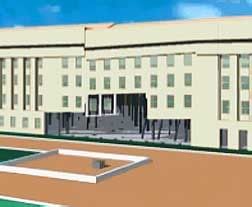
A still from the PBPR, a 3-D model by the ASCE. The three red slants here are columns 15-17. Among the worst damaged, these are listed in the Performance Report as “missing, broken, disconnected,” elsewhere described as "without remaining function.” Some were entirely knocked loose but found, some were disconnected but standing, and some totally obliterated, here represented by dots on the floor where they were. These red “columns” appear out of place when all those around and behind it are verified or presumed vanished. I suspect this graphic is incorrect by having the three red pillars shown as anything but dots.

If these three mystery slants are indeed something other than columns 15-17, then we are left with a roughly 90 foot-wide area in which all supports were obliterated on the ground floor, front line - leaving plenty of room for the engine-fuselage-engine penetrating core of a 757, whose deeper but less even damage further in would explain the collapse of everything above that twenty minutes later. While some confusion about this has encouraged speculation and no-757 theories, a little research would show that in either analysis, red is red; missing or in place but non-functional, these columns are no longer functioning support columns because something heavy and fast has traumatized them.

Sources:
[1], [3] Mlakar, Paul et al. “The Pentagon Building Performance Report.” American Society of Civil Engineers. January 2003. PDF version. www.fire.nist.gov/bfrlpubs/build03/PDF/b03017.pdf
[2] Eastman, Dick. "You Decide: Fighter Jet? Or 757? 911 Pentagon Crash Evidence proves False-Flag Frame-up." http://www.bedoper.com/eastman/
[4] Hoffman, Jim. “ERROR: 'Surviving Columns Preclude 757 Crash'” 811 Review.com http://911review.com/errors/pentagon/columns.html

Saturday, May 19, 2007

SUPPORT COLUMNS {Masterlist}

Update on the Pentagon's Support Columns thought by some to disqualify a 757
Adam Larson/Caustic Logic
The Frustrating Fraud
Last updated 9/10/07 mid-day


According to the ASCE's Pentagon Building Performance Report, “the original structural system" of the Pentagon "was entirely cast-in-place reinforced concrete using normal-weight aggregate." [2] This means the frame, comprised of columns supporting and connected to beams, girders, and floor slabs. The report illustrated "the typical members" in the impact area (left). The reinforcements in these columns are vertical bars, typically six, wrapped with a welded rebar that spirals from top to bottom. This cage is filled and covered with concrete, all told measuring 21” square. [3] These were evenly spaced at intervals of roughly ten feet (I'm not sure exactly).

As seen above, many impacted columns inside the building exhibited a pronounced inward bend, what seems to be a bowing by Boeing. At least one column on the outer wall seems to bear this mark: Column 9aa - warped by the left wing"

Assessing initial, pre-collapse damage to support columns is problematic; after the impacted section collapsed about twenty minutes after the 757 attack, the initial plane imprint was invisible beneath a heap of masonry, with only a few published photographs taken of the in that window of time. There was little if any video of the elusive original wound, and of course no up-close studies conducted. While most of the photos are of the best quality, it was still a violent and chaotic scene and a little hard to read, but often all investigators, even official ones, had to go on.

In assessing a “hole,” we can talk about superficial damage like removal of the building’s limestone façade and windows, and structural damage to the building’s frame and support columns. Missing outer wall and windows are generally agreed on when addressed on both sides of the debate – this is all evident. But not everybody agrees on the state of the columns in the 757’s alleged flight path.
For example, take the roughly 16 foot wide "hole" apparent on the second floor; the ASCE reported "on the second floor, the facade was missing between column lines 11 and 15. However, windows and their reinforcing frames were still in place between column lines 11 and 13," thus leaving the impression of less damage there. [1] One photo I've seen shows what seems to be a column running down the middle of that hole where 14 would be - but all other shots show no column in that spot. Through the magic of selectivity, many 9/11 Truthers have found this pillar intact and sound and concluded no plane fuselage entered there.
- Why they're wrong. Columna 14AA: The Smoking Gun That Fell Away?

But the main question with the state of the supports is on the first floor; above is one of the few shots of the first floor showing clearly the impact point and the right (south) half of the damaged area where the plane hit. Note the orange of fires is here prevalent on the second floor and almost absent from the first. This is consistent with the high impact of the fuselage breaching the floor slab and sending exploding jet fuel into both floors, and the reported banking angle of the plane, with starboard wing tipped high and cutting across the second floor slab. Just beneath that and just to the right of main impact, is what would have to be the entry “hole” for the 757’s right engine and wing root. In that spot, most all sources on both sides agree, there are three exterior columns there, 15-17AA, that are badly damaged and warped (the picture above is from the ASCE’s Performance Report). Opinions differ as to whether or not that’s odd, and what it means for the 757 impact story.
- I disagree with nearly everyone here, and this post explains why. This graphic sums it up somewhat:


One clue there’s a problem with identifying just what was a column in this area is the discrepancy even between official reports, explained in this Split-off sub-post:
Confusion in Reports: 15-18 missing, present, or a bit of both?

If these three mystery slants are indeed something other than columns 15-17, then we are left with a roughly 90 foot-wide area in which all supports were obliterated on the ground floor, front line - leaving plenty of room for the engine-fuselage-engine penetrating core of a 757, whose deeper but less even damage further in would explain the collapse of everything above that twenty minutes later.

Additional column damage deeper in the building will be covered in another forthcoming post, and will also be touched on briefly in an upcoming post on the “Punch-out” hole.