Showing posts with label debris. Show all posts

Friday, February 8, 2008

WILLIAM LAGASSE, 2001

WILLIAM LAGASSE, 2001
Adam Larson / Caustic Logic
The Frustrating Fraud
February 8 2008 11pm


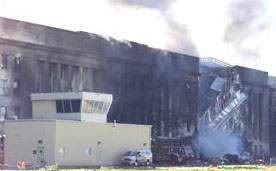
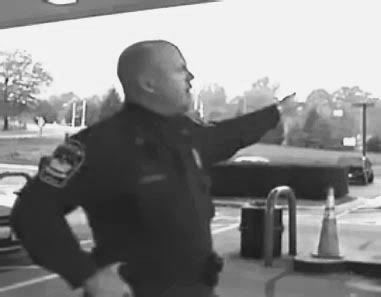
My recent analysis of Chad Brooks’ 2001 Library of Congress interview, in the spirit of fairness, deserves a counterpart analysis for Sgt. William Lagasse. Both officers who would later agree on a north-of-the-Citgo flight path were also audio-taped for the LoC about their experiences in late 2001; Lagasse’s eight-minute-long account was recorded on December 4, about two weeks after Brooks’. [MP3 Listen/Download Link] Like Brooks, he gave the same basic location he did for his videotaped 2006 interview: “I was refueling my police cruiser at the Barracks K gas station,” also known as the Citgo and the Navy Exchange, “approximately 1/8 of a mile from the heliport side of the Pentagon.” But unlike Brooks, whose 2001/06 accounts seem to conflict, Lagasse seems probably consistent on the core point of the plane’s placement relative to the station.

At 4:42 he describes his sense of security as largely unchanged by the attack: “We all kind of knew that something like that was going to happen eventually. […] we knew there was a potential for an aircraft to hit the building,” he said, and added “I’ve never felt entirely safe at the building because it is such a target.” A skeptic might wonder if this previous talk about inevitable plane impacts helped condition him to see an impact instead of the flyover that would have to happen if it were north of the Citgo. But he is and always has been a clear impact witness: “The image of the airplane flying into the building has not ever left me.”

He describes briefly helping people out of construction area before he pulled back due to the smoke, and with his supervisor began a “methodical search and recovery of evidence from the aircraft.” He apparently didn’t think the debris seemed planted in any way. Oddly, at 7:18 he said “I remember being on the scene and seeing a chunk of the plane that just said “Ameri” on it.” This doesn’t sound familiar from the photos I’ve seen from as early as one minute after the crash. He also said “I remember seeing the light poles that the plane hit. That knocked it down. It’s absolutely surreal.” Indeed, especially considering he saw them on location, and in 2006 had shifted the location he remembers seeing them – and Lloyd’s taxi – to a point further north to match the flight path he was giving then.

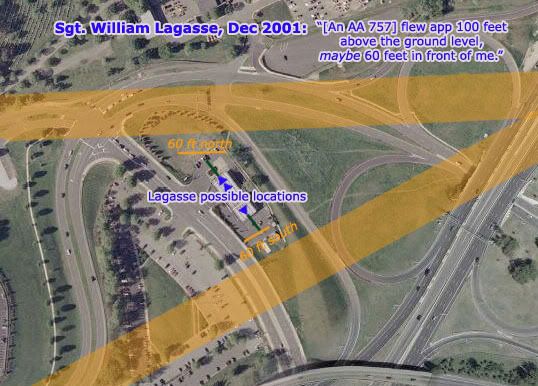
And what flight path did he imply in 2001? It was a beautiful, clear day. He was standing outside his car with a great view, filling the tank. At first he didn't hear anything, but watched as "an American Airlines 757 flew approximately 100 feet above the ground level maybe 60 feet in front of me.” That’s as specific as it gets. The interview alone is inconclusive and vague and on its own it can’t tell us much. With pumps on both ends of the station, if we didn’t know which way he was facing, we’d have this scenario [orange swathes just over 60 feet north or south represent a 757 wingspan set along the basic NoC path and along the official/damage path]:
But of all people Sgt. Lagasse has been verified and verified as at the north end of the station and facing north. In 2003 he explained to Dick Eastman how he saw the right side of the plane, then described its flight path as north of the station. In September 2006 the Citgo station's security video was released showing perhaps Lagasse under the north canopy (and apparently no one under the south). In November CIT interviewed Lagasse and was able to record him remembering details to match the video, and got a further very detailed description of the trajectory and placement with visual cues.

Lagasse + North Path = uber-corroborated, perhaps over-corroborated. Score one for CIT. While the interview itself is inconclusive, their arguably star witness has no apparent discrepancies between 2001 and 2006.

Side-note of unknown relevance: I’m not sure who he’s referring to when Lagasse says at 6:25 “We have one officer who’s been recognized perhaps too much, and then we’ve got several officers who haven’t been recognized at all. And that’s – it’s disheartening.”

Friday, January 4, 2008

THE LIGHT POLES

Clipped or Staged?
Adam Larson / Caustic Logic
The Frustrating Fraud
Last Updated Jan. 7 2008


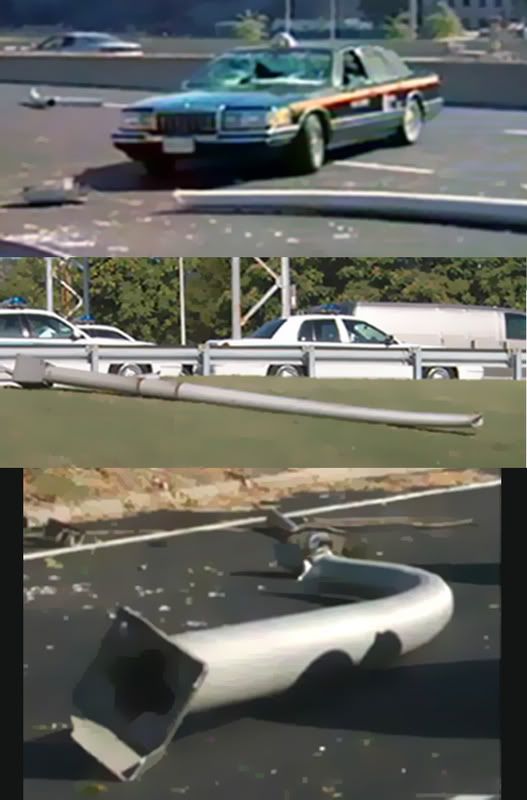
In denying a 757 impact at the Pentagon on 9/11, Loose Change looked at, among other things, the five light poles said to have been shorn by the wings of Flight 77 just before impact. The video cited previous problems when planes hit light poles - pole left damaged but standing, wing comes off, plane crahes. “And yet Flight 77 managed to tear five light poles completely out of the ground,” Avery continued, “without damaging either the wings or the light poles themselves.” How precisely he knows that the wings were undamaged on the plane he believes doesn't exists is left unexplained, but to prove the poles were untouched, they had hard proof - actual photographs, including those at left. A look at the very photos they used proves the assertion flat wrong. If these light poles aren’t damaged, why don’t they have lights on them? [at left: pole 1, pol 4, and pole 1 again. below right, pole 5.]

Clearly if a Boeing 757 with its 125 feet of wings came swooping in over the highway, it’d cut some poles – but since they insist on seeing no plane, the Loose Change people summarize that the undamaged poles “seem to have just popped out of the ground.” The only implication I can see in this is of a covert Pentagon system of specially designed poppable light-poles to fake a cruise missile/drone strike out to look like an airliner attack. I guess it’s possible, but the photos show that this system also seems to mangle the tops of the poles on the way down, which they would have to to effectively fake an airliner attack, thereby proving fallacious the whole issue which started by insisting there was no such damage.

This is perhaps the most-widely-cited graphic analysis of the light pole arrangement, which of course aso coincides with the 'official' flight path. This graphic was made in 2002 or so by UK 'debunker' Ron Harvey. Another researcher, Dick Eastman, first doubted the poles' existence: "Ron Harvey says that 5 poles were downed. Ever hear that from any other source? I saw eye witness testimony that one pole was "clipped."" [link] Later he admitted their existence; "The poles not a question that is in dispute. I have long acknowledged the existence of the poles as soon as I finally got my hands on an actual picture of one (Ron Harvey was not forthcoming with me at the time) -- in fact it was the pole data in contrast to the witness accounts that first suggested the presense of two converging aircraft paths." [link.] One had a swooping 125 foot wingspan backed by 100 tons of force - and flew well above the poles, which were knocked down by air vortices off the wingtips of his F-16 killer jet.


Russel Pickering's analysis at PentagonResearch.com found that they were 27.66 feet high, made of .188 inch-thick aluminum, 8 inches in diameter at the base and 4.5 inches at the top and topped with 70 pound lampheads. The reason the wings wouldn't be damaged is because the use of a "breakaway style" pole design. As Pickering explains: "this limited damage factor is why the FAA requires these type of poles in the "safety zones" around airports and helipads. They recognize that this type of pole minimizes damage to aircraft." He cited the FAA's rules: "any structure located within 250 feet of runway centerline has to be frangible, which means the structure needs to break away when hit by an aircraft to minimize damages to the aircraft and its pilot."

I have done my own anlysis now on poles 1 and 2 (pole 1 being the one that allegedly speared Lloyd England's windshield). I deduced a slightly different pole height than Pickering, although he's probably right and, along with tree damage and a slight mark high on a camera pole, have mapped out a rough outline of the plane's apparent bank at that moment - right-high, like the witnesses all have said.


If these were faked, they were faked well, The PentaCon video in 2007 made the case that the light poles were staged to fake the official attack path, and poorly so at that, bearing dozens of effects errors. Largely a rehash of Eastman's early theory sans the killer jet and beefed up with better witness pool, the video and its makers propose the poles were cut down, crimped, and in one case curved, some point perhaps weeks in advance, hidden in the bushes unnoticed, and dragged out for the attack in the morning. Or something to that effect. The one that hit Lloyd England's taxi was trickier, and they go to great length to explain the conspiracy behind this, or at least to argue there must be one. As PentaCon producer Craig Ranke (aka Jack Tripper) explained:

"If you accept that the plane flew on the north of the station you MUST accept that ALL the physical damage was staged/simulated/fabricated. Therefore, because the light poles line up perfectly with all the physical damage to the building there is no reason to suggest that any natural force [...] or projectile at all brought them down. They were simply removed and planted BEFORE the event."

That's of course one of the many reasons I do not accept the north side flight theory.

Wednesday, January 2, 2008

TWISTED ORANGE TRAILERS

TWISTED ORANGE TRAILERS
Adam Larson / Caustic Logic
The Frustrating Fraud
December 18 2007
last update 1/2 1am


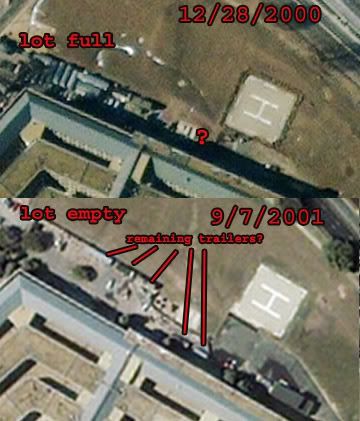
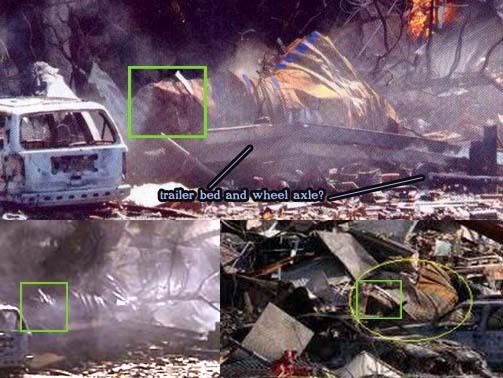
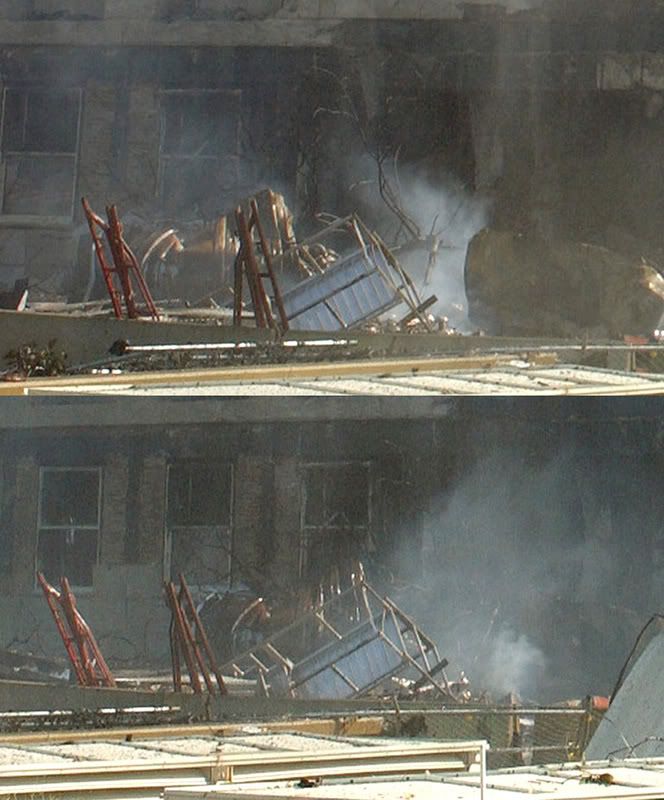
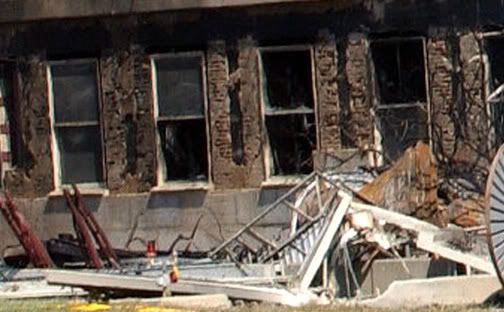
I'm still working out my analysis of the trailers-in-the-impact-zone situation: were they exploded to string airliner-ish confetti across the lawn and helipad as some have speculated? Were they removed entirely before the event as satellite images (see left) suggest is quite possible? Attack witnesses Micheal DiPaula gives a picture of an amptying but not empty construction zone: “we were in the process right prior to September 11 cleaning out the area. We just – we moved all the trailers. Actually, on the tenth we had some other trailers that were just leaving because we were getting ready to turn it back over to the building. And we had one trailer left, which was the – we had the Singleton trailer out there. And – and then we had some other trailers over here. So that’s the lay down area, were the plane actually came over.” So it seems possible there were trailers right there, and gone after, presumably removed by the plane on its way in. Are there any photos of trailers inside the Pentagon? What constitutes a trailer exactly? Why the hell am I still wasting time on things like this? These are the questions I've been tackling for the last three days.

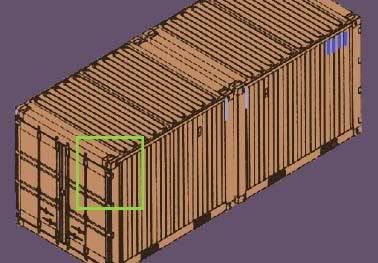
In this case just the graphics and a few notes and links should suffice. Thanks to John Farmer for bringing up this issue again and spurring me with his post The Trailer (redirecting at the moment). Until I read that, I'd been baffled by the melty cheesy form seen in the construction area just north of impact, by the burning SUV (see below), seeing an orange tarp - or something - though others had previously identified this as some type of trailer. More accurately, as Farmer proposed, I'd consider it a steel cargo container, the angle from it being tipped over by the left wing, and the warping mostly due to fire that gave it the rust color. It seems it may have been ON a towable trailer, judging by the floor remaining beneath it and apparent wheel axle. This graphic represents what I feel is the most likely style matching the Pentagon sample, with various matching features highlighted.


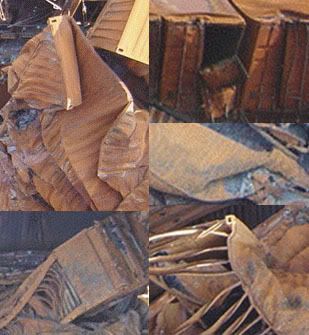
Doesn't look quite right? For comparison, see these sample images of cargo containers subjected to explosion and fire aboard the M/V Hanjin Pennsylvania, which burned for four days off the coast of Yemen in November 2002 after a nasty fireworks mishap. The twisted shapes are those that fell to the bottom of a massive container cell that collapsed. Note the different appearance of corrugated vs. bare-ribbed walls, perhaps different styles of container. The pictures and info were found at this site.

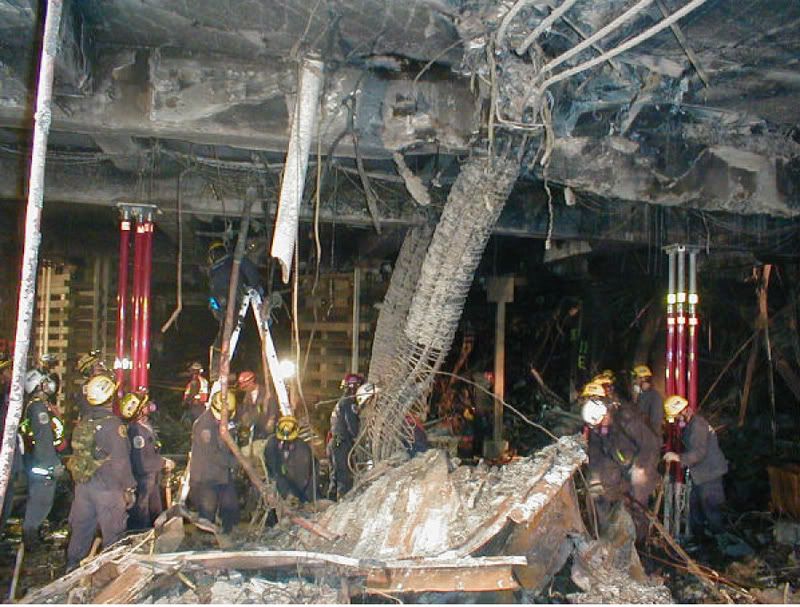
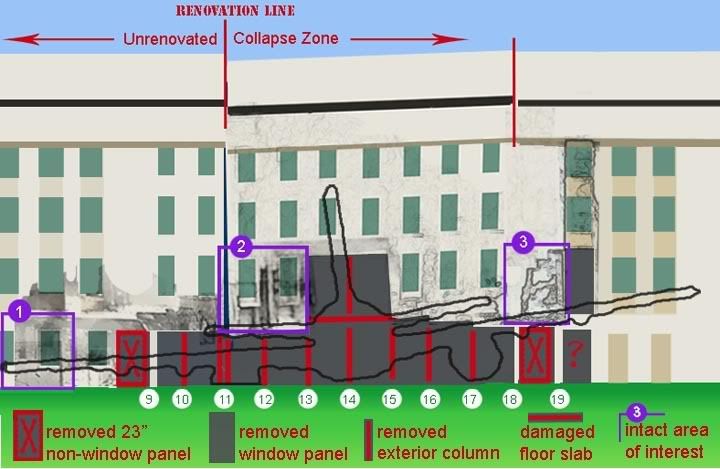
Compare again to this stray scrap photographed from at least two angles, found just inside the Pentagon. It appears to be neither part of the plane nor of the building. In fact it looks kind of like somethinng from the Pennsylvania. Below are the shots these are from, the second (by FEMA's Jocelyn Augustino) I've labeled with the likely column assignations. There are no supports on line 10 in this area, and by looking at the photo index in the ASCE's Performance Report, I've pegged this snake skeleton of a remnant as that of column 9B.
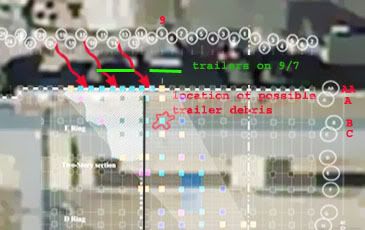
Below is the ASCE's column damage pattern laid over a rendering of the September 7 satellite image (lined up along expansion joints, in black). The trailer location on the right (the plane's left) corresponds roughly with the tipped and melted trailer seen above. The one on the left more closely matches the position to have wound up at column 9B given the 'official' 757 trajectory (red arrows represent approximate angle and impact points of engines and fuselage).

Therefore I speculate that we're dealing with two similar cargo containers in the spots where containers and trailers had previously been seen. One remained outside, the other inside, battered, and invisible in the available photos but for this good-sized scrap (and possibly others if I dug deeper). The intact one shows no sign of exploding to scatter debris, being as it is intact. The other possible container or trailer would have had to undergo a peculiar directed explosion to put it inside the building while leaving no similar traces I've seen in the other direction, away from the building. So while both possible trailers are possibly compatible with a plane strike (no detailed forensics yet), neither seems to make sense from the explosion and fakery hypothesis.
---
Update: Two more pictures of a rather shiny looking warped trailer, near the same construction scaffolding seen in other photos of the trailer.
These are close-up crops of Jason Ingersoll high-res photos provided by CIT. Another from that batch also has background details useful here, from later in the day, after it dried up:

Saturday, October 13, 2007

No Fires? a Stool Sample of IPS Evidence

last updated 10/13/07

We’re told Flight 77 took off with about 11,500 gallons of jet fuel for its transcontinental journey, and that this fuel was contained in its wings, which span 124 feet. So if it flew into the side of the Pentagon, we should expect to see a line of jet-fuel fire at least 124 feet wide across the façade, and yet more burning fuel exploding forward through broken windows into the building with the plane’s momentum and burning everything in its path to cinders. From the outside, it'd probably look like this:


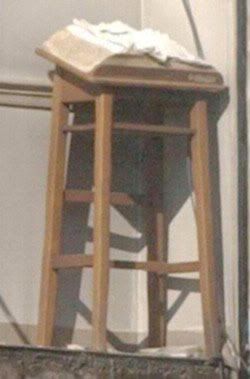
911 In Plane Site, for one, is certain that an airliner was not responsible and it was not even well-faked. In his narration, IPS writer/poducer/host Dave Von Kleist cited as evidence a relative lack of fire damage near the attack point on the ground floor. While some of the pictures he showed clearly indicated massive fires, he zoomed in on a post-collapse photo of the upper floors and calmly pointed out “On the 3rd floor it's plain to see a file cabinet with a computer monitor. Neither of them are damaged. On the second floor you can see a wooden desk, it hasn’t burned. And on the first floor, a very curious sight indeed, a wooden stool with a book that is laying open. The pages aren’t even singed.”


Dave knows that the Pentagon has five floors - the 5th has no exterior windows and the 1st is not visible in the shot above, which is precisely the picture he chose to use. Look just to the left of the building's peak and count down - 5, 4, 3… there's that miraculous stool, one floor slab above the impact site and a floor above any fire. The file cabinet Von Kleist cites on the third floor is actually on the 5th, and the wooden desk from the 2nd floor is actually on the 4th. His careful analysis of the public evidence completely subtracted two floors, one of which – the second floor - is clearly visible in this shot and looks rather seriously burnt.

Don't think I'm just nit-picking here. As critics point out, you don't level charges this serious without good evidence, and it's major blunders like this stool sample - and there are perhaps hundreds in IPS alone, that can derail people without adequate bullshit detectors. The video that has bragged “September 11 changed the world. This video will change September 11,” on closer analysis, looks more like a parody of 9/11 skeptics than an authentic effort at what it claims.

Other examples of the stool sample used to question the jet fuel fire:
911 Review.org
Pentagon Strike (video)
Glen Yeadon

More on the book in question reveals the 'stool' as a likely bible lectern:
""Yet, as he (Mark Williams) looked up into the black chasm torn into the symbol of the mightiest military on earth, Williams saw a sign of hope. On a second floor, right next to where the jet sheared off a section of the building, was an undisturbed stool. And on it was a thick, open book. Fellow searchers who had gotten a close look said it was a Bible. It was not burned. Nor was anything around it or on the two floors above it. "I'm not as religious as some, but that would have me thinking," the soldier said. "I just can't explain it."

It sure does look odd, but the reason nothing there burned was by being on the third floor. This site thinks it's some other kind of book. Must've been important to get its own lectern in the corner. If it was a bible, I'd like to know what page it was left open to. If there's a message of 'hope' here, I doubt it's from God.

Saturday, August 25, 2007

BARBARA HONEGGER

THE PSYCHIC MUNCHKIN BEHIND THE HOLY GRAIL
Adam Larson
Caustic Logic/The Frustrating Fraud
December 15 2006


Perhaps the oddest case in the small but fertile world of government functionary-9/11 Truth crossover is that of Barbara Honegger, a dedicated but elusive and little seen 9/11 warrior with murky roots (apparently military and intelligence). She was allegedly into weird parapsychic stuff, channeling voices of supercomputers from the future and whatnot, [1] before she went to work in the late 1970s for a rising star named Martin Anderson at the Hoover Institute (where he remains as a Senior Fellow). She then followed Anderson to the White House as an assistant to join the Reagan-Bush transition team in 1980. Anderson advised Reagan on everything from foreign intelligence to education, finance, and arms control, probably worked for Bush sr., and during the Clinton Years focused on teaching classes at Stanford (home of the Hoover Institute and where Condi Rice was briefly provost). Anderson was later an advisor to George W. Bush in his 2000 presidential campaign, [2] and eventually became a member of Rumsfeld’s influential Defense Policy Board in 2001. [3]

Honegger_White_House
Muchkin Honegger smiling with Reagan and Bush in the White House.
Honegger herself had split off from her Republican benefactors early; she only served the Reagan White House as a researcher and policy analyst until she resigned in 1983 under unclear circumstances – either over sexual discrimination or something else. In May 1985 Newsweek ran a piece on Honegger titled “The Munchkin's Musical” that stated “White House aides began whispering that Honegger was a believer in ESP who claimed she'd ridden on Halley's comet.” [4]

At the time she was also among the first to have leaked details of the “October Surprise” scandal, much of which was later verified by numerous involved parties. The deal was allegedly made by George Bush and William Casey to delay the release of the hostages in Iran - a delay that cost Carter the White House and gained it for Reagan and Bush. [5] Her charges culminated with the 1989 book “October Surprise,” predating Gary Sick’s work of the same name (which does not mention her) by two years. In the end, the scandal cost Reagan nothing, covered up by an investigation headed by a certain Lee Hamilton, who would go on later to 9/11 Commission and Iraq Study Group fame. Honegger later left a small mark on the Iran-Contra scandal, carried out as it was by largely the same networks responsible for the October Surprise, continuing to weave a picture of Bush-centered intrigue.

Despite all this, she not only remained alive but went on to tie Bush's son and former Defense Secretary in with carrying out 9/11, her works on which carry the disclaimer "all of Honegger’s research and publications on September 11 are solely in her capacity as a concerned private citizen and do not imply official endorsement." This is because in 1995 she was given a cushy job as Senior Military Affairs Journalist at the Naval Postgraduate School, which she holds till the present, writing about such things as a cyber-defense exercise in 2002: “all the National Security Agency’s Trojan horses and Air Force and Army’s info-warriors couldn’t break through the cyber walls erected by the Naval Postgraduate School’s ace “Blue” Team,” she wrote. [6] How ironic then that what some suspect of being NSA Trojan horse 9/11 arguments should have eventually broken through her psychic shields and into her research.

Honegger’s role in the 9/11 Truth movement is huge and will perhaps go down as her crowning achievement, for good or ill. Her legacy here is centered on revealing to Mike Ruppert inside info on the War Games of 9/11 which scrambled the defense and were probably co-ordinated by a Maestro working for Dick Cheney. These revelations formed what Ruppert called “in my opinion – the holy grail of 9/11 research,” and a key point for the smarter edge of the movement at large. [7] Her credentials thus seem solid, but her later works I’ve seen are sloppy and full of holes and leaps. In October 2004 she reportedly told a forum in Los Angeles that “shoe bomber” Richard Reid was really Osama bin Laden, who apparently dyed his hair, trimmed his beard, removed a few wrinkles and turned himself in as it were by trying to ignite his shoes on a trans-Atlantic flight. [8]

Honegger’s later works include "The Pentagon Attack Papers," published as an appendix in Jim Marrs’ “The Terror Conspiracy,” 2006, taking her squarely into this blog's turf. In her Pentagon analysis, she argued against a big plane and for a traditional bombing. This, she's certain, happened at 9:32, with anything happening at the official time of 9:37 being some sort of cover – possibly the impact of “an airborne object significantly smaller than […] a Boeing 757.” She cites a mixed bag of evidence, from hard fact like a stopped clock to repeated government “slips” to irrelevant coincidences, and has cited war games at the Pentagon that morning, which are unverifiable but likely incorrect. [9] (I will post on this theory in more detail sometime soon).

She has also tied the alleged original pilot of Flight 77 before it was hijacked, Captain Charles Burlingame, to “a Task Force that drafted the Pentagon's emergency response plan on what to do in case a plane hit the building.” She appears to be the source of the similar charge laid out in Loose Change, second edition’s opening segment. It’s an intriguing possibility, but it doesn’t help her tentative case that she then finds it “extremely likely, if not certain - that this 'task force' that […] Burlingame was part of was
the Cheney counterterrorism preparedness task force, and that the Pentagon plane pilot, therefore, directly knew and even worked with/for Cheney.” [10] Maybe that parapsychic training is helping her to fill in the gaps with right-brain impulses or insights from the future that make it all make sense…

No more promising is her citation of “the already legion evidence that Flight 77 did not hit the Pentagon:" “the small hole in the west side of the Pentagon being not nearly large enough for the plane’s fuselage, let alone wing width," "no damage to the lawn where Flight 77 allegedly struck and skidded before hitting the building," "wrecked plane parts at the site identified as being from an A-3 Sky Warrior, a far smaller plane than that of Flight 77, a Boeing 757.” [11] Of course my debunkings are legion as well, or getting there. "The small hole" - the unmarked lawn - the plane parts - The A3 Sky Warrior Theory.

While her reputation in the movement is generally sterling and I don’t know enough to cast large stones, these aspects of Honegger’s works – her unexplained leaps, need to tie Cheney in personally, and especially disagreeing with me over the Pentagon evidence - are deeply flawed. Whatever her intentions, she has served as a useful and strangely credible-seeming source, and also a comet-riding psychic moonbat in the employ of the US military pushing among the worst 9/11 theories. That doesn't prove anything but it's worth considering.

Sources:
[1] http://www.mindcontrolforums.com/mindnet/mn202b.htm
[2] “2001: Mr. Hoover Goes to Washington?” Myszewski, David. Stanford Review. Volume XXV, Issue 6: January 2001
http://www.stanfordreview.org/Archive/Volume_XXVII/Issue_7/2001/
[3] Martin Anderson: Keith and Jan Hurlbut Senior Fellow. http://www.hoover.org/bios/anderson
[4] Source lost... I'll check at the library and get back...
[5] http://www.spartacus.schoolnet.co.uk/JFKhonegger.htm
[6] Honegger, Barbara. “NPS Aces Second Annual DoD Cyber Defense Exercise.” http://www.nps.navy.mil/PAO/Internal/Cyber_Defense.htm
[7] Ruppert, page 336.
[8] Propaganda Patterns: Official Stories, Limited Hang Outs, Best Evidence, Distracting Disinformation
a political map of political collapse and possibilities. http://www.oilempire.us/propaganda.html
[9] Honegger, Barbara. “THE PENTAGON ATTACK PAPERS: Seven Hours in September: The Clock that Broke the Lie”
Appendix to THE TERROR CONSPIRACY by Jim Marrs. Publication date, Sept. 6, 2006 http://johnmccarthy90066.tripod.com/id206.html
[10] "War Games" by the US military on 9/11: paralysis of air defenses that ensured the success of the attacks? who coordinated these efforts?” http://www.oilempire.us/wargames.html
[11] See [9].

Tuesday, August 21, 2007

PUNCH-OUT PAGE {Masterlist}


PUNCH-OUT PAGE {Masterlist}
Adam Larson/Caustic Logic
The Frustrating Fraud
Last updated July 16 2007


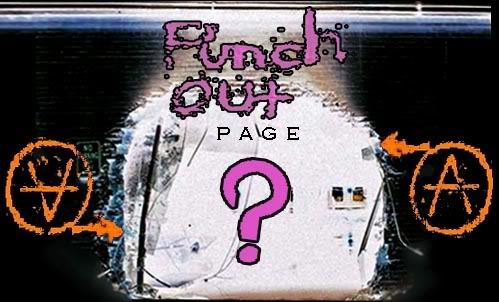
It’s long past time I worked out a study of the much-discussed but little-explained “punch-out” hole at the end of the plane’s trajectory through the Pentagon. The official story maintains that the disintegrating 757 plowed in a northeasterly direction clear through the E, D, and C rings of the building, the furthest-reaching elements from the fuselage coming to rest just outside the inside wall of the final ring, and into the open, ground-level service roadway past that – the A-E Drive that runs around the building between C and B rings. Burning debris was ejected with enough force to leave marks on the outer B ring wall, but otherwise stopped in the drive.
Russell Pickering of Pentagonresearch.com, who has studied the issue more than perhaps anyone else, aptly describes this exist wound as “one of the most anomalous features of the Pentagon attack […] absolutely inexplicable in terms of the composite nose of a Boeing 757-200 "punching out" through it," given "curiously little" of any plane parts outside of it. [1] It’s a perfect hole implying strong, evenly applies force and yet no ready sign of just what part of the plane made this and then - apparently - vanished before hitting the next wall.
Here is the earliest photo Pickering could locate of the hole, before any marking were spray-painted and before the debris inside was pulled forward. Note the ground is strewn with scattered bricks and flooded with water from firefighting efforts. [2] Compare this with with the damage to ring B's wall across from it [below], separated only by fifty feet of air; not a brick removed. [3]
Only a few photos of the exit hole have been released, many had seen it, and none have explained it with any useful precision. It has proven a magnet for mystery-mongers and skeptics from across the credibility spectrum.

How exactly the plane's trajectory wound up giving us what we’ve seen is left a bit vague in the official record.
- official "explanations:" confusion/silence over the exact cause of the hole.

- Analysis of the plane debris at and near the site.

- Carlson's backhoe punch-out theory assessed for errors

- Possibility of a purposeful, explosive punch-in

Personally I cannot venture a solid guess as to what happened here. The hole was either cut out with explosives for some reason or somehow caused by the barreling 757, perhaps via debris that was removed before the pictures we’ve seen were taken. I’m certainly open to suggestions. But I have to agree that IF there is a physical crime – an inside job element to the Pentagon attack that can be shown with evidence - this is the most likely spot to look.
---
Sources:
[1] Pickering, Russell. “Exit Hole” Pentagon Research. http://www.pentagonresearch.com/exit.html
[2]. [3] Photo Source: Pentagon Research. Exit Hole Chronology. http://www.pentagonresearch.com/062.html

Monday, August 6, 2007

PUNCH-OUT HOLE “EXPLAINED” BY OFFICIAL ACCOUNTS

PUNCH-OUT HOLE “EXPLAINED” BY OFFICIAL ACCOUNTS
Adam Larson / Caustic Logic
The Frustrating Fraud
July 22 2007
Last updated/edited July 25


Official Dodginess:
How exactly Flight 77's trajectory through the building wound up giving us the exit hole we’ve seen is left a bit vague in the official record. The American Society of Civil Engineers' Pentagon Building Performance Report shows a photo of the hole but gives no adequate explanation. Its terse summary: "there was a hole in the east wall of Ring C, emerging into AE Drive, between column lines 5 and 7 in Wedge 2. The wall failure was approximately 310 ft from where the fuselage of the aircraft entered the west wall of the building," [1] The Arlington County After Action Report noted “the damage extended all the way through the inner wall of the C Ring, a distance of approximately 285 feet,” and showed a photo of the hole captioned “penetration through the inner wall of the Pentagon’s C Ring.” [2] An account of FEMA Urban Search and Rescue shoring/bracing of the building is the most detailed of these three reports. It explains that "a nine foot diameter exit hole was created in the wall of C ring and the remainder of the debris from the impact ended up in the alley between C ring and B ring known as A & E Drive," and elsewhere shows a photo of the "'exit wound' where the plane debris exited the C ring." [3]

These three reports, a few early press conferences, published eyewitness accounts, and a handful of photos constitutes the body of evidence on this hole. While it’s been widely seen and commented on, it has not yet been explained with any useful precision, and contradictory theories dominate to an unsettling degree.

Impact Energy Waves?
In October 2004, the National Geographic Channel program Seconds from Disaster proposed a novel theory by which shockwave pressure from the impact cause the punch-out hole. By this model, plane debris and heavy, exploding jet fuel, perhaps along with explosions of things in the building, gave off shockwaves that reverberated and crossed through the building’s first floor. Having no other exit point, these somehow directed themselves and whatever was in front of them to focus on that precise spot, punching the neat 9x11’ hole we’ve seen. [4] While this explains both the improvised exit and the lack of any major evident airplane parts, the official story has generally maintained it was physically caused by the plane, or some part of it, though which part has been widely contested.

Engine?
Military District of Washington’s news service reported two weeks after the attack, mentioning that “an aircraft engine punched the hole out […] on the inside wall of the second ring of the Pentagon." [5] Though the quote has been widely republished, no other official sources support this claim. No debris seen there looks like engine debris.The piece’s author got the “second ring” part wrong (whether one counts A-E or E-A, C is the third ring), so maybe identifying an engine was an error as well.

Fuselage/Nosecone?
As widely noted, Pentagon renovation spokesman Lee Evey explained implausibly during a September 15 press conference “the nose of the plane just barely broke through the inside of the C ring, so it was extending into A-E Drive a little bit. So that's the extent of penetration of the aircraft." [6] As Killtown wondered “how could the fragile nose of Flight 77 penetrate all the way through 3 reinforced concrete/steel hardened rings and punched out a hole through the inside wall of Ring C and leave no evidence of itself outside the punch-out hole?” [7] This seems unlikely, even given that the “hardened” walls from impact to exit really totaled only 22” of unreinforced brick and limestone [link forthcoming], but spanned between by about fifty damaged support columns and only one plane fuselage to absorb the other end of these blows.

What survived this was not precisely the nose cone, but more likely some element(s) of the nosecone assembly – landing gear, landing gear door, cockpit panel or cargo door – some tattered portion of the forward fuselage. As Jim Hoffman explained, in such an impact, “only the parts of the aircraft with the greatest density and total mass, such as the lower third of the fuselage, could be expected to penetrate far into the building. That part also has a small frontal profile - approximately the size of the punch-out hole.” [8] Of course there is no piece of debris anywhere near the size of the hole seen in any of the available photos, but the illustration is helpful. The fuselage had a lot of mass, tens of tons, and though it was under great stress, it didn’t simply disappear on impact.

Landing Gear?
It stands to reason that as the plane disintegrated, the densest parts of aircraft wound up at the deepest point of penetration. For example, the flight data recorder from the tail end of the plane was reportedly found just inside the punch-out hole. [9] The heavier elements from the front end would also come to rest around this point. The book Debunking 9/11 Myths identified the landing gear. The book cited Paul F. Mlakar, ASCE team leader and lead author of the Performance Report, who “saw the landing gear with his own eyes” during his early onsite inspections, for its explanation that:

“The hole was not made by an engine or the nose of Flight 77 pushing through the building’s interior - or a missile - but by the crashing jet’s landing gear, which was ejected beyond the bulk of the wreckage. […] As one of the heaviest and most dense parts of the plane, the landing gear flew farther than any other item in the wreckage and was responsible for puncturing the wall in Ring C.” [10]

Other photos and accounts seem to back this up by recalling or even showing a wheel, a tire, and even a massive landing gear strut, near the hole. But there are some serious problems with this theory as well, like the ASCE’s own Performance Report not identifying this alleged hole-puncher as such, which noted that "the landing gear" (all three sets?) were in fact found inside the building, hardly the best place to be after exiting through the hole into the AE Drive. [13] These questions will be summarized more fully in a [separate post].

ASCE and FBI Secrecy
Mlakar's ASCE study team “went to great lengths of detail down to individual columns” in the plane’s path, Russell Pickering noted, providing their own photos and personal damage assessment of nearly all of them. Yet they danced around the cause of the punch-out, as Pickering wrote, offering “not a single explanation for the exit hole.” [14] The three columns nearest the breeched wall - 1N-North, 3N-North, and 5N-North - remained un-photographed and listed in the report as “damaged per FBI.” [15] Pickering suspects falsification of the status of these three columns to hide inexplicably severe impairment. [16]

He speculated that “the building team […] weren't allowed back at the exit hole for some reason," and noted how "they indicated in the report why they didn't have photos of those columns and who gave them the damage report on the columns - the FBI.” The one photo they published of the exit hole itself was not one of their own, but also credited to the FBI, further indicating this area had special investigative significance to the bureau, although this could have many possible reasons. [17]photo of the hole used by the ASCE, credited to the FBI (lower right, very small print.) [18]
---
Sources: forthcoming
[1] Mlakar, Paul F., Donald O. Dusenberry, James R. Harris, Gerald Haynes, Long T. Phan, and Mete Sozen. “The Pentagon Building Performance Report.” American Society of Civil Engineers. January 2003. ISBN 0-7844-0638-3. Page 28. PDF download link
[2] Arlington County After-Action Report. on the Response to the September 11 Terrorist Attack on the Pentagon. PDF downloaded from http://www.arlingtonva.us/Departments/Fire/edu/about/FireEduAboutAfterReport.aspx. The report bears no publisher or copyright info – it was compiled by Arlington County and Titan Systems Corporation, and released July 2002 according to this story: Weiger, Pam. “Pentagon report: After-action.” NFPA Journal. Nov/Dec 2002. http://findarticles.com/p/articles/mi_qa3737/is_200211/ai_n9114927/pg_1
[3] Titus, Leo J. Jr., P.E./Virginia Task Force One Urban Search & Rescue Team. “A Review of the Temporary Shoring Used to Stabilize the Pentagon After the Terrorist Attacks of September 11th, 2001.” May 3, 2002. Pages 9, 12. PDF download link: http://www.aesvn.org/resources/Pentagon-Shoring.pdf
[4] Seconds From Disaster – season one episode 12 “Pentagon 9-11.” National Geographic Channel. First Aired October 26 2004 http://en.wikipedia.org/wiki/Seconds_From_Disaster
http://channel.nationalgeographic.com/channel/seconds/episodes.html
[5] Military District of Washington. Press Release. (9/26/01) original url: http://www.mdw.army.mil/news/Commentary-Remembering_the_honored_dead.html. Accessed at: http://www.snopes.com/rumors/pentagon.htm
[6]
Monday, May 21, 2007

VIDEO REVIEW: PENTAGON STRIKE

First released for free viewing online in mid-2004, the Flash animation short Pentagon Strike (subtitled “what hit the Pentagon on 9/11?”) immediately made waves with its slickly-produced, strong-seeming argument that something other than a Boeing 757 was responsible for the attack on the Pentagon. It was created by Darren Williams, a 31 year-old British systems analyst and member Laura Knight-Jadczyk’s Cassiopaea.org. Williams e-mailed a copy of the video to Knight-Jadczyk, who posted a link on the group's Web site August 23. “Within 36 hours,” the Washington Post later reported, “Williams's site collapsed under the crush of tens of thousands of visitors. But there were others to fill the void […] Across thousands of sites, demand for the video was so great that some webmasters solicited donations to pay for the extra bandwidth.”

My younger brother first told me about this little mind bomb in late 2004. Until that point the whole no plane argument never did sound right to me, but he swore this video would change my mind. I finally watched it and was actually impressed, if still skeptical, and started my journey to sort the glittery from the gold regarding this part of the attack I’d previously ignored.

Eventually associated as well with the Quantum Future Group and the website Sings of the Times, Pentagon Strike is still available for viewing at the same site: http://www.pentagonstrike.co.uk/flash.htm if you haven’t seen it yet. It wouldn’t be entirely fair to call the video deliberate disinfo – Conspiatainment is a better word. It does give fair warning, opening with a screen reading in part “Critical Discernment suggested – knowledge and awareness recommended.” Of course they had a certain kind of “awareness” in mind, and knew few people at the time had much “knowledge” of the attack and would be well set-up to glean it from the video that’s done loading now…

It starts with brooding trip-hop music and a voiceover from Adolph Hitler, I believe, and text alerting us that despite the official story of the Pentagon attack, “in reality a Boeing 757 was never found.” What follows is a five-plus minute montage of still images and animated text in which circumstantial evidence like the seized videos of the attack is well-explained enough. The five stills from 2002 are analyzed incredulously, and a slew of eyewitness reports – or select snippets anyway – verifying all the tiring charges: small jet, missile, no plane parts, etc. Quoting the video’s backer Laura Knight-Jadczyk, the on-screen text reads “the very first descriptions - before the mind control machine had time to go into action” had described something “like a missile.” This was a clever way of indirectly misquoting Mike Walters (who said it was an AA jet that was flying like a missile and two other witnesses who thought it sounded like a missile).

As for the video’s physical evidence analysis – what I didn’t know then but can finally comment on – the punch-out hole analysis is better than average; they have it correctly placed and no talk of six walls. But otherwise it’s an unprecedented display of the Frustrating Fraud, all the machinations used before and repeated later. Williams again rehashes the Meyssan trick of showing a spray of fire foam while claiming to show the single small hole in the façade. Deceptive long shots of the lawn showing no debris are brandished, and only the smallest bits are shown up close – a supposedly exhaustive run-down that passed up, as usual, the telltale landing gear found inside the building. The unmarked Pentalawn and a brief golf animation are cleverly used to imply a specific 757 witness (Tim Timmerman) was lying about his whole story – just look at that lawn! The blue tarp smugglers were vaguely shown in the section on plane wreckage with a large question mark. The unburnt stool on the third floor is featured, as it was in IPS at about this same time, in questioning where the supposed 757-full of jet fuel went (answer: across the two floors beneath that – it never touched the third floor).

But such misleading “facts” are emotionally bolstered by a varied musical underpinning with well-timed highs and lows and long moments of suspense punctuated with dark techno/trip hop and screaming groove metal borrowed from the Dust Brothers (via Fight Club) and Marilyn Manson. This work clearly puts emotion above logic even as a computerized voice tells the viewer “you are now looking at the objective reality – please stay focused.” The video seems designed to snap the viewer dizzily from one point to the next, a torrent of images, “facts” and “quotes” that has worn down the skepticism defenses millions of average 9/11 Truthers and likely created thousands of new skeptics itself. After an open-minded six minute viewing experience, it would seem almost undeniable to many that anything but a Boeing 757 struck the temple.

These people know all about “mind control machines” going into action.

Tuesday, May 1, 2007

JIM HANSON'S DE-VINE REVELATION

Yage-tripping former Republicans for 9/11 Truth?
Adam Larson/Caustic Logic
The Frustrating Fraud
Last Edited: 4/30/07


[note: I've been getting away from the fun old game of ridiculing fraudsters lately, focusing on solidifying my own case and doing more serious research, but just found this little gem from the Idaho Observer, February 2005, which I had missed before.]

Before he discovered the truth of 9/11, Jim Hanson of Columbus Ohio was a five-decade Republican and "former district campaign manager for Richard Nixon," as conspiratainment radio host Greg Szymanski explained in a February 2005 piece for the Idaho Observer. Szymanski was talking to the retired attorney because of an excellent 1/2 page ad he had taken out in the Columbus Dispatch newspaper "denouncing the Bush administration specifically concerning one photo of the Pentagon crash, which he claims will prove government complicity in 9/11."

The photo refered to by Hanson is the famous shot taken by Mark Faram shown above (cropped on the debris), which Szymanski incorrectly described as “the only piece of wreckage of Flight 77 ever made public.” This also seems to be Hanson’s understanding as well, since he summed up "if it can be proved that this piece didn’t come from Flight 77,” then there would be NO wreckage released of the plane, and this “ would open the door, exposing the rest of the government conspiracy."

This is a serious question then, so Hanson set out two main supports for his conclusion that this did not come from the doomed Flight. Hanson laid out his first charge: While the scrap clearly matches the American Airlines paint scheme, “after blowing up the photo and matching rivets to those of the 757 that supposedly crashed into the Pentagon, I found there wasn’t a match. This piece of wreckage was from a different plane.” I’ve seen this claim made around by others, but still haven’t looked into it closely. A reasonable match to an AA 757 has been demonstrated well enough in this early piece by Jim Hoffman, but for the moment I’ll ignore the possibility that Hanson is flat wrong that the Faram scrap is not from a 757 as alleged, suspend judgment, and turn to his second corroborating proof.

On close examination of the photo, Hanson found "a curious piece of wood or what I have determined to be a liana vine, imbedded into the aluminum piece of wreckage.” A liana vine! What a revolutionary observation! Did the plane swing into the building on a vine in Tarzan style? A little research shows that lianas are a general type of burly climbing vine, one species of which is used in the Ayahuasca or Yage, a ritual Incan hallucinogen now popular in certain non-traditional circles (though usually not elderly Republicans). Is there more to Hanson’s visionary approach to 9/11 Truth than meets the eye? Is he seeing at the heart of the official lie the very vine he’s tripping on?

Whatever the validity of his observation, it all fell together from there: “I then found out that another 757 went down in the South American jungle in 1995, where liana vines (similar to wicker) grow abundantly.” As Szymanski explained, Hanson phoned the NTSB and was told the mangled remains of that 757 were stored at an undisclosed "military disposal site for investigation.” He then had a serious enough hunch to charge that “I think the military substituted this piece of wreckage in an attempt to deceive the public, in an attempt to make them believe Flight 77 hit the Pentagon when it didn’t."

How it is the scrap doesn't match the official 757 plane model but could be from a different 757 he's never seen photos of is unclear to me. I would've guessed all 757s are riveted the same. Furthermore, unless this original flight was AA, it would have had to be re-painted, and it seems odd the special effects guys would miss the woody vines twisted into the metal as they sraped off the paint and stencilled on part of a lower-case "n" to proper scale. Hanson too was aware of the depth of their faux pas: "I think this one mistake regarding the military photo, could bring down the house of cards and expose the entire conspiracy." Hanson himself was putting his Republicanism on hold over the affair; "I am no longer affiliating myself with the Republican Party considering the outrageous acts that have been perpetrated on the American people. This is beyond politics,” he told Szymaski and his readers. “This is outright fascism."

And for the record, here’s the proof of the 21st Century Reichstag Fire that brought Fascism to our own shores: the only non-metal substance I can see with the scrap, the yellow stuff at the bottom, and a couple of ideas as to what it could be:

Don’t scoff! If Hanson is correct, the fate of the free world could be at stake here.

Source: Szymanski, Greg. "Life-long Republican believes only piece of Flight 77 wreckage was planted at Pentagon on 9/11." Idaho Observer. February 2005. http://proliberty.com/observer/20050208.htm

Saturday, March 24, 2007

PLANE PARTS part I

ENGINE PARTS – THE DRIVING ISSUE
Adam Larson
Caustic Logic/The Frustrating Fraud
Last Updated 5/26/07


In their effort to cast doubt on the official story of the Pentagon attack, Loose Change explained that a 757 is driven by “two Pratt and Whitney Engines made of steel and titanium alloy which are nine feet in diameter, twelve feet long, and weigh six tons each.” Considering government claims that the plane entirely disintegrated in the fire (an explanation I’m certain they’re exaggerating), “it is scientifically impossible that twelve tons of steel and titanium was vaporized by kerosene." We’ve seen no intact nine-foot engines, and they couldn't have burned away, so a logical conclusion would be they never existed. “The two engines should have been found relatively intact. Instead, there was a single turbojet engine approximately three feet in diameter found inside the building.” I’m not sure where they got this from, but the only source coming to mind (Desmoulins, whose evidence we'll see below, and his wasn't intact either). But one small engine would mean we’re looking at a missile, not a plane.

Jim Hoffman's 9-11 Review noted of the Loose Change take “perhaps ‘engines should have been found relatively intact’ if the Pentagon were made out of bamboo. Since when has an engine survived a 500-mph impact with a masonry building relatively intact?” [1] Indeed, the engines are not so solid as Dylan made them sound. First off, citing the engines as being nine feet across and solid titanium is deceptive – what we see that’s so big is the engine with its outer housing. The outer shell is strong enough to withstand winds but not concrete walls, against which it would be shredded. I’m not sure what they’re made of but I’m guessing well-formed composite plastic materials in multiple layers with reinforcing fibers and whatnot. They could also be metal, or some mix, but essentially it's just a sturdy aerodynamic shell. The hard titanium alloy stuff is inside the actual engine, which is six feet in diameter at its widest point – the front fan - and considerably narrower otherwise. The variously sized and carefully arranged internal parts – gears, center shaft, burners, housings - would mostly remain intact after the crash and fire, but not necessarily neatly assembled any more.


The engine above is a different model than what we’re looking for here, but the concept and proportions are about the same in all models. This is Turbofan engine, improving on the old turbojet design by adding the larger fan to move a large column on top of what it ignites. The basic idea is the fan pulls in air, passes much through the outer fan duct where it just moves through, while compressing the air in the middle into an inlet where it is passes through several compressor discs to futher pack it with oxygen before passing the fuel burners that ignite the air in the combustion housing. The explosive air is then directed back out the rear nozzle to drive the plane, passing on the way over curved slats on the edges of the turbine discs which in turn spin the shaft that drives the fan and feeds the cycle.

So the point is that even large engines have small parts, radial wheels of differing sizes set along a central shaft. If intact, an engine found would look a bit like the diagram above – if the parts were scattered with the force of penetration, then we should expect views like those below. No whole engines were seen, only parts that may be from an engine, so if there were engines there they broke up and scattered into the building.

The famous photo at left was taken by two days after the attack, showing a gear removed from building and snapped by FEMA photographer Jocelyn Augustino just north of the impact zone. Compared to the worker’s leg, it appears to be 24-32 inches in diameter. French researcher Jean-Pierre Desmoulins identified it as “a rotor (high pressure stage) coming from a jet engine” He also noted “on the top left of the image, what seems to be the housing of this engine,” an apparently tubular piece of debris (here outlined in red, along with a piece of what seems sheet metal that appears to have about the same curve. [1] The size looks reasonably close, but it almost seems the gear is in fact larger in diameter than its supposed housing. I don't know what the hell this thing is. It's round, which means likely from an engine.

Eric Hufschmid made the same call as Desmoulins in his video Painful Deceptions, seeing the rotor and its slightly-smaller casing as proof the "engine" here is too small for a 757 and more likely the single engine of a Global Hawk.

If the disc is from an engine it was from a big one. Some have speculated that it was a turbofan hub from a proper Rolls Royce RB 211 engine (the model AA uses for its 757s). The “cleats” on the edge would then be to hold the larger fan blades in place. Compared to the hub of a standard 757 engine in the graphic at right (it would be beneath the “hubcap” in the center) it indeed seems roughly the right size. Russell Pickering agreed it may be a fan hub from a 757, but also noted “that component is similar to many engine parts in many various engines.” [3] He doesn’t seem to know much more than me here. I’m not even sure the notches are cleats to hold fan blades, but could be for other turbine-related spinning activities deeper inside. The knowledgeable folks at Aerospaceweb were uncertain as well but guessed that it “looks like a rotary disk from the interior of the plane's engine.” [4] Jim Hoffman also called it a turbine rotor. [5]

Speculation arose early on that the part was from a 757 but not from its engine. As Loose Change explained “after this photo was published by American Free Press readers wrote in to suggest that the turbine was a piece from the auxiliary power unit (APU) mounted in the tail section of a 757." Others like Jon Carlson have dismissed this as speculation "dropped into the conversation as disinformation.” [6] Chertoff-busting Chris Bollyn implausibly claims he contacted people at Honeywell (makers of the APU), Pratt & Whitney and Rolls-Royce, (makers of the engines used on 757s) and was able to get confirmation on all three fronts from someone employed there that the non-descript round part was definitely not from anything any of them built. [7]

Karl Schwarz was able to positively identify it as "a "turbojet" component from an US Air Force/Navy vintage type of jet engine technology that was used on just a limited number of fighters, bombers and reconnaissance planes." His prime culprit is pf course the JT8D, a tiny engine used in pairs on the tiny A3 Sky Warrior. It seems the A3 doesn't actually use JT8Ds after all, as explained in my "A3 Skywarrior Theory" post.

Another possible engine part was seen later, in the batch of evidence released by the government after the end of the Zaccarias Moussaoui trial in mid-2006. It’s of non-descript debris at the Pentagon, clearly pivotal in Moussaoui’s guilt. The scale here is less clear, but it looks like a rear turbine gear with its curved blades for allowing ignited air to pass, and the base of the contral shaft that drives the fans. Or it could be the other end, the fan hub seen from behind, the ridges would then be the fan-holding cleats.

The photo at right was posted in 2002 on Rense.com by Sarah Roberts, a Pentagon employee seeking to debunk no-planes theories. She says the photo was taken "in either D or C-ring" by rescue workers with Virginia Task Force 1 (VATF-1). "The large circular piece in the middle appears to be the diffusor section of the compressor, though this is not known for certain.” [8] Jerry Russel and Richard Stanley at 9-11 Strike, who lean towards no-plane theories, admit this and other parts match those from a 757’s engines but wondered “whether the parts were from a 757, or were they planted as fake evidence, perhaps having been from an earlier 757 crash?" [9]


Finally another VATF-1 photo. A round rim (bottom right): another engine part? Source: Sarah Roberts.

[1] ERROR: 'Engine Parts From the Pentagon Crash Don't Match a 757' http://911review.com/errors/pentagon/turbofans.html
[2] COMMENTS ON MYTHOLOGY BUBBLE PART 5. http://perso.orange.fr/jpdesm/pentagon/pages-en/wr-eng.html
[3] http://911review.org/Wiki/PentagonPlaneRotor.shtml
[4] http://www.aerospaceweb.org/question/conspiracy/q0265.shtml
[5] See [1].
[6] Carlson, Jon. "Missing Pentagon Jet Engine Identified? - A 727 JT8D Rense.com. 3-2-2005. http://www.rense.com/general63/ident.htm
[7] See [6].
[8] Roberts, Sarah. “Photos Of Flt 77 Wreckage Inside The Pentagon” Exclusive Photos & Story Remse.com. 12-4-2002 http://www.rense.com/general32/phot.htm
[9] "The Five-Sided Fantasy Island: An analysis of the Pentagon crash on 9-11." version 2.0 (3/12/2004) Page 3 of 5. By Richard Stanley & Jerry Russell. 911 Strike. http://www.911-strike.com/engines.htm

Sunday, March 18, 2007

THE ENTRY WOUND

THE ENTRY WOUND: A 90-FOOT WIDE "SIXTEEN-FOOT HOLE"
Adam Larson / Caustic Logc
The Frustrating Fraud
Updated 8/30/07


Note: I first wrote this article nearly a year ago when I didn't knw as much and was on different tangents. I've updated it a few times and it's getting slapdash. I will de totally revising my ttext and graphics at some point in the near-future to make this a solid contribution rather than the mess it is.
(check also Jim Hoffman's page on common "errors" associated with the entry wound analysis.)

Perhaps the most prevalant mistake among myriad that has been repeated ad nauseam by no-plane researchers is focusing on the “small hole” in the breached outer ring. 911 In Plane Site host Dave Von Kleist reminded viewers of the dimensions of a Boeing 757 - 124 foot wingspan and 44-foot tailfin heighth - and then he explained two different versions of the hole in the Pentagon, neither of which would allow the alleged Flight 77 to pass. At one point he asked “how does a plane of those dimensions fit into a hole only 65 feet across?” and at another point “how does a 757 fit into a 16 foot hole and leave no damage, or wreckage on the outside of the pentagon?” In Loose Change, narrator Dylan Avery says “the only damage to the outer wall is a single hole no more than sixteen feet in diameter.” Others have it at 12 feet, or as low as five, and other cite a wider damage area but still deny passage to 124-foot-wide jetliner.

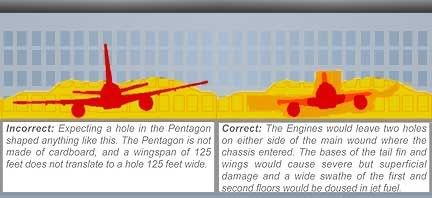
Both videos and may others cite the lack of holes for wings and tailfin, apparently taking their own charges of “stage-managed event” too literally, and looking for a cookie cutter punch-out of a cardboard prop shaped exactly like a plane’s profile. (note on the graphic: it was hitting not dead-on but at a 45 degree angle and so the hole would be slightly wider than the actual chassis, but no larger vertically.)

Indeed what should we expect? Well, I'm no structural engineer or other type of expert, but I have enough common sense to take my own crack at it. Let's start with the main chassis, as I did. When the nosecone hits at about 350 mph, like a bullet (or a missile!) it would easily pierced the outer wall, leaving a hole about 12-15 feet high and 16-18 feet wide.
In the shot at left, the second floor facade breaching is limited to a perhaps twelve foot wide set of windows and section of wall, presumably taken out by the base of the tailfin. But this allows us to clearly see a bright patch of fire just a few yards in on the second floor, which is intact at that point. So whatever pierced the outer wall was large enough to take out the wall and the edge of that floor and hurl burning material across it. but since the rest of the floor is intact, clearly the object was small enough that it was instantly diverted/mangled/compressed to fit entirely beneath the second floor slab. I've been unable to verify the exact clearance even from the ASCE report, but from photo analysis it seems to have about 13-15 feet available - roughly the size to allow a barreling 12-foot-high 757 body. Note also the recognizable line of orange jet fuel fire – from left to right it progresses from ground level to piles of burning debris on the second floor. This is consistent with the alleged baking angle of the plane with starboard wing tipped high and cutting across the second floor slab, left engine basically at ground level.

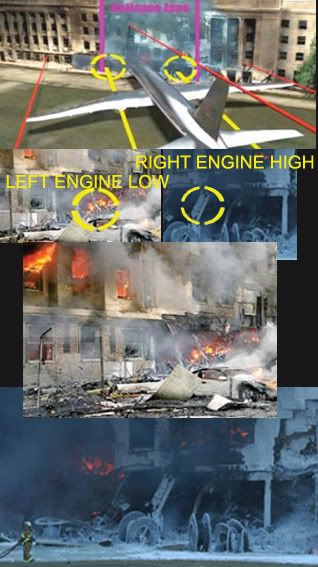
Having clearly accounted for the main chassis, the question of what happened to the massive engines, which occupy a space about 50 feet wide, at first stumped me. Dense, cylindrical, with a diameter of about nine feet, would probably obliterate the outer walls and enter the building intact, in fact advancing ahead of the rest of the plane. They were, after all, what was driving the whole thing, and after tearing loose from the exploding wings their own unhindered momentum and the last second or two of fuel burning would shoot them through like blocky missiles until lack of fuel and resistance forced them to stop, likely in various pieces. Radial parts that could well be from such engines were found inside the building. On the way in, they would knock out holes, I believe, like those shown below.


Top: Still from Purdue University simulation, yellow added. Below left: knocked-out section of the first floor to the left of main entry point with fires inside and out, likely entry point for left engine. Below, right: what I had previously taken as broken and oddly tilted support columns on the first floor just to the right of main impact, likely entry point for right engine.
---
(update): Many have taken these columns as signs the plane could not have entered - since they lie at the "shoulder" of the alleged plane's impact, between wing base and chassis, they could almost be right. Though it never seemed a big enough problem for me, it was troubling. It was also a bit sloppy to call these "support columns" when the three each look different and all columns on the left side were uniformly removed. Jim Hoffman has decided they are at least as likely parts of the second floor slab that broke after losing their supports and fell at this angle. I did a lengthy post on this. If these are indeed something else, then we are left with a roughly 80-100 foot-wide area in which all supports were obliterated - leaving plenty of room for the penetrating core of a 757 and explaining the collapse of everything above twenty minutes later.

Compare this to the size of the initial "hole" we see above, from a simplified computer graphic done up by the ASCE and fairly accurate. The limestone facade and essentially all outer columns are gone from an open span of it looks like nearly 100 feet of the ground floor, even with the three slants on the right that probably aren't columns. Again,plenty of room.

What I could see in this damage is a high 16 foot hole flanked by two 10-foot holes set lower amid a jumble of lesser damage. The possible engine holes seem to be about 70 feet apart, which is how far apart the engines would be if hitting at a 45 degree angle as alleged. The math is correct, and we have a roughly 100-foot damage area or “hole” with all columns removed. The plane fits – at least as far as width, but should it be able to fly or compress its entire 155-foot length inside and disappear? Well, that seems less likely, but perhaps depends on the nature of the “renovations” just completed there and on exactly how many feet of steel reinforced concrete stood in its way.

And as for the "no plane" evidence's recycling in Loose Change, they insist on their sixteen foot hole while the shot on screen has the spray from a fire hose completely covering both this hole and the 65-foot-plus damage area around it that even IPS showed. Then they highlight the plane's outline with the chassis hole entirely on the second floor! Despite their marvelling at the plane flying "inches" above the ground, they think it deviated upward in its final feet and hit the second floor, leaving the greater damage below unexplained. I feel sorry for these guys' girlfriends - their careful analysis of the Pentagon evidence gets it in the wrong hole. And we all know it's not good to get germs from the fallacy hole in the truth canal.

Thursday, March 15, 2007

911 IN PLANE SITE - PARTIAL REVIEW

IN PLANE SIGHT OR JUST PLAIN SHITE?
Adam Larson
Caustic Logic/The Frustrating Fraud
December 13 2006


When Versailles, Missouri-based Dave Von Kleist saw the Meyssan-produced “Hunt the Boeing” website out of Paris, he decided it “drew some very serious questions as to what had really happened at the Pentagon.” Von Kleist aired his concerns via the Power Hour, his daily radio show with his wife Joyce Riley, and later wrote, produced, and hosted a documentary video clumsily titled 911 In Plane Site (911 IPS) – “The FIRST 911 Video to Present VIDEO EVIDENCE – Not Theories.” Directed by William Lewis of "Police State 21" and first released in mid-2004, IPS promised “September 11 changed the world. This video will change September 11.” Others agreed and promoted it; famous writer, comedian, and brilliant civil rights activist Dick Gregory plugged for it (“everyone in America should see this video”) and millionaire 9/11 truth financier Jimmy Walter funded its wide distribution and helped it get local showings and press write-ups nationwide; it proved remarkably successful and largely dominated the field - at first.

Lurid, cluttered, and unbalanced: who says you can't tell a DVD by its cover?
This video was not a wise investment for Walter’s stated cause of bringing the truth to the people, which is clear from the opening montage of 9/11 crash and collapse replays underpinned with über-serious synthesized orchestral music that drags on way too long. It hasn’t improved much before the several agonizing minutes spent examining the “attachment” beneath the windowless “military cargo plane” known as Flight 175, and of the odd-looking video of yellow flashes on the WTC’s façade before – not after but just before - the planes hit. Jeremy Baker at OilEmpire put my own thoughts well, doubting the planners would be so stupid “as to attach a large, highly visible incendiary device to the bottom of a plane that they knew would be showing its belly proudly on every TV set on the planet.”

Gene Sharp
Dave Von Kleist on the set of 911 IPS
I’m not scientist enough to totally dismiss Von Kleist’s allegations (traceable back to LetsRoll 911 at least) that the planes were firing yellow-flashing missiles from these pods, but the official explanation seems to make more sense: the pods were simply wing faring, an ordinary thing on these two aluminum planes (if distorted by glare high in the brilliant sky). The planes then gave off yellow flashes, as aluminum would do, upon impact, not before (it’s not as easy to precisely read shadows from half a mile away as he thinks). Yet at the video’s conclusion Von Kleist specifically cited his worst evidence – the pods and yellow flashes - as hard and final proof of the otherwise compelling case that “terrorists with box-cutters” were not to blame for this event. He ended by asking his viewers after seeing his great epic “where’s your line in the sand?”

While the video finds irrefutable proof of remote control airliners at the widely documented battle of the World Trade Center, when presented with a lack of evidence of the attack vehicle at the Pentagon, the video’s logic runs wild and latches onto Meyssan’s case, opening its exploration with what Von Kleist thinks is his strongest point, that the Pentagon was not hit with one of the windowless, pod-equipped, missile-firing military drones used in New York, but with a simple missile. All in all, the case is poorly made, focusing mostly on the hole in the outer wall, the plane’s alleged entry wound, giving two drastically different sizes for this hole, both of which he feels were too small to allow a 757 to pass.

One particularly embarrassing mistake in the video is Mike Walters’ partial quote describing Flight 77, “it was like a cruise missile with wings,” which was cited as evidence of a missile. But in the full interview he said clearly it was an American Airlines jet that was like a cruise missile, I guess in the sense that it was flying through the air and was being used as a weapon to pierce a bunker. Any idiot could verify this with a quick Google search, as I did, yet Von Kleist and his entourage were so proud of this evidence they sent everyone who bought IPS a free copy of CNN’s “America Remembers,” so we could see how that video also only played that part of the interview.

As with the attacks he claimed to be unmasking, I doubted so many mistakes could be made on sheer accident, and began to suspect intentional sabotage. Jeremy Baker at Oilempire, a 9/11 Truth site, agreed and wrote of widespread concern that “the producers of this film may be operatives attempting to sabotage and derail the 9/11 visibility movement from within.” Baker bemoaned the effect of this video, amplified by its wide viewing, on the larger movement:

“You don't often see so many glaring blunders in serious documentary film-making, and if you think our detractors won't hop on each and every one of them you‚re wrong. These screw-ups, like it or not, reflect on the entire community of 9/11 activists (especially the ones who so strongly support this video) and could go a long way to alienating the fence sitters we can and should be trying hard to woo.”

With nary a true claim in it, 911 In Plane Site was eventually too widely ridiculed to serve as the vehicle for “changing September 11;” I actually found Fintan Dunne’s dismissal of it as “the In Plane Shite movielet” to be mildly clever. Someof hismoreegregious 'mistakes"in the WTCanalysis arewell-covered in this anonymouly-produced video "Not In Plain Sight." Perhaps even worse, Von Kleist was too old, conservative,and Missourian to effectively reach the teeming masses of the young, urban, and gullible. Both of these problems would be addressed as the Frustrating Fraud and the other flawed seams wound their way into another video try at setting loose the change Von Kleist was unable to.

Sources:
> 911 In Plane Site, the Director’s Cut. 2006. Power Hour video. Directed by William Lewis. Writtem produced and hosted by Dave Von Kleist.
> Baker, Jeremy. “911 – In Plane Site: A Critical Review” Undated, copyright 2004. article copied from: www.oilempire.us/bogus.html#planesite http://911research.wtc7.net/essays/baker1.html

Thursday, March 8, 2007

WE'VE LOST RUPPERT...

MIKE RUPPERT'S POORLY-AIMED PARTING SHOT

From Meyssan to 911 In Plane Site to Loose Change, and in myriad other forums on many levels, the no-plane-at-the-Pentagon theory had grown into a central plank of the 9/11 Truth Movement, its unquestioning acceptance appallingly wide. I was especially disappointed with former LAPD narc turned investigator of elite crime Mike Ruppert. Before and after 9/11 he has taken on multiple issues through his newsletter From the Wilderness, from government drug dealing to international banking scandals and the CIA-Wall Street connection. From the 9/11 attacks until at least 2003 he consistently tried to, as an Oil Empire timeline summed up, “warn the 9/11 Truth Movement not to over-invest its energies and its credibility in questions of physical evidence” since such lines of reasoning “invite sabotage by U.S. counterintelligence programs.” [1] In his video The Truth and Lies of 9/11 Ruppert pointed to the ineffectiveness of the Zapruder film in changing the public mind on the JFK assassination. I considered him the model of 9/11 research in my earlyinvestigative phase; like me he skirted the divisive issues like the Pentagon attack because of their relative un-provability.

By 2004 he was wrapping up his 9/11 arguments, dropping the issue as dead, "Rubicon" I guess being the obituary. He was moving on to a broader program to prepare the world for the post-Oil Peak crash. In his master 9/11 opus and parting shot Crossing the Rubicon, Ruppert took the isue head-on. He stated “I have never believed Flight 77 hit the Pentagon,” and further described the attack craft, much like IPS and Loose Change might, as:

“the miracle plane. The one that nobody actually saw hit the Pentagon; the one that left no recognizable debris matching an airliner; the one [Thierry Meyssan] did a pretty convincing job of proving never hit the Pentagon because the hole was way too small and the damage pattern […] was totally inconsistent with a mid-sized passenger jet like a 757; the one where the engines melted, disappeared or evaporated, or were transported into space by the Starship Enterprise and never found; the one that flew like a fighter plane or a cruise missile.” [2]

He showed a certain change of heart, describing the analysis of physical evidence like Meyssan’s as “a key forensic technique used by police officers.” Of course Meyssan was “crucified in the American press,” and it was this Frenchman flogging, not the fear of being wrong (as Meyssan seems to be), that gave Ruppert his lesson “about what happens in America when one tries to make a conspiracy case in the public arena, based solely on physical evidence.” [3]

So despite his earlier caution, even Ruppert isn’t really with me on this case. Even as he has tired of “what happens in America” and fled to Caracas and the protective embrace of Hugo Chavez, on his way out the door he let us know the frustrating fraud has its tentacles everywhere, even superceding his finely honed “cop instincts.” How did it get to this point, and where does it go next?

Sources:
[1] Robinowitz, Mark. The Complete "No Planes on 9/11" Timeline. Accessed October 20 2006 at: http://www.oilempire.us/no-plane-timeline.html
[2] Ruppert, Michael C. Crossing the Rubicon. 2004. page 351.
[3] See [2].

Friday, February 23, 2007

THE CRIME SCENE / OBSTACLE DODGE

THE CRIME SCENE / OBSTACLE DODGE
Adam Larson / Caustic Logic
The Frustrating Fraud
Last updated 8/11/07


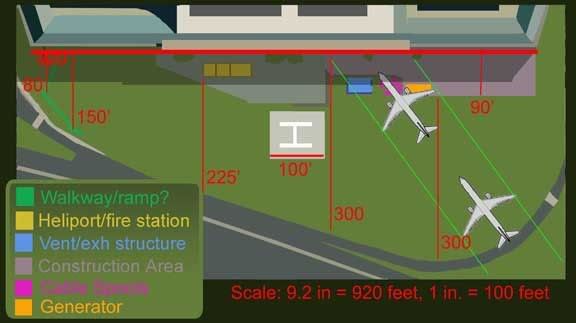
Ever the master of re-inventing the wheel, I’ve assembled an accurate map of the West lawn crossed by Flight77 and some key features that play into the attack. The helipad itself is pretty obvious, but the other features I’ve done in a color code system with a key. Neither the angle of attack nor the linear measurements here are mathematically precise, but generally accurate. The red lines are based on the 920-foot width of the Pentagon’s façade and indicate widths across identifiable spans of the lawn.
Lets look closer at these, from left to right. The unidentified walkway (neon green) with its small structure at the end is not terribly important in the layout or the attack, but is a good foreground reference point for the views from the CCTV security cameras. The post they occupied is just off frame here to the left, their field of view encompassing almost exactly the lawn’s area in near-useless resolution. The green expanse is of course the west lawn itself, the one so widely noted to bear no visible mark of a 757. True enought, the "Pentalawn" itself was untouched in this plane-into-building crash, but there is plenty of evidence of such a missile even in the sparesely-filled space in front of the building.

Next is the heliport (yellow), only about 100 feet from the impact site but essentially untouched. It also housed a mini-fire station with a fire engine. Obviously designed to hanndle helicopter crashes, it seems rather convenient the 757 should hit where the engine could basically spray the fires down without even pulling out. The heliport also served later in the day as the gathering point for the famous fuselage scraps.

Next the blue rectangle represents a ventilation/exhaust structure, obviously just renovated along with the rest of wedge one. This is set into the ground, and surrounded by a low concrete lip, about one foot high. This is the dark outline on the map, which suffered damage to the south wall, the vents inside scraped and mangled, and its east wall, closest to the building, was obliterated. In this photo, we see the gouge in the low south wall, bearing the curve of the bottom edge of an engine on the scale of a 757's. I don’t know the purpose of the light at left usually referred to as a locator light. It’s not far from the helipad I guess. What we have at right is the damage anyone in the know means when they say the plane hit the ground or anything on the ground before striking the building. This is the closest thing to a mark on the unmarked Pentalawn, and indeed a couple feet of turf seems scraped off right here.

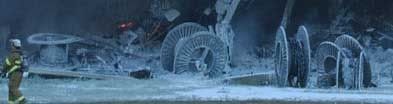
This shot also gives us a good look at the next feature, the cable spools (magenta). There were at least five of these feeding communications cables into the new office space in the renovated wedge. They are at least six feet high when on edge, and some have taken these remaining intact as showing that no part of the plane was lower than that – putting a 757 too high unless it could pass through these, which of course it couldn’t. In fact these are small enough to have been passed over by the gaps between fuselage and engines, or even been rolled aside by the plane’s wake. They are built to roll after all, and probably rolled more during the explosion on impact, and so what we see here is not necessarily the configuration they had WHEN the plane came in. And anyway, they weren’t untouched – note that the one on its side at far left looks slightly deformed, probably by the main fuselage or left wing faring.

Moving on to the other side of the plane’s trajectory, we encounter the fenced-in construction area, shaded lavender. The fence was torn through at that corner by the right engine, as seen below (photoshopped to illustrate the cable spools all evident in the background).
Finally we have the backup generator (orange), parked at the stricken corner of the construction area. It’s the thing on the right above. The giant truck trailer had a front half (generator), and a back half (diesel engine). The issue of having diesel fumes being emitted right by the intake vents is beyond the scope of this site. Anyway, the generator trailer was pushed aside, suffered a burnt spot, a dent in its top, and a massive deformation of its front (generator) half, presumably by the right engine, and possible subsequent melting in the diesel fire. It started out totally rectangular and somehow ended up like this: According to the impact damage and the most astute of eyewitness accounts, the plane was indeed banking starboard high, its left engine basically scraping ground, its right high enough to smack a 12-foot high trailer. It must be noted that the majority of the warping seen here is probably not from the engine itself, but melting from the ensuing fire; it was the diesel fuel in this generator burning that caused most of the smoke at the Pentagon.
---
Not enough evidence? Here are some other quality pages with maps of the scene/details on the obstacles to help you ponder:
- My map is too close to account for the light poles, except the last one. Excellent analysis of these at Eric Bart’s site: LINK
- Desmoulins: The damage before impact LINK
- Pickering/Pentagon Research: Scene map -detailed, includes positions of fire trucks and plane scraps. LINK
- 911 review.com, Jim Hoffman: Error: Obstacles preclude a 757 LINK