Showing posts with label PENREN. Show all posts

Monday, August 6, 2007

THE OUTER WALL: HOW MANY INCHES OF WHAT?

THE OUTER WALL: HOW MANY INCHES OF WHAT?
Adam Larson / Caustic Logic
The Frustrating Fraud
Updated August 5 2007


Many questions have been raised about whether a Boeing 757 could have breached the imposing “steel-reinforced,” and just-upgraded, walls of the Pentagon. As 911 In Plane Site and others have explained, each wall of the five-floor, five-side bunker of five nested rings was 18” of solid steel-reinforced concrete, giving 9 feet total the plane would’ve had to pierce to plow through three rings as alleged. Of course this is ridiculous, but in fact, besides the inner C ring wall where the small and odd punch-out hole occurred, a majority of the plane only passed through one major external wall, on the outer E ring where the plane entered through a gaping 90-foot-wide hole. So I set to figuring out how that wall was constructed - how many inches of what?

Wedge one, the southwest fifth of the building, had just been renovated against terrorist attack, with work one day away from completion when Flight 77 plowed into the ground floor of the strengthened zone. This curious fact has attracted much attention among skeptics, but the ASCE’s Pentagon Building Performance Report notes “structurally the renovation was not major,” and makes little mention of the changes other than to note “the exterior walls and windows were upgraded to provide a measure of resistance to extreme lateral pressures.” [1] There was also the addition of a new fire suppressing sprinkler system, which did little good; [separate link], new windows (to which we’ll return), and several less noteworthy upgrades. But the main issue here is the outer wall of the massive office-bunker that was breached.

According to the Performance Report, “the original structural system, including the roof, was entirely cast-in-place reinforced concrete using normal-weight aggregate." [2] This frame is comprised of columns supporting beams, girders, and floor slabs. The report illustrated "the typical members" in the impact area (left). The reinforcements in these columns are vertical bars, typically six, wrapped with a welded rebar that spirals from top to bottom. This cage is filled and covered with concrete, all told measuring 21” square. [3]

Spanning between these sturdy columns, the impacted exterior wall of the E ring was “mostly non-load-bearing masonry infilled in a concrete frame.” This consisted of “5 in. thick limestone […] backed by 8 in. unreinforced brick.” [4] Apparently most of the surface area encountered was only masonry, just over a foot of it. This is not too imposing. But just after noting the weakness of the outer walls, the report mentions that “in some areas the backing is a cast-in-place concrete wall.” [5] I had been looking at a photograph that looked like that to me, and became confused as to how much concrete structure there really was in the wall that the 757 slammed into. I’m now in agreement with Russell Pickering, who decided:

“The exterior columns were 21 inch square steel reinforced concrete covered with 6 inches of limestone facade. In panels with windows it had the 6 inch limestone facade and 8 inches of brick backed with Kevlar mesh. In panels without windows it was 8 inches of brick and 10 inches of concrete.” [6]

This sounds good, and I see evidence for this distinction. As an article passed on by Jim Hoffman noted:

“The idea of supporting the brick infill walls with a reinforced concrete wall "backing" was rejected as a "typical" approach because of the Pentagon's extensive fenestration (although this design was accepted for "blank" wall panels with no window openings).” [7]

The one place I was seeing concrete backing was a damaged non-window panel on the second floor, thought to be the impact point for part of the right wing. Note what seems a third layer of brick is actually stained on the concrete, which fades to gray at the bottom where the backing was smashed to cobble exposing the 2-layer rebar.

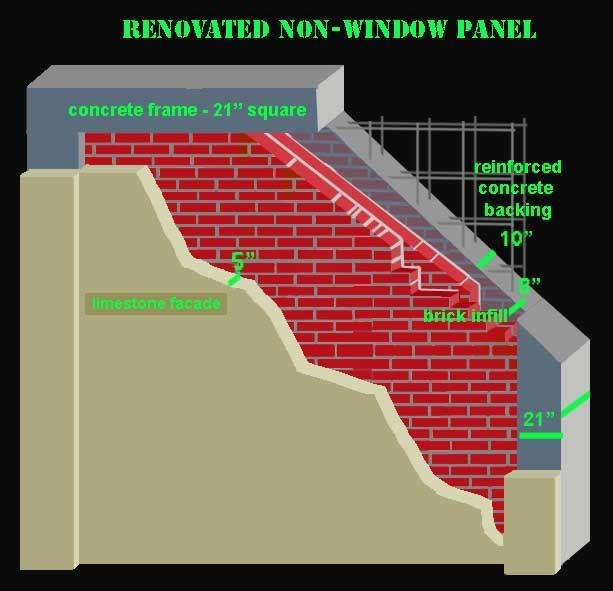
I felt like making a model of the solid slab as seen above. I’m going with the Performance Report’s limestone width of 5,” making the sturdy non-window panel 23” thick. 10” of concrete backing 13” of masonry.

[right click - open in new window to enlarge]
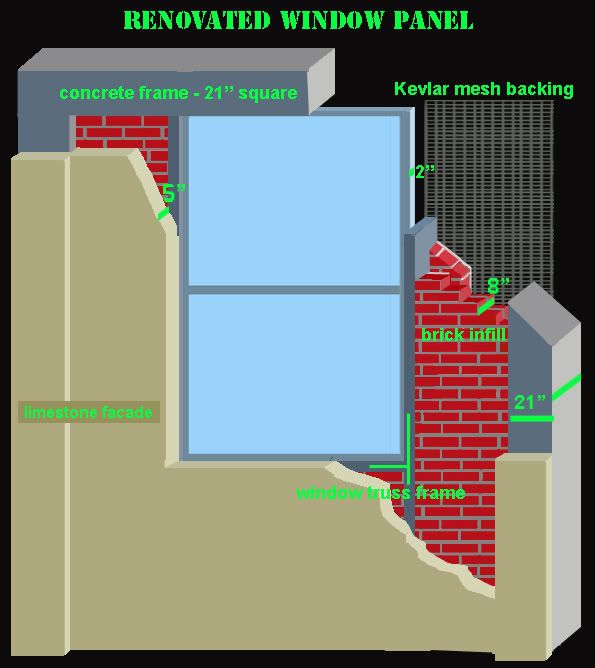


In general, however, this is not the type of wall the 757 impacted. “In panels with windows it had the 6 inch limestone facade and 8 inches of brick backed with Kevlar mesh.” Another part of the renovation was the Kevlar cloth, the material in bullet-proof vests, stretched between the columns along the back side of the unreinforced spans of outer wall. This sturdy netting didn’t add any real strength, and was in fact an admission of the very weakness of this panel type; Architecture Week reported the idea as being “holding together building materials so they wouldn't become deadly projectiles in an explosion.” [8] The Kevlar did little good, however, when the bricks were followed in by an exploding, full speed, Boeing 757 that took out the very columns the mesh was anchored to.
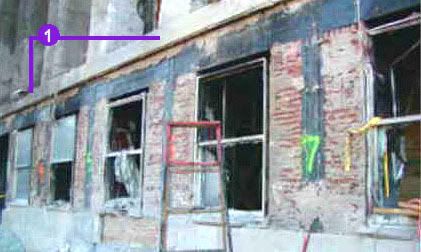
As a side note and because I numbered it in my graphic below (area 1), here is a portion of the unrenovated first floor just north of impact, with the old windows and no Kevlar backing. These panels are missing the window panes and limestone facade from the sills up, exposing the frame and unreinforced brick infill. (note the numbering – Columns 7, 6, and 5.)

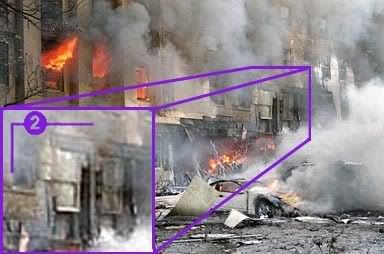
Straddling the renovation line, the damage would have presented an excellent before-and-after comparison for future study, but for the collapse, twenty mintes after impact, of the upgraded half of the picture. The majority of façade damage as the worst of the structural impairment was in the renovated section, from column line 11 south. Right on that dividing line, briefly, one of the more interesting aspects of the renovation was made visible. One article explained how the window frames actually added structural integrity, according to a renovation plan for “erecting structural reinforcements around the windows, anchoring at the top and bottom to structural concrete floor slabs [which] accepts blast forces from the walls themselves and transfers both window and wall loads into the horizontal slab diaphragms.” [9] Here are two panels exposed on the second floor, between columns 11 and 13, directly over the northern half of the worst of the airliner damage. Facade, brick, and presumably Kevlar seem to be removed, while the columns, window truss framing, and even the glass panes are intact. (the number 2 refers to placement on the graphic at bottom of page)
At the risk of dropping free advertising to the makers of these windows, all sides seem in agreement over how well they held up after the attack. Architecture Week noted “the blast-resistant windows […] remain remarkably intact and in place adjacent the point of impact. Some were popped out of their frames by the force of the exploding jet fuel, but they fell without breaking or splintering.” [10] Ralph Omholt noted “the general good condition of the windows,” correctly deducing “this wasn’t a major impact zone of a B-757.” [11] The "major impact zone" is in fact just beneath that, where there are no windows at all or wall panels for over 100 feet.

Here is a graphic I just finished showing what was encountered and destroyed. For the most part, it seems quite plausible for a 757 with its massive, bullet-shaped fuselage and dense, speeding engines, and hardy wing roots to have done all this. Weaker window panel removal accounts for most of the missing outer wall, while intervening column removal was more uniform, in my analysis, than widely believed. Notably on columns 15-17, I’m in disagreement with the ASCE who listed these as present but impaired.
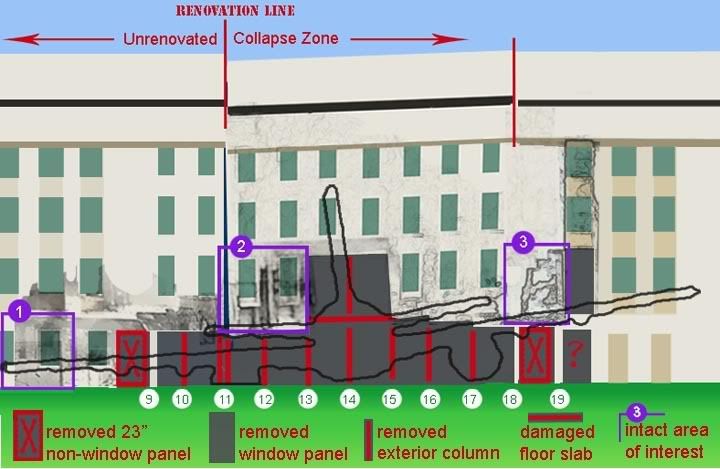
The big “X” panels were the strongest – backed with 10” of concrete - and yet were removed, despite being hit by neither fuselage nor engines. This is one of the things that I’d classify as counter-intuitive about the Pentagon evidence. Take the one on left; a non-window panel – not renovated, so perhaps not 23 inches of material, totally destroyed by one of the weakest parts of the plane – its outer wing. And to its immediate left, a much weaker panel totally intact but for its lost facing and windowpane.
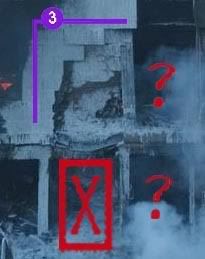
The X on the right is even stranger. The question mark to the right of this mystery spot seems to be one of three doorway, somehow enlarged, and above that, a final weak window panel removed. But the “X” marks the mystery I can’t answer yet. It’s immediately beneath my highlighted area 3, and presumably the same panel type as analyzed above – again, totally missing. What hit this panel, concrete backed, and removed the whole thing? The wing itself hit higher it seems, looking at that line of second floor damage. The under-hanging engine was a ways to the left, and yet this first floor panel was apparently removed completely by nothing in particular.

It might help to recall the wings hitting objects like light poles and a large generator on the way in. Some accounts imply that the wings were possibly exploding even before impact, with parts flying in on the blast cloud only approximating a plane’s profile. Maybe a major wing element impacted here at just the wrong angle and took out the masonry and all its reinforced concrete backing, uniformly.

In summary, let me revisit an old question raised by Dave Von Kleist in 911 IPS and passed on in Loose Change and elsewhere; “Question – Could a 757 have pierced 9 feet of steel reinforced concrete, and left a 14 to 16 foot hole, and no wreckage?" The answer is that it didn’t need to. Most of the “bunker” surface it pierced was 13 inches of brick reinforced limestone, explaining the 110-foot span of eliminated panels (and 90 feet of removed columns) it created and into which the vast majority of wreckage “disappeared” on its own inertia. But I guess the answer he was looking for was more like “of course not – only a missile could do that.”

sources:
[1] Mlakar, Paul F., Donald O. Dusenberry, James R. Harris, Gerald Haynes, Long T. Phan, and Mete Sozen. “The Pentagon Building Performance Report.” American Society of Civil Engineers. January 2003. ISBN 0-7844-0638-3. PDF download link. pp 3.
[2], [3] Ibid. Text pp 5, graphic pp 6.
[4], [5] Ibid. pp 11.
[6] Russell Pickering. "Exit Hole." Pentagon Research. http://www.pentagonresearch.com/exit.html
[7], [9] Biscotte, Michael N., P.E., and Keith A. Almoney “Retrofitting the Pentagon for Blast Resistance.” Structure magazine. July/August, 2001. http://911research.wtc7.net/mirrors/guardian2/pentagon/pentagon-retrofit.htm
[8], [10] Novitski, B. J. "Pentagon Battered but Firm." Architecture Week. Undated. http://www.architectureweek.com/2001/1003/news_1-2.html
[11] Omholt, Ralph. “9-11 and the IMPOSSIBLE: The Pentagon. Part One of An Online Journal of 9-11.” Physics 911. Undated. http://physics911.net/omholt

PUNCH-OUT HOLE “EXPLAINED” BY OFFICIAL ACCOUNTS

PUNCH-OUT HOLE “EXPLAINED” BY OFFICIAL ACCOUNTS
Adam Larson / Caustic Logic
The Frustrating Fraud
July 22 2007
Last updated/edited July 25


Official Dodginess:
How exactly Flight 77's trajectory through the building wound up giving us the exit hole we’ve seen is left a bit vague in the official record. The American Society of Civil Engineers' Pentagon Building Performance Report shows a photo of the hole but gives no adequate explanation. Its terse summary: "there was a hole in the east wall of Ring C, emerging into AE Drive, between column lines 5 and 7 in Wedge 2. The wall failure was approximately 310 ft from where the fuselage of the aircraft entered the west wall of the building," [1] The Arlington County After Action Report noted “the damage extended all the way through the inner wall of the C Ring, a distance of approximately 285 feet,” and showed a photo of the hole captioned “penetration through the inner wall of the Pentagon’s C Ring.” [2] An account of FEMA Urban Search and Rescue shoring/bracing of the building is the most detailed of these three reports. It explains that "a nine foot diameter exit hole was created in the wall of C ring and the remainder of the debris from the impact ended up in the alley between C ring and B ring known as A & E Drive," and elsewhere shows a photo of the "'exit wound' where the plane debris exited the C ring." [3]

These three reports, a few early press conferences, published eyewitness accounts, and a handful of photos constitutes the body of evidence on this hole. While it’s been widely seen and commented on, it has not yet been explained with any useful precision, and contradictory theories dominate to an unsettling degree.

Impact Energy Waves?
In October 2004, the National Geographic Channel program Seconds from Disaster proposed a novel theory by which shockwave pressure from the impact cause the punch-out hole. By this model, plane debris and heavy, exploding jet fuel, perhaps along with explosions of things in the building, gave off shockwaves that reverberated and crossed through the building’s first floor. Having no other exit point, these somehow directed themselves and whatever was in front of them to focus on that precise spot, punching the neat 9x11’ hole we’ve seen. [4] While this explains both the improvised exit and the lack of any major evident airplane parts, the official story has generally maintained it was physically caused by the plane, or some part of it, though which part has been widely contested.

Engine?
Military District of Washington’s news service reported two weeks after the attack, mentioning that “an aircraft engine punched the hole out […] on the inside wall of the second ring of the Pentagon." [5] Though the quote has been widely republished, no other official sources support this claim. No debris seen there looks like engine debris.The piece’s author got the “second ring” part wrong (whether one counts A-E or E-A, C is the third ring), so maybe identifying an engine was an error as well.

Fuselage/Nosecone?
As widely noted, Pentagon renovation spokesman Lee Evey explained implausibly during a September 15 press conference “the nose of the plane just barely broke through the inside of the C ring, so it was extending into A-E Drive a little bit. So that's the extent of penetration of the aircraft." [6] As Killtown wondered “how could the fragile nose of Flight 77 penetrate all the way through 3 reinforced concrete/steel hardened rings and punched out a hole through the inside wall of Ring C and leave no evidence of itself outside the punch-out hole?” [7] This seems unlikely, even given that the “hardened” walls from impact to exit really totaled only 22” of unreinforced brick and limestone [link forthcoming], but spanned between by about fifty damaged support columns and only one plane fuselage to absorb the other end of these blows.

What survived this was not precisely the nose cone, but more likely some element(s) of the nosecone assembly – landing gear, landing gear door, cockpit panel or cargo door – some tattered portion of the forward fuselage. As Jim Hoffman explained, in such an impact, “only the parts of the aircraft with the greatest density and total mass, such as the lower third of the fuselage, could be expected to penetrate far into the building. That part also has a small frontal profile - approximately the size of the punch-out hole.” [8] Of course there is no piece of debris anywhere near the size of the hole seen in any of the available photos, but the illustration is helpful. The fuselage had a lot of mass, tens of tons, and though it was under great stress, it didn’t simply disappear on impact.

Landing Gear?
It stands to reason that as the plane disintegrated, the densest parts of aircraft wound up at the deepest point of penetration. For example, the flight data recorder from the tail end of the plane was reportedly found just inside the punch-out hole. [9] The heavier elements from the front end would also come to rest around this point. The book Debunking 9/11 Myths identified the landing gear. The book cited Paul F. Mlakar, ASCE team leader and lead author of the Performance Report, who “saw the landing gear with his own eyes” during his early onsite inspections, for its explanation that:

“The hole was not made by an engine or the nose of Flight 77 pushing through the building’s interior - or a missile - but by the crashing jet’s landing gear, which was ejected beyond the bulk of the wreckage. […] As one of the heaviest and most dense parts of the plane, the landing gear flew farther than any other item in the wreckage and was responsible for puncturing the wall in Ring C.” [10]

Other photos and accounts seem to back this up by recalling or even showing a wheel, a tire, and even a massive landing gear strut, near the hole. But there are some serious problems with this theory as well, like the ASCE’s own Performance Report not identifying this alleged hole-puncher as such, which noted that "the landing gear" (all three sets?) were in fact found inside the building, hardly the best place to be after exiting through the hole into the AE Drive. [13] These questions will be summarized more fully in a [separate post].

ASCE and FBI Secrecy
Mlakar's ASCE study team “went to great lengths of detail down to individual columns” in the plane’s path, Russell Pickering noted, providing their own photos and personal damage assessment of nearly all of them. Yet they danced around the cause of the punch-out, as Pickering wrote, offering “not a single explanation for the exit hole.” [14] The three columns nearest the breeched wall - 1N-North, 3N-North, and 5N-North - remained un-photographed and listed in the report as “damaged per FBI.” [15] Pickering suspects falsification of the status of these three columns to hide inexplicably severe impairment. [16]

He speculated that “the building team […] weren't allowed back at the exit hole for some reason," and noted how "they indicated in the report why they didn't have photos of those columns and who gave them the damage report on the columns - the FBI.” The one photo they published of the exit hole itself was not one of their own, but also credited to the FBI, further indicating this area had special investigative significance to the bureau, although this could have many possible reasons. [17]photo of the hole used by the ASCE, credited to the FBI (lower right, very small print.) [18]
---
Sources: forthcoming
[1] Mlakar, Paul F., Donald O. Dusenberry, James R. Harris, Gerald Haynes, Long T. Phan, and Mete Sozen. “The Pentagon Building Performance Report.” American Society of Civil Engineers. January 2003. ISBN 0-7844-0638-3. Page 28. PDF download link
[2] Arlington County After-Action Report. on the Response to the September 11 Terrorist Attack on the Pentagon. PDF downloaded from http://www.arlingtonva.us/Departments/Fire/edu/about/FireEduAboutAfterReport.aspx. The report bears no publisher or copyright info – it was compiled by Arlington County and Titan Systems Corporation, and released July 2002 according to this story: Weiger, Pam. “Pentagon report: After-action.” NFPA Journal. Nov/Dec 2002. http://findarticles.com/p/articles/mi_qa3737/is_200211/ai_n9114927/pg_1
[3] Titus, Leo J. Jr., P.E./Virginia Task Force One Urban Search & Rescue Team. “A Review of the Temporary Shoring Used to Stabilize the Pentagon After the Terrorist Attacks of September 11th, 2001.” May 3, 2002. Pages 9, 12. PDF download link: http://www.aesvn.org/resources/Pentagon-Shoring.pdf
[4] Seconds From Disaster – season one episode 12 “Pentagon 9-11.” National Geographic Channel. First Aired October 26 2004 http://en.wikipedia.org/wiki/Seconds_From_Disaster
http://channel.nationalgeographic.com/channel/seconds/episodes.html
[5] Military District of Washington. Press Release. (9/26/01) original url: http://www.mdw.army.mil/news/Commentary-Remembering_the_honored_dead.html. Accessed at: http://www.snopes.com/rumors/pentagon.htm
[6]

Friday, July 13, 2007

A PUNCH-OUT FOR CARLSON’S BACKHOE THEORY

A PUNCH-OUT FOR CARLSON’S BACKHOE THEORY
Adam Larson / Caustic Logic
The Frustrating Fraud
July 13 2007


The “punch-out hole” in the C Ring is a true mystery of the Pentagon attack, addressed by an anarchy of theories both in the conspiracy world and in the official story. Official reports fail to clearly explain the near-perfect “wall failure” at the end of the damage path through the building, though they tie it in one way or another to the airliner impact. [location, basics, and official explanations here.]

Some researchers have often seen the possibility that this hole was made on purpose, to some specification for an unknown reason. It’s been wondered if this was related to one of the secondary explosions reported by some. I had wondered on first seeing the hole’s near-perfect form and its size if it wasn’t made by emergency workers [see picture]. It's perfect for human entry, almost a doorway really.

One novel notion to this effect that I feel deserves its own brief post was proposed in 2005 by perennial no-planer clown Jon Carlson.” IT IS CRYSTAL-CLEAR,” he announced at Rense.com, “that this wall opening was made by contruction workers needing to access the inner Pentagon [and] NOT by a landing gear as claimed by Popular Mechanics. “ He presented “the evidence that the WALL OPENING next to the road that runs inside the Pentagon was actually made by a backhoe.” [1]

Carlson noted the symbols that look like upside down anarchy signs, bracketing the spray-painted words “punch out” to the right of the hole. Now, from what I know (a quick internet search) of construction terminology, a “punch list” is “a list of discrepancies that need to be corrected by the contractor,” while a “punch out” is a process of inspecting a site and making a punch-list. [2] In this case, it seems to be a directive to assess the damage inside, or an acknowledgement that the erea had been punched-out. But Carlson gets mixed up and explained “in CONSTRUCTION TERMINOLOGY 'punch-out' refers to making an opening in a wall to access the inside contents of the wall or the inner room.” [3] Oops. Better run a punch-out on Carlson’s wrecked research for any discrepancies to bill him for.

First, let’s look at the Pentagon Renovation press conference from just after the attack that Carlson took as the “FINAL WORD” that this hole was made intentionally. Presenter Terry Mitchell said on September 15:

“this pile here is all Pentagon metal. None of that is aircraft whatsoever. As you can see, they've punched a hole in here. This was punched by the rescue workers to clean it out. You can see this is the -- some of the unrenovated areas where the windows have blown out.” [4]

While it’s not clear which photo(s) he’s really referring to here, Carlson joined this quote with the photo below and for good reason. Note the markings, the flat/straight/square metal scraps (building debris), and the clear view through the gutted building to the (unrenovated) outer E Ring wall north of the impact point. It seems likely, as Carlson decided, that this is the photo referred to.


This must not be the case however – according to Russel Pickering of Pentagonresearch.com anyway, this photo was taken by a FEMA photographer on September 20, nine days after the attack, and five days after Mitchell’s presentation. [5]

Whatever he was really talking about, Mitchell’s “FINAL WORD” is not as useful as Carlson pretends; just before this quote he also said “there was a punch-out. They suspect that this was where a part of the aircraft came through this hole, although I didn't see any evidence of the aircraft down there.” [6] There certainly were parts that seem to be from the plane at the punch-out [link coming], so if he’s talking about the same location, it would appear Mitchell got confused – calling it first a punch-out and then a punch-in. Or perhaps he was showing two different areas. Whatever the case, no other official sources I’ve seen mention a manmade punch-in - they all say the plane did it but can’t agree exactly how.

Carlson then looked at the photo above with its “orange circled 'V's [which] directed the backhoe operator to make the opening within the V's.” He also drew attention to “the orange arrow on left edge of the opening,” just beneath the “no-parking” sign. [7] This he seems to take as the “dig here” mark, but it was clearly painted on after the brick damage.

In fact in the first photos showing the hole there on 9/11, the wall bears no spray-painted “directions” at all to guide the operator, thus nullifying Carlson’s evidence here. This was all done after the fact. The purple backhoe directive to “punch out” the area with its bucket did not appear on the wall until September 14, just in time to be misread by Mitchell the next day. [8] The Vs and the arrow appeared earlier, late on the 12th. As for these symbols, they seem to stand for “victim,” as Pickering explained in his rebuttal to Carlson’s piece:

“[T]he markings on the wall to which Jon refers are international rescue symbols, not backhoe directions. The "V" indicates a victim has been located. If there is a line through the V (an upside down "A") that indicates the victim is deceased. If there is a circle around it, that means the victim has been removed.” [9]

Pickering’s chronological study of hole photos shows that the markings were not there by mid-day Tuesday, but the Vs had been placed, crossed, and circled by photos from that night. [10] Given the devastation inside, I’d find it curious that all bodies in that zone were cleared in less than a day before the morning of 9/13. This could be another clue, but I don't understand the procedures and it's a bit of an aside...

Despite Carlson’s transparently silly analysis, Pickering noted in his rebuttal “the exit hole is very important evidence to indicate a government cover-up because it can't be explained by an aircraft hitting the building.” [11] His worthy analyses of the hole can be found compiled here: http://www.pentagonresearch.com/exit.html Though I cannot agree with his certainty that this is something intentional, I must admit his theory makes at least as much sense as the vague official stories.

Sources:
[1], [3]. [7], [9], [11] Carlson, Jon. “PM Claims Landing Gear Made Pentagon 12 Foot Hole.” With responses from Russell Pickering. March 9 2005. Rense.com. http://www.rense.com/general63/pmm.htm
[2] Home Building Manual. Glossary. http://www.homebuildingmanual.com/Glossary.htm
[4], [6] Lee Evey, Pentagon Renovation Manager, Rear Adm. Craig Quigley, Deputy Asst. Sec. of Def. for Public Affairs, and Terry Mitchell, chief, Audiovisual Division, Office of ASD PA. The Pentagon, Arlington, Virginia. September 15, 2001. 11:00 A.M. EDT http://www.defenselink.mil/transcripts/transcript.aspx?transcriptid=1636
[5], [8], [10] Pickering, Russell. “Exit Hole chronology.” Pentagonresearch.com. http://www.pentagonresearch.com/062.html

Saturday, April 7, 2007

COLUMN CONFUSION - OFFICIAL REPORT DISCREPANCIES

COLUMN CONFUSION: OFFICIAL REPORT DISCREPANCIES
Adam Larson / Caustic Logic
The Frustrating Fraud
Last Updated September 4 2007


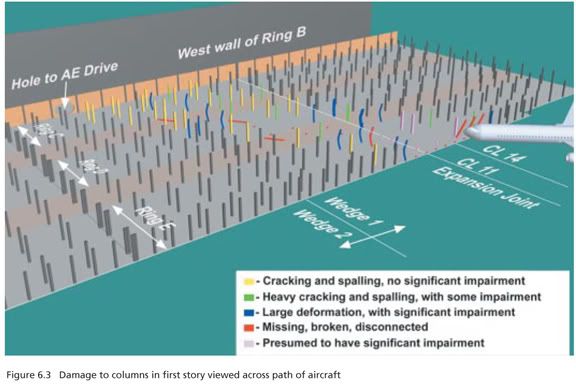
It's not just the conspiracy theorists who have a problem identifying present vs. missing support columns in the Pentagon attack aftermath. The official story as well has two schools of thought regarding first floor column status, neiter one correct by my analysis. The American Society of Civil Engineers (ASCE) Pentagon Building Performance Report, looking at first floor damage, sees columns 15, 16, and 17 “severely distorted but still attached at least at their top ends to the second-floor framing.” [1] This is what I originally saw as well, as have most others.

But this is likely incorrect, though it requires a separate post to explain the reasons why I believe these columns were removed and replaced by horizontal elements from above (floor slab, facing, masonry) that on fist blush look like columns but are not.

A still from the PBPR, a 3-D model by the ASCE. The three red slants here are the columns 15-17 I have brought into question. The lavender ones are “presumed” to have suffered major or total damage – which means they were in the collapse zone, invisible in early photos, and so unknown. The red pillars are the worst damaged, “missing, broken, disconnected,” elsewhere described as "without remaining function.” Some were entirely knocked loose but found, some were disconnected but standing, and some totally obliterated, here represented by dots on the floor where they were. These red “columns” appear out of place when all those around and behind it are verified or presumed vanished. I suspect this graphic is incorrect by having the three red pillars shown as anything but dots.

Note also that some spaces aren't color-coded at all but left blank. Despite their impressive credentials, no one at ASCE had time to look up close before the collapse, and only so much could be told afterward. In the collapse zone “the team was unable to determine specifically the level and extent of impact damage,” the report notes. Left of the “CL 11/Expansion joint” line such absence was verified by on-site inspection, on the right they probably decided on their assessments by looking at the early photos as seen on this site. The spots left blank were apparently the ones not visible in photos, and so they didn't even venture a guess.

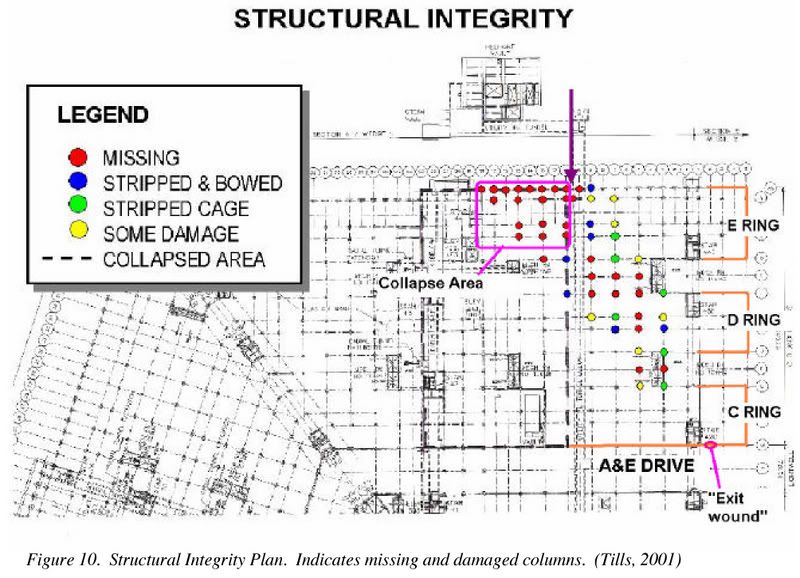
Oddly enough, another, earlier, official report disagrees with these and backs me up on this point. The Pentagon’s own Renovation Program included a slide of “structural damage” for a News Briefing in March 2002. [3] The slide showed columns #15-17, along with the entire outer row between columns 9 and 19 uniformly listed as missing. This graphic is condensed from their original – column numbering was as unreadable on theirs, but the expansion joint on column line 11 was the cut-off line for the collapse area. counting right to left from column 10, we see they have column 18 missing as well, which is odd considering the photos I’ve seen shows that one at least at standing proud even after the collapse.
The same graphic as reproduced in FEMA Urban Search and Rescue's Pentagon Shoring Report.


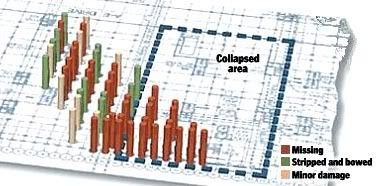
And another, earlier yet report in the Washington Post (9/23/01) employed the graphic above, likewise showing columns 10-17 on the front line listed as "missing," as well as 18 and in this case column 9 as well. This columns was in fact intact (post forthcoming). It seems they've removed two columns I see as standing. Note the other side of their collapse zone is way over there at about column 23, which is clearly not the case - as we see below, colum 18 both marks the cutoff line of the collapse zone and remained standing afterwards.

Here is a montage centered on the damaged expanse between columns 18A and 19A. The first shots are lined up with the ASCE's report of the non-columns 15-17, as well as their identification of #18. All sources agree that CL 23 represented the edge of the 23 column-wide pronounced facade section, so I measured out the area in question before and after the collapse. Note column 18 is standing at all times, though damaged, and 19 remains in good shape.

So one school of official reports thought insist wrongly that columns 15-17 are present and rightly that 18 and 19 are intact, whie the other rightly asserts that columns 15-17 are gone, but wrongly classes columns 9 and/or 18 as missing too. Should it be that hard for any one source get it all right at the same time?

Sources:
[1] American Society of Civil Engineers. “The Pentagon Building Performance Report.” January 2003. PDF version. www.fire.nist.gov/bfrlpubs/build03/PDF/b03017.pdf
[2] http://911research.wtc7.net/pentagon/official/index.html
[3] “Structural Damage (.JPG 77 KB) (020307-D-6570C-008.jpg)” Graphic used for: DoD News Briefing, Thursday, 07 Mar 2002 - 11:00 am http://www.defenselink.mil/news/Mar2002/g020307-D-6570C.html
[4] Washington Post. "Rebuilding the Pentagon." Graphic. Publisheed September 23 2001. http://www.washingtonpost.com/wp-srv/nation/graphics/attack/pentagon_7.html

Wednesday, January 24, 2007

FROM THE BLIND SPOT TO THE EMPTY SIDE

Curiously, among the 266 people on board the attack planes, defense contractor Raytheon lost a remarkable four employees, three of them on Flight 11 alone. But I mention this because of the fourth Raytheon casualty: Stanley Hall, 68-year-old Director of Program Management for Electronic Warfare, perished on Flight 77 on his way to the company's operations in Goleta, California. He had been described by colleagues as “our dean of electronic warfare,” and had been instrumental in their development of anti-radar technology. [1]

Strange then that the plane carrying Raytheon’s anti-radar expert also proved the most effective of the four attack planes at evading radar tracking. As American 77 bore down on Washington, it crossed Ohio and West Virginia unseen by civilian controllers, who thought perhaps it had crashed. For some reason, we’re told, there was no radar at all here, with tracking done only by transponder in a system falsely called “secondary radar.” [2] And the hijacked plane had one of those stupid transponders – as they all seem to – that can be easily disabled by hijackers, as all hijacked flights were on 9/11.

While the other three weaponized airliners were tracked by radar despite the transponder invisibility, Flight 77 was unseen for over half an hour after the hijackers killed its transponder signal. At about 9:25, it entered Washington airspace, which did have radar that picked it up to everyone’s worry. Vice-President Cheney was informed immediately, but twelve minutes later it hit the Pentagon with, allegedly, no warning at all. [3] A spokesman said “the Pentagon was simply not aware that this aircraft was coming our way,” and so obviously had implemented no defense and no evacuation. [4] This despite the just-established protocols for an airliner hit on the building that resulted from a series of drills over the year before 9/11.

And then there’s the Pentagon renovation project (PENREN), a years-long program of updating and remodeling the massive building one wedge, or section, at a time. It just happens that of the five sections, Wedge One, the Navy Wing and home of the US Naval Command, was the first up. Work had begun back in 1998, and a few select tenants moved in as early as February 2001. The grand opening for the wedge was held on March 8, and the first Naval tenants were handed their key a week later, eventually running their Naval Command Center in its brand new office space. [5]

Damage to Sections one and two
Damage to the Pentagon’s West side, penetrating the outermost E, D, and C rings
But six months later as the sixty-year anniversary of the Pentagon’s original ground-breaking approached, work was still underway on at least the telecommunications systems, hence the giant spools of cable out front; the area was still a fenced-off construction zone when it came under air attack on September 11. The wedge had supposedly been upgraded with fire-suppressing sprinklers, blast-resistant windows, and more support columns in the off chance terrorists should strike at the very heart of America’s military. Renovation officials have cited their upgrades as slowing the plane’s impact and minimizing death, though it plowed through roughly 300 feet of these improvements.

Due to the incomplete nature of the work space, only about 800 people were in the entire wedge one, where there would normally have been about 5,000, further minimizing the death that day. [6] In fact the plane struck just south of the dividing line with wedge two, and pushed fires well into that section; Civil Engineering magazine noted "far less damage and loss of life than the terrorists might have anticipated," and for this credited "the facts that renovation of Wedge 1—an undertaking that substantially fortified that segment—was within days of completion, and that Wedge 2, about to undergo renovation, had been vacated." [7]

Russell Pickering aptly noted of these oddities:

“It's the fact that they hit "near the middle" of the only section that had been "renovated and reinforced with blast resistant windows" where the "staffing levels were lower than usual" on the "other side" of the building from "the top-level military brass, including U.S. Secretary of Defense Donald Rumsfeld" one day before the completion of the renovation on "Wednesday, September 12th, 2001" that has generated some suspicion about the "well-coordinated" attacks.” [8]

For good or ill, this is precisely true.

Sources:
[1] Lecacy.com Tribute: Stan Hall. Tribute submitted by Jane Weiger. Accessed October 9, 2005 at: http://www.legacy.com/Sept11.asp?Page=TributeStory&PersonId=91767
[2] Phillips, Don. “Pentagon Crash Highlights a Radar Gap.” Washington Post. November 3, 2001. Page A06. Accessed November 12, 2004 at: http://www.washingtonpost.com/ac2/wp-dyn?pagename=article&node=&contentId=A32597-2001Nov2
[3] Thompson, Paul. The Terror Timeline. New York Regan Books. 2004. Page 416.
[4] Newsday, 9/23/01, New York Times, 10/16/01. Via: http://www.wanttoknow.info/9-11cover-up10pg
[5] Pentagon renovation details. Accessed November 12, 2005 at: http://renovation.pentagon.mil/projects-W1.htm
[6] See [3]. Page 422
[7] Powell, Ann Elizabeth. “September Eleventh: The days After, the Days Ahead.” Civil Engineering Magazine. November 2001. http://www.pubs.asce.org/ceonline/ceonline01/0111feat.html
[8] Pickering, Russell. "The Pentagon." Pentagon research. http://www.pentagonresearch.com/pentagon.html