Showing posts with label plane parts. Show all posts

Sunday, June 1, 2008

THE PHYSICAL EVIDENCE {masterlist}

THE PHYSICAL EVIDENCE {masterlist}
The Frustrating Fraud
Last updated January 2 2008


This post is to organize the sub-posts dealing with the analysis of the physical evidence at the Pentagon attack scene. I am not a structural engineer, forensic scientist, or airplane mechanic. I'm a janitor, but have enough common sense, basic scientific knowledge, and ability to visualize spatial dynamics and physical processes to give my analysis some worth. Some of this is just conjecture, some backed by some research. And most importantly, I’m driven by a desire to actually figure out what makes the most sense, and not be ruled by mystery and speculation. Initially my research was to decide how far off-track Pentagon Strike and 911 In Plane Site really was, but since then I have put together a plausible explanation for what physically happened there that morning centered around the impact of a plane rougly the size and shape of a Boeing 757 and seemingly painted with the American Airlines standards. It's not the only possibility, but as I'll demonstrate it's probable, likely, or at at least as plausible as any other theory, putting the lie to the myriad claims it could not be so.

Just as I was posting this starting late in 2006, the new paradigm of no-757 hoaxing was emerging – Citizen Investigative Team and the witnesses whose geometry logically rules out an impact by a missile, drone, 757, anything, with all the points of evidence addressed below fabricated independently, some in real-time, to indicate a plane strike on the official path. To demonstrate how remarkably convoluted that would be all I need do is keep plugging away at the details like I have been and take as leads the points they think they can twist into making their silly case seem to make sense. To address the witness verification, logic, geometry, and honesty aspects of CIT, I’ve gone out on several limbs listed in a separate masterlist.

In piecing this together I’ve drawn on official and governmental sources, FOIA released documents shared by others, published personal accounts, and mostly on many hundreds of photographs and the published opinions of various theorists. I'm indebted in tiny part to 911 IPS/Loose Change/Hufschmid et al for getting me started and wondering, but indebted massively to the groundbreaking works of John Judge, Mark Robinowitz, Jim Hoffman, Russell Pickering, Joel van der Reijden, Scott Bingham, and various others for showing and addressing in a sane manner ALL the evidence available and thus allowing me closer to the reality of the situation. So in drawing on the works of others, there are only so many new ideas here. What I do is try to understand a point at the basic level, verify it by what I know or can learn, and then simplify and convey the core ideas in my own way. There are no math or science prerequisites for understanding the evidence of this crime scene as I've boiled it down.

In fact, as some have pointed out, the Pentagon may have become such a focus of flawed theories because of the simplicity of the crime scene. The WTC was almost volcanically destroyed and buried, but the Pentagon was basically a five-story office building left almost totally intact. The impacted section was primarily on a single floor of the building and of course inside the plane. Identification of plane parts and bodies would be easier by orders of magnitude than the New York crime scene. And if no such evidence existed, many reasoned, this would become the “weakest link” in the official story. The scant evidence available does not bear them out – this is someone’s weakest link, but not the government’s.

> ATTACK PATH DAMAGE AND QUESTIONS
- Precision Low-Rider: The remarkably anomolous final attack altitude - admittedly quite a feat for a hulking 757. And yet...
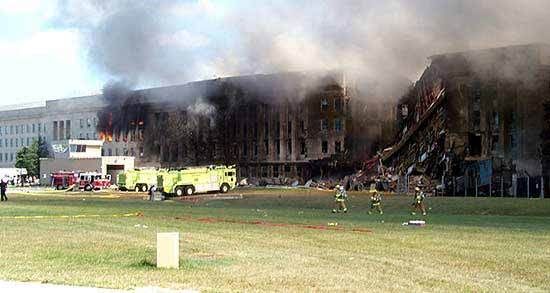
- The widely-cited unmarked lawn: A plane so low and yet not quite THAT low. Again suspicious but ultimately a red herring IMO. It seems that however unlikely, it flew that razor's edge of altitude, pushing the envelope to the maximum.
- From the Blind Spot to the Empty Side: The lack of radar coverage over the attack route and the stroke of "luck" that had the plane hit the just-renovated and partly empty side of the building.
- The "undamaged" light poles: Testifying the 'official' flight path and altitude, were these clipped by the plane, popped with FX, or planted in advance?
- Analysis: Poles 1 and 2 proportions, shear height, clues to final plane bank, just a hint of getting into the Lloyd issue...
- Map of the crime Scene and the "obstacle Dodge." The heliport, attack path, generator, etc. mapped out and explained. Excellent resource to be updated soon to reflect the below.
- Vent Structure Damage: If the plane could be said to have hit the ground before impact, this is where it did so.
- Twisted Orange Trailers: Analysis of scrap metal at the scene with some angles and stuff. Pretty cool.
- Cookie Identification Team: The damage points that line up so well they're called 'cookie-cutter,' or too perfect, by critics. Generator trailer, fencem vent retaining wall, tree damage, general impact hole.
- Like Two Bulldozers: A new view highlights the consistency of the damage path with a 757 strike or some damn good fakery.

> IMPACT DAMAGE

- The Entry Wounds: Analyzing the tiny "16-foot hole" so many insist could not have allowed a 757. It's actually 90 feet wide.
- The "16-foot hole challenge." coming soon.
- The outer wall: how many inches of what?: External Wall construction notes - 18" of steel-reinforced concrete? 13" of brick reinforced limestone? Or what?
- Support columns Masterlist: The "intact support columns" thought to preclude a 757 - anlysis with thee linked sub-posts demonstrating incorrect official reports, questioning the status of columns 15-17aa, and the PentaCon guys' analysis of "intact" column 14aa on the second floor.
- Pentagon Foundation Damage?
- Right Wing Damage Continuity

> DEPTH OF PENETRATION
- Early revisionist accounts decided only one ring was damaged. I run rings around their deeply flawed analyses (from 2001 and 2002) for no big plane at the Pentagon. They should have learned by now, but it doesn't seem they have.
- Nine feet of Steel Reinforced Idiocy: Plane penetrates 300 feet, fraud logic penetrates nothing.
- Punch-Out Page - intro on the punch-out hole at the end of the plane's alleged penetration, masterlist of more posts on the hole.

> FIRE:
- No fires? "A Stool Sample of IPS Evidence."
- Impact fireball: Fireball Fakery: Challenge to CIT

> THE PLANE PARTS:

- Part I: The Engines: Parts that could be from almost any engine - including a 757's.
- Part II: Landing Gear: a wheel and a landing gear that look like those from a 757.
- Part III: the Scrap Over the Scraps: Fuselage segments from an American Airlines jet.
- The Flight Data Recorder {masterlist}: Found intact, with altitude, speed, etc details programmed in, and coming out weird. A lot to cover... especially the animation.

>THE BODIES:
-
Faces of Death, the Moussaoui Edition: The government's release of new evidence in mid-2006 as the Moussaoui case closes - are we seeing the Flight 77 victims here?
- also covered at the end of the
nine feet of idiocy piece.

Thursday, December 6, 2007

PLANE PARTS part II: LANDING GEAR

WHERE 757 MEETS GROUND, EVIDENCE MATCHES OFFICIAL PLANE
Adam Larson
Caustic Logic / The Frustrating Fraud
January 8 2007
last updated 12/9/07


The TLC Wheel
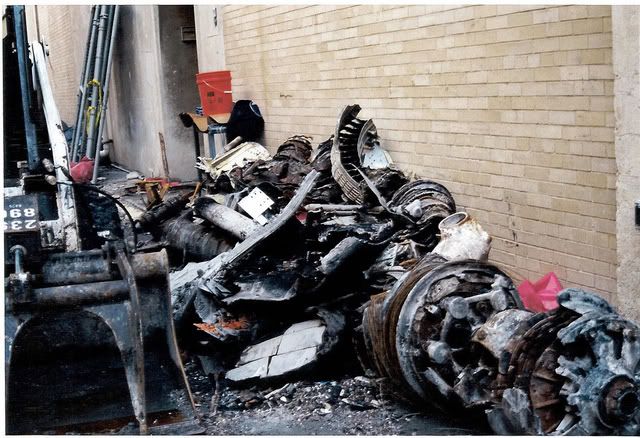
The picture at left was taken by an unknown photographer on September 12 and shown in a The Learning Channel documentary. The location is in the Pentagon’s A-E Drive, at the far end of the plane’s trajectory between rinds B and C, just outside the curious 'punch-out' exit hole. It’s of a wheel rim generally thought to be from Flight 77. No missile I know of uses landing gear with wheels, but smaller planes do, and debate has raged over whether or not this is the precisely and verifiably a 757’s wheel or from something smaller.

Karl Schwarz, among his information that was “hand-delivered to New York Attorney General Eliot Spitzer,” decided the wheel is “the type made by B.F. Goodrich in their aerospace division. They also made the wheels for the 757 but a simple proportional check of width versus diameter will easily show that the below photo is not of a wheel hub from a 757 [...] This radius being about the same as the width of the wheel hub is also another clue that the 757 story is a Bush Lie." To clue us in on the truth, he noted that this looks like an A3 Skywarrior wheel - if it had the wrong wheels. "This is the type of wheel hub one would expect to find as one of the two rear wheels on an A-3 refitted with current equipment rather than equipment that is no longer being manufactured." [source]

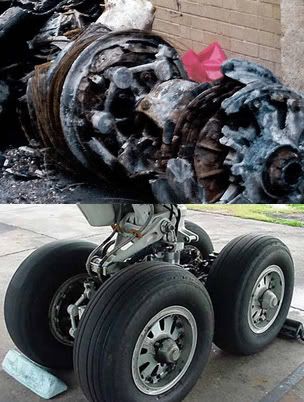
Schwarz’s radius/width wheel analysis was apparently passed on by Dylan Avery in Loose Change first edition and then misinterpreted by the debunkers at “Internet Detectives” as radius/diameter: “I'm not sure what [Avery] means by this, as all circular objects have a diameter twice their radius.” [2] Anyway, in comparing the same images Avery used, which the Detectives considered good enough, we see clearly that the rim width/hub radius at left (red/blue) is about exactly the tire width/hub radius at right - the radius/width of the C Ring rim matches that of a 757.

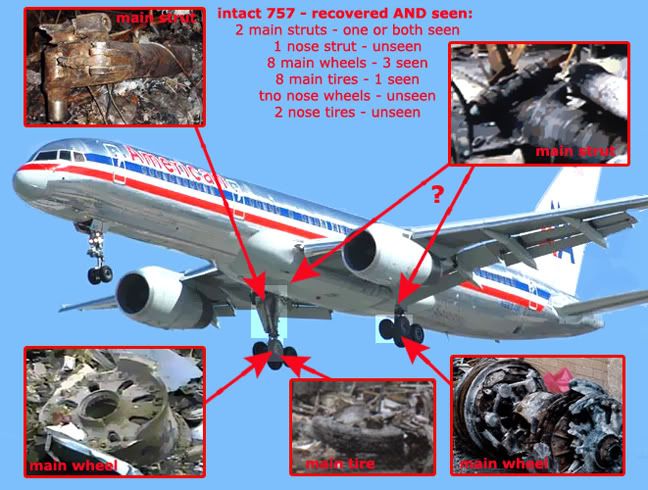
Another point I recall seeing made at LetsRoll 911 was the difference in the holes placed radially around the center mount. Both seem to have a symmetrical arrangement but a differing number – the Pentagon rim with eight, the intact gear sporting ten, it seems. This is not so odd though, as Russell Pickering found out with some research, the 757-200 series (which Flight 77 was) uses precisely two different types interchangably - "one with 10 slots and one with 8." It's hard to say which type FLight 77 was equipped with, since, as Pickering found, "airlines are not obligated to use the same rim and gear manufacturer on a particular aircraft.” [source] My guess is it had eight holes. In fact the debunkers at Aerospaceweb.org found a photo showing the very craft in question - tail number N644AA - sporting main gear wheels with eight slots, just like the one that wound up in the drive. If it was planted, it was done right. But where are the other seven main gear wheels? Or the two nose gear wheels?

More Wheels

Above is a photo first published back in September. I first found it at the Loose Change Forum (halfway down page), posted by LCF member Digest, who had just re-deployed, to Iraq I would guess. Additional details remain hazy, but it would seem to be in the A-E Drive as well, and shows some apparent engine parts as well as a glimpse of the main gear strut (which I'll discuss in a moment) and a main gear wheel assembly with two battered wheels attached that seem to match the TLC wheel. Compare this with the main gear seen on a 757 (left).


The Strut(s)

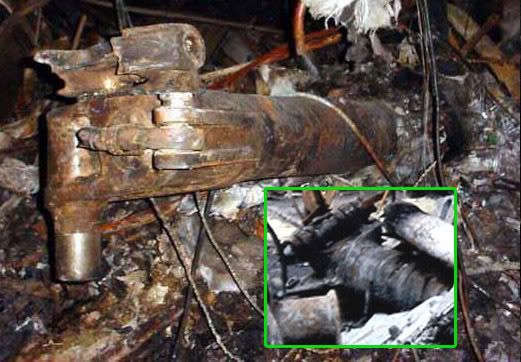
Then we can see what had once attached this wheel to the plane, a massive hydraullic leg found in the C Ring just inside the exit hole – not far from the wheel. This appears to be one of two main landing gear struts. Pickering wasn’t at first sure of the size of this clearly hydraulic artifact. He speculated it might be something from inside the building, like “the cylinder from a trash compactor,” but noted “if it could be proven that it was from an aircraft other than a 757 [that] would obviously be significant.” The inset is from the photo above - it bears the same hallmarks, and could be either the same strut or its counterpart.
Then he located another photo that clarified the scale of the thing, filling much of a room, as seen above, and compared this shot with a photo of a 757 landing gear in the shop, which Pickering obtained and I’ve superimposed for human scale. Taken together, these led Pickering to conclude “it must be a landing gear,” and its trunion link layout and other clues strongly suggesting a 757's. [source] Some scientists interviewed for the Dutch TV program Zembla were shown these photos [video link - 1:50 mark] and decided it was likely from a 757.

Whatever the merits of the too-small wheel analysis, after reviewing this massive, fundamental, and highly likely 757 part buried in the wreckage, any further discussion of the precise type of wheel at the end of it would now seem doubly ludicrous. All the HTB people have left now is the contention that these photos were stage-managed, the parts planted, or complete CGI forgeries. And they probably will make that case, if they bother acknowledging this evidence at all, as well as that the wheel in the forgeries is far too small. But for those who rely exclusively on evidence like Loose Change, Pentagon Strike, In Plane Site, or Painful Deceptions, the solution is simple - they will never be confronted with the landing gear photo, which was excluded from all these in-depth videos for some reason.

The Tire/Gear At Impact

Additionally, a single large tire - or at least half of one - was seen in the A-E Drive, in close proximity to the wheel found there. It is not pristine, but relatively intact for having passed through 300 feet of building. Perhaps this has to with being shielded by the rest of the plane. Of all eyewitness reports, only Noel Sepulveda recalls the landing gear down before the plane impacted. Other witnesses specifically report the landig gear was NOT extended at impact. William Lagasse: "The 757’s flaps were not deployed and the landing gear was retracted." [fifteen corroborating accounts compiled by Arabesque], and so remained safely tucked within the plane's underside, presumably until the fusealge came apart around it.

What We've Seen

What we've seen is actuall a decent percentage of the landing gear, mostly just inside and outside the 'punch-out' hole which was semi-officially caused by some unspecified part of the Landing gear. One massive main strut apparently came to rest inside this opening, perhaps the same one was later photographed outside in the drive, along with the two wheel segment, which may well have been pulled out from inside. All of the gear we can identify as likely exiting the building on its own is that lone piddly wheel and tire, photographed from the beginning on the pile of rubble fanning out from the hole. The rest of the gear not shown on this page, if it was there at all, was buried somewhere inside that high-security installation and not publicly shown yet to my knowledge. One sobering possibility that should be considered is whether perhaps the smaller, unseen nose gear had detached early on, in its folded and dense postion, and buried itself nearly intact in a victim's torso. Would this photo be released if so? I actually hope not.


Sources:
[1] Schwarz, Karl W. B. “Pop goes the Bush mythology bubble Part 5: Exploding the myth of the Bushes as an all-American family.” Online Journal, via www.karlschwarz.com/02-02-05_Schwarz.pdf
[2] “Loose Change, section two: The Wheel Hub.” Internet Detectives. http://internetdetectives.biz/case/loose-change-2#the-wheel-hub

Tuesday, August 21, 2007

PUNCH-OUT PAGE {Masterlist}


PUNCH-OUT PAGE {Masterlist}
Adam Larson/Caustic Logic
The Frustrating Fraud
Last updated July 16 2007


It’s long past time I worked out a study of the much-discussed but little-explained “punch-out” hole at the end of the plane’s trajectory through the Pentagon. The official story maintains that the disintegrating 757 plowed in a northeasterly direction clear through the E, D, and C rings of the building, the furthest-reaching elements from the fuselage coming to rest just outside the inside wall of the final ring, and into the open, ground-level service roadway past that – the A-E Drive that runs around the building between C and B rings. Burning debris was ejected with enough force to leave marks on the outer B ring wall, but otherwise stopped in the drive.
Russell Pickering of Pentagonresearch.com, who has studied the issue more than perhaps anyone else, aptly describes this exist wound as “one of the most anomalous features of the Pentagon attack […] absolutely inexplicable in terms of the composite nose of a Boeing 757-200 "punching out" through it," given "curiously little" of any plane parts outside of it. [1] It’s a perfect hole implying strong, evenly applies force and yet no ready sign of just what part of the plane made this and then - apparently - vanished before hitting the next wall.
Here is the earliest photo Pickering could locate of the hole, before any marking were spray-painted and before the debris inside was pulled forward. Note the ground is strewn with scattered bricks and flooded with water from firefighting efforts. [2] Compare this with with the damage to ring B's wall across from it [below], separated only by fifty feet of air; not a brick removed. [3]
Only a few photos of the exit hole have been released, many had seen it, and none have explained it with any useful precision. It has proven a magnet for mystery-mongers and skeptics from across the credibility spectrum.

How exactly the plane's trajectory wound up giving us what we’ve seen is left a bit vague in the official record.
- official "explanations:" confusion/silence over the exact cause of the hole.

- Analysis of the plane debris at and near the site.

- Carlson's backhoe punch-out theory assessed for errors

- Possibility of a purposeful, explosive punch-in

Personally I cannot venture a solid guess as to what happened here. The hole was either cut out with explosives for some reason or somehow caused by the barreling 757, perhaps via debris that was removed before the pictures we’ve seen were taken. I’m certainly open to suggestions. But I have to agree that IF there is a physical crime – an inside job element to the Pentagon attack that can be shown with evidence - this is the most likely spot to look.
---
Sources:
[1] Pickering, Russell. “Exit Hole” Pentagon Research. http://www.pentagonresearch.com/exit.html
[2]. [3] Photo Source: Pentagon Research. Exit Hole Chronology. http://www.pentagonresearch.com/062.html

Monday, May 21, 2007

VIDEO REVIEW: PENTAGON STRIKE

First released for free viewing online in mid-2004, the Flash animation short Pentagon Strike (subtitled “what hit the Pentagon on 9/11?”) immediately made waves with its slickly-produced, strong-seeming argument that something other than a Boeing 757 was responsible for the attack on the Pentagon. It was created by Darren Williams, a 31 year-old British systems analyst and member Laura Knight-Jadczyk’s Cassiopaea.org. Williams e-mailed a copy of the video to Knight-Jadczyk, who posted a link on the group's Web site August 23. “Within 36 hours,” the Washington Post later reported, “Williams's site collapsed under the crush of tens of thousands of visitors. But there were others to fill the void […] Across thousands of sites, demand for the video was so great that some webmasters solicited donations to pay for the extra bandwidth.”

My younger brother first told me about this little mind bomb in late 2004. Until that point the whole no plane argument never did sound right to me, but he swore this video would change my mind. I finally watched it and was actually impressed, if still skeptical, and started my journey to sort the glittery from the gold regarding this part of the attack I’d previously ignored.

Eventually associated as well with the Quantum Future Group and the website Sings of the Times, Pentagon Strike is still available for viewing at the same site: http://www.pentagonstrike.co.uk/flash.htm if you haven’t seen it yet. It wouldn’t be entirely fair to call the video deliberate disinfo – Conspiatainment is a better word. It does give fair warning, opening with a screen reading in part “Critical Discernment suggested – knowledge and awareness recommended.” Of course they had a certain kind of “awareness” in mind, and knew few people at the time had much “knowledge” of the attack and would be well set-up to glean it from the video that’s done loading now…

It starts with brooding trip-hop music and a voiceover from Adolph Hitler, I believe, and text alerting us that despite the official story of the Pentagon attack, “in reality a Boeing 757 was never found.” What follows is a five-plus minute montage of still images and animated text in which circumstantial evidence like the seized videos of the attack is well-explained enough. The five stills from 2002 are analyzed incredulously, and a slew of eyewitness reports – or select snippets anyway – verifying all the tiring charges: small jet, missile, no plane parts, etc. Quoting the video’s backer Laura Knight-Jadczyk, the on-screen text reads “the very first descriptions - before the mind control machine had time to go into action” had described something “like a missile.” This was a clever way of indirectly misquoting Mike Walters (who said it was an AA jet that was flying like a missile and two other witnesses who thought it sounded like a missile).

As for the video’s physical evidence analysis – what I didn’t know then but can finally comment on – the punch-out hole analysis is better than average; they have it correctly placed and no talk of six walls. But otherwise it’s an unprecedented display of the Frustrating Fraud, all the machinations used before and repeated later. Williams again rehashes the Meyssan trick of showing a spray of fire foam while claiming to show the single small hole in the façade. Deceptive long shots of the lawn showing no debris are brandished, and only the smallest bits are shown up close – a supposedly exhaustive run-down that passed up, as usual, the telltale landing gear found inside the building. The unmarked Pentalawn and a brief golf animation are cleverly used to imply a specific 757 witness (Tim Timmerman) was lying about his whole story – just look at that lawn! The blue tarp smugglers were vaguely shown in the section on plane wreckage with a large question mark. The unburnt stool on the third floor is featured, as it was in IPS at about this same time, in questioning where the supposed 757-full of jet fuel went (answer: across the two floors beneath that – it never touched the third floor).

But such misleading “facts” are emotionally bolstered by a varied musical underpinning with well-timed highs and lows and long moments of suspense punctuated with dark techno/trip hop and screaming groove metal borrowed from the Dust Brothers (via Fight Club) and Marilyn Manson. This work clearly puts emotion above logic even as a computerized voice tells the viewer “you are now looking at the objective reality – please stay focused.” The video seems designed to snap the viewer dizzily from one point to the next, a torrent of images, “facts” and “quotes” that has worn down the skepticism defenses millions of average 9/11 Truthers and likely created thousands of new skeptics itself. After an open-minded six minute viewing experience, it would seem almost undeniable to many that anything but a Boeing 757 struck the temple.

These people know all about “mind control machines” going into action.

Saturday, March 24, 2007

PLANE PARTS part I

ENGINE PARTS – THE DRIVING ISSUE
Adam Larson
Caustic Logic/The Frustrating Fraud
Last Updated 5/26/07


In their effort to cast doubt on the official story of the Pentagon attack, Loose Change explained that a 757 is driven by “two Pratt and Whitney Engines made of steel and titanium alloy which are nine feet in diameter, twelve feet long, and weigh six tons each.” Considering government claims that the plane entirely disintegrated in the fire (an explanation I’m certain they’re exaggerating), “it is scientifically impossible that twelve tons of steel and titanium was vaporized by kerosene." We’ve seen no intact nine-foot engines, and they couldn't have burned away, so a logical conclusion would be they never existed. “The two engines should have been found relatively intact. Instead, there was a single turbojet engine approximately three feet in diameter found inside the building.” I’m not sure where they got this from, but the only source coming to mind (Desmoulins, whose evidence we'll see below, and his wasn't intact either). But one small engine would mean we’re looking at a missile, not a plane.

Jim Hoffman's 9-11 Review noted of the Loose Change take “perhaps ‘engines should have been found relatively intact’ if the Pentagon were made out of bamboo. Since when has an engine survived a 500-mph impact with a masonry building relatively intact?” [1] Indeed, the engines are not so solid as Dylan made them sound. First off, citing the engines as being nine feet across and solid titanium is deceptive – what we see that’s so big is the engine with its outer housing. The outer shell is strong enough to withstand winds but not concrete walls, against which it would be shredded. I’m not sure what they’re made of but I’m guessing well-formed composite plastic materials in multiple layers with reinforcing fibers and whatnot. They could also be metal, or some mix, but essentially it's just a sturdy aerodynamic shell. The hard titanium alloy stuff is inside the actual engine, which is six feet in diameter at its widest point – the front fan - and considerably narrower otherwise. The variously sized and carefully arranged internal parts – gears, center shaft, burners, housings - would mostly remain intact after the crash and fire, but not necessarily neatly assembled any more.


The engine above is a different model than what we’re looking for here, but the concept and proportions are about the same in all models. This is Turbofan engine, improving on the old turbojet design by adding the larger fan to move a large column on top of what it ignites. The basic idea is the fan pulls in air, passes much through the outer fan duct where it just moves through, while compressing the air in the middle into an inlet where it is passes through several compressor discs to futher pack it with oxygen before passing the fuel burners that ignite the air in the combustion housing. The explosive air is then directed back out the rear nozzle to drive the plane, passing on the way over curved slats on the edges of the turbine discs which in turn spin the shaft that drives the fan and feeds the cycle.

So the point is that even large engines have small parts, radial wheels of differing sizes set along a central shaft. If intact, an engine found would look a bit like the diagram above – if the parts were scattered with the force of penetration, then we should expect views like those below. No whole engines were seen, only parts that may be from an engine, so if there were engines there they broke up and scattered into the building.

The famous photo at left was taken by two days after the attack, showing a gear removed from building and snapped by FEMA photographer Jocelyn Augustino just north of the impact zone. Compared to the worker’s leg, it appears to be 24-32 inches in diameter. French researcher Jean-Pierre Desmoulins identified it as “a rotor (high pressure stage) coming from a jet engine” He also noted “on the top left of the image, what seems to be the housing of this engine,” an apparently tubular piece of debris (here outlined in red, along with a piece of what seems sheet metal that appears to have about the same curve. [1] The size looks reasonably close, but it almost seems the gear is in fact larger in diameter than its supposed housing. I don't know what the hell this thing is. It's round, which means likely from an engine.

Eric Hufschmid made the same call as Desmoulins in his video Painful Deceptions, seeing the rotor and its slightly-smaller casing as proof the "engine" here is too small for a 757 and more likely the single engine of a Global Hawk.

If the disc is from an engine it was from a big one. Some have speculated that it was a turbofan hub from a proper Rolls Royce RB 211 engine (the model AA uses for its 757s). The “cleats” on the edge would then be to hold the larger fan blades in place. Compared to the hub of a standard 757 engine in the graphic at right (it would be beneath the “hubcap” in the center) it indeed seems roughly the right size. Russell Pickering agreed it may be a fan hub from a 757, but also noted “that component is similar to many engine parts in many various engines.” [3] He doesn’t seem to know much more than me here. I’m not even sure the notches are cleats to hold fan blades, but could be for other turbine-related spinning activities deeper inside. The knowledgeable folks at Aerospaceweb were uncertain as well but guessed that it “looks like a rotary disk from the interior of the plane's engine.” [4] Jim Hoffman also called it a turbine rotor. [5]

Speculation arose early on that the part was from a 757 but not from its engine. As Loose Change explained “after this photo was published by American Free Press readers wrote in to suggest that the turbine was a piece from the auxiliary power unit (APU) mounted in the tail section of a 757." Others like Jon Carlson have dismissed this as speculation "dropped into the conversation as disinformation.” [6] Chertoff-busting Chris Bollyn implausibly claims he contacted people at Honeywell (makers of the APU), Pratt & Whitney and Rolls-Royce, (makers of the engines used on 757s) and was able to get confirmation on all three fronts from someone employed there that the non-descript round part was definitely not from anything any of them built. [7]

Karl Schwarz was able to positively identify it as "a "turbojet" component from an US Air Force/Navy vintage type of jet engine technology that was used on just a limited number of fighters, bombers and reconnaissance planes." His prime culprit is pf course the JT8D, a tiny engine used in pairs on the tiny A3 Sky Warrior. It seems the A3 doesn't actually use JT8Ds after all, as explained in my "A3 Skywarrior Theory" post.

Another possible engine part was seen later, in the batch of evidence released by the government after the end of the Zaccarias Moussaoui trial in mid-2006. It’s of non-descript debris at the Pentagon, clearly pivotal in Moussaoui’s guilt. The scale here is less clear, but it looks like a rear turbine gear with its curved blades for allowing ignited air to pass, and the base of the contral shaft that drives the fans. Or it could be the other end, the fan hub seen from behind, the ridges would then be the fan-holding cleats.

The photo at right was posted in 2002 on Rense.com by Sarah Roberts, a Pentagon employee seeking to debunk no-planes theories. She says the photo was taken "in either D or C-ring" by rescue workers with Virginia Task Force 1 (VATF-1). "The large circular piece in the middle appears to be the diffusor section of the compressor, though this is not known for certain.” [8] Jerry Russel and Richard Stanley at 9-11 Strike, who lean towards no-plane theories, admit this and other parts match those from a 757’s engines but wondered “whether the parts were from a 757, or were they planted as fake evidence, perhaps having been from an earlier 757 crash?" [9]


Finally another VATF-1 photo. A round rim (bottom right): another engine part? Source: Sarah Roberts.

[1] ERROR: 'Engine Parts From the Pentagon Crash Don't Match a 757' http://911review.com/errors/pentagon/turbofans.html
[2] COMMENTS ON MYTHOLOGY BUBBLE PART 5. http://perso.orange.fr/jpdesm/pentagon/pages-en/wr-eng.html
[3] http://911review.org/Wiki/PentagonPlaneRotor.shtml
[4] http://www.aerospaceweb.org/question/conspiracy/q0265.shtml
[5] See [1].
[6] Carlson, Jon. "Missing Pentagon Jet Engine Identified? - A 727 JT8D Rense.com. 3-2-2005. http://www.rense.com/general63/ident.htm
[7] See [6].
[8] Roberts, Sarah. “Photos Of Flt 77 Wreckage Inside The Pentagon” Exclusive Photos & Story Remse.com. 12-4-2002 http://www.rense.com/general32/phot.htm
[9] "The Five-Sided Fantasy Island: An analysis of the Pentagon crash on 9-11." version 2.0 (3/12/2004) Page 3 of 5. By Richard Stanley & Jerry Russell. 911 Strike. http://www.911-strike.com/engines.htm

Monday, January 22, 2007

PLANE PARTS part III

THE SCRAP OVER THE SCRAPS

Eyewitnesses to the Pentagon attack’s aftermath have repeatedly cited nothing left of the plane but scraps small enough that you could pick up in your hands, as we’d expect. Loose change-types simply adore repeating CNN reporter Jamie McIntyre’s initial reporting of this observation, much to his dismay, seeing in it an honest no-plane testimony before he was “gotten to.” The HTB skeptics love the hand-size bits because they can then turn this around and contend that the scraps are just as easy to plant by hand.

"Spooked" at Humint Events Online, likely a parody site but possibly sincere, suggested in October 2006 a "Flight 77" decoy flyover coupled with a small "beam weapon” to "knock down the lamp poles and fry the generator and create the hole in the building." the plane parts we've seen "were pre-planted and also sprinkled from an over-flying plane a la Operation Northwoods.” He explained this “it's rather tempting to wonder if this C-130,” which is verified as flying over the Pentagon just after the attack and then scoping out Shanksville, “was packed with 757 fuselage pieces (in American and United colors) to sprinkle from above.” [1] Of course it was planted if it doesn’t fit your theory. Never suspect your own theory was planted, always keep the attention elsewhere…
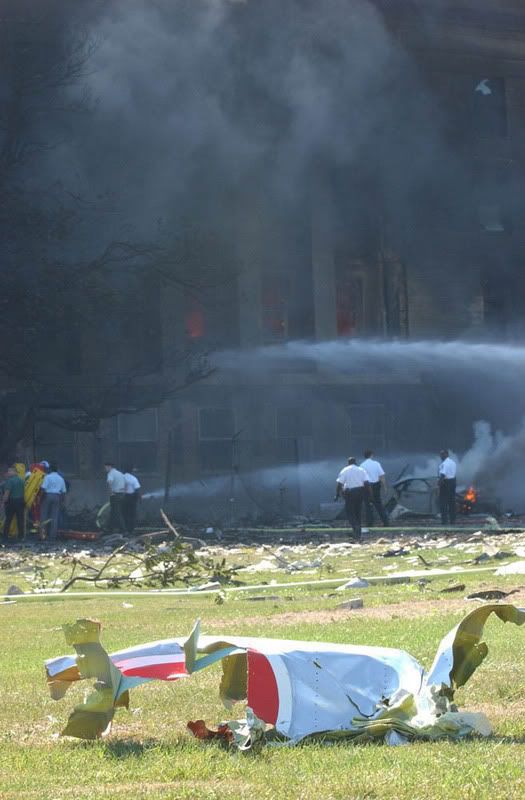
Other no-757 skeptics do raise some relevant questions about the characteristics of the scraps found on the lawn, especially the piece seen above, which is here located to the north (left) of impact, famously captured by Mark Faram. This scrap is clearly from the main chassis, given the red paint generally taken as part of the ‘n’ in “American,” which is painted near the front of the fuselage. Some note the pristine quality of the metal as a clue it was planted. I wouldn’t call this pristine by a long shot, but it does look a bit nice and neat. If they’re right, these scraps may have been planted, but with this inexplicable special effects snafu built in.

The other thing some have noted is that if the main chassis entered the building intact as alleged, and was only blown up, torn up, and burned up as it pierced 300 feet deep, it would be highly odd that such scraps would be outside. It must be noted the tail section also has a giant red "A" on the tailfin, which more than the chassis should be expected outside, but other photos likethe "c" shown below are clearly from the front lettering.

As for the unpainted wings widely cited as "disappearing" upon impact since they weren't found sheared off whole: They would have exploded, as the place the fuel was stored, and been left outside in small peces. The tailfin is more likely to have survived intact, but has not been seen, and may heve blow up into pieces as well in te general explosion. I would look in the field of shiny metal scraps for the possible remains of these silver appendages:


Here are two more shots from the same general area showing three more fuselage sections with parts of an AA paint job. The building in the background on the right is the heliport, where pieces are apparently being gathered and then taken elsewhere by FBI agents for some kind of investigative work.

As to precisely where they were first picked up it’s hard to say. That they would be being fished out of the flaming wreckage inside the building before singeing is clearly not the case – they were obviously outside the building. Were they scraped off by the second floor slab as the cockpit and upper fuselage entered? If so I’d expect deeper crumpling than that.

And yet another aluminum scrap, bearing distinctive airliner-proportioned rivets and an edge of red paint. Russell Pickering noted the “obvious smooth cut trimmed by rivets (at the bottom left) which indicated to me it was on the corner of a door or window.” He located the red paint sans white outline on the big red stripe down the side, and decided it was from the edge of either the forward or aft cargo doors on the right side of the aircraft.” [?] These are on the lower half, and could not be accounted for by the upper part’s collision with the second floor slab. It also seems to have torn off neatly and early on. I have a hypothesis this cleanly torn metal outside the bunker walls may play into, so I’ll end it there with this still a bit of a mystery I need to look into more

So we’ve seen what may well be parts from a Rolls Royce RB 211 engine or engines, landing gear matching a B757’s in size, scale, and design, metal scraps marked like wing, chassis, and/or tail sections from an AA commercial jetliner and we’re down to the scraps. But the HTB people may still be holding out for yet further proof. Indeed, much remains to be seen: The nosecone, cockpit control panels, seats, passengers (or have we seen these?), oxygen masks, box cutters, plane tickets, official American Airlines napkins, etc. And of course all of those can be planted too.