Showing posts with label FEMA. Show all posts

Monday, September 10, 2007

COLUMN 9AA - WARPED BY THE LEFT WING

COLUMN 9AA - WARPED BY THE LEFT WING
Adam Larson / Caustic Logic
The Frustrating Fraud
September 10 2007
last updated 9/11 early am


In assessing the outer column damage upon impact, I had been hazy for a while on the status of column 9aa (aa meaning the outermost position on a column line). It would have been two columns over to the left (north) of the collapsed portion, and officially impacted by Flight 77’s left wing but left intact. In error I had included it as part of the columns-removed area, which I had taken as too wide. This has now been updated. Although I was focused on the right-hand side and didn’t see or wonder about this non-controversial support. It was usually listed as intact though deformed and impaired, and no-planers hadn't made any noises about it I've heard. But finally I have looked into it and found a few early (pre-shoring) photos that show it – barely. Column line 9 is roughly highlighted in each of the below to help locate it


By coincidence, these four shots rotate, zoom out, and clear-up if looked at in sequence. The first, least clear shot is pre-collapse, less than 20 min after impact, seen close and from the left and obscured by smoke. The second view is further out, just after the collapse, and somewhat clearer. The third view is off to the right from behind the smashed generator, with all up-front fire extinguished, and the final view is a long shot from the far right. Note how the curvature of the columns seems to shift with perspective – it bends to the left when seen from the left, appears straight seen straight-on, and curves to the right when seen from that side. This shape consistently indicates in inward bend.


Column 9 is also visible in figure 9 from FEMA’s Shoring Report (above), again seen from the right, post-collapse, post-fire, but pre-shoring. It’s the “damaged column,” one of the many that necessitated the bracing that report documented. Other photos of column 9 in the report, once the wood went up, are taken head-on and show no evident lateral curve. Figure 16 (left) shows the first of the supports being finished the night after the attack, with the space to the right still left hanging.

The close-up photo used in the American Society of Civil Engineers’s 2002 Pentagon Building Performance Report shows a column displaying “triple curvature” (shown from the right). Besides three remnants of its original square-sided casing, the angular concrete is gone, the column “stripped to spiral reinforcements.”

Regarding the evident curve, its clear inward orientation is seen elsewhere in the building with other columns, in what appears to be a bowing by Boeing. The fulcrum of appears to be in its upper portion, about 2/3 of the way up from the foundation. This is presumably the impact point of any type of wing in the area. The ASCE’s report listed the column as “5 to 6 inches out of plumb.” By the photo below, showing the column and its bend in its stabilization period environs, it seems visibly at least that misaligned at the top end in particular, further indicating a high impact.

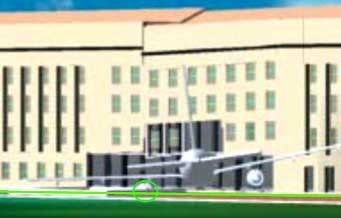
But this graphic used in the ASCE’s report seems to disagree, with the left engine centered just to right of column 11aa with columns 10, 9, and 8aa visible to left. In addition to there being no evidence of the left engine entering well below ground level as shown, the wing crosses low on column 9 in this mock-up, almost certainly too low to have created the bend seen above. It might seem presumptuous of me to question the ASCE's graphic placement, but it seems warranted by this evidence to venture that we have an inaccurate graphic here.

They seem to have placed the right wing correctly given the building damage at that location, but neither the left wing or engine seem marked properly. Perhaps they were trying to avoid an overly-complex explanation as to how the wings could impact at differing angles from each other, and just dropped on an intact 757's profile stretched to account for the angular impact. This is about the same reason I've done the same and am still not explicitly reconciling the wing discrepancy here. But the key to seeing how this is possible is to keep in mind that the plane impacted at such an angle that the right wing/engine and much of the fuselage were scattered inside the building by the time the left wing or tailfin ever touched the facade or outer columns. I intend to post this theory in the near future, but for now, I propose a correction like this:

My green rotation, compared to the ASCE's in red, accounts better for both the column warping seen here and for the lack of an engine burrowed six feet under the floor slab. It does seem the engine was likely low enough to have impacted the building’s foundation, if glancingly, and also possibly just high enough to have cleared the floor. This ambiguity is interesting for another study of Citizens’ Investigative Team's undamaged foundation claims by possibly making their point moot.

Tuesday, August 21, 2007

PUNCH-OUT PAGE {Masterlist}


PUNCH-OUT PAGE {Masterlist}
Adam Larson/Caustic Logic
The Frustrating Fraud
Last updated July 16 2007


It’s long past time I worked out a study of the much-discussed but little-explained “punch-out” hole at the end of the plane’s trajectory through the Pentagon. The official story maintains that the disintegrating 757 plowed in a northeasterly direction clear through the E, D, and C rings of the building, the furthest-reaching elements from the fuselage coming to rest just outside the inside wall of the final ring, and into the open, ground-level service roadway past that – the A-E Drive that runs around the building between C and B rings. Burning debris was ejected with enough force to leave marks on the outer B ring wall, but otherwise stopped in the drive.
Russell Pickering of Pentagonresearch.com, who has studied the issue more than perhaps anyone else, aptly describes this exist wound as “one of the most anomalous features of the Pentagon attack […] absolutely inexplicable in terms of the composite nose of a Boeing 757-200 "punching out" through it," given "curiously little" of any plane parts outside of it. [1] It’s a perfect hole implying strong, evenly applies force and yet no ready sign of just what part of the plane made this and then - apparently - vanished before hitting the next wall.
Here is the earliest photo Pickering could locate of the hole, before any marking were spray-painted and before the debris inside was pulled forward. Note the ground is strewn with scattered bricks and flooded with water from firefighting efforts. [2] Compare this with with the damage to ring B's wall across from it [below], separated only by fifty feet of air; not a brick removed. [3]
Only a few photos of the exit hole have been released, many had seen it, and none have explained it with any useful precision. It has proven a magnet for mystery-mongers and skeptics from across the credibility spectrum.

How exactly the plane's trajectory wound up giving us what we’ve seen is left a bit vague in the official record.
- official "explanations:" confusion/silence over the exact cause of the hole.

- Analysis of the plane debris at and near the site.

- Carlson's backhoe punch-out theory assessed for errors

- Possibility of a purposeful, explosive punch-in

Personally I cannot venture a solid guess as to what happened here. The hole was either cut out with explosives for some reason or somehow caused by the barreling 757, perhaps via debris that was removed before the pictures we’ve seen were taken. I’m certainly open to suggestions. But I have to agree that IF there is a physical crime – an inside job element to the Pentagon attack that can be shown with evidence - this is the most likely spot to look.
---
Sources:
[1] Pickering, Russell. “Exit Hole” Pentagon Research. http://www.pentagonresearch.com/exit.html
[2]. [3] Photo Source: Pentagon Research. Exit Hole Chronology. http://www.pentagonresearch.com/062.html

Monday, August 6, 2007

PUNCH-OUT HOLE “EXPLAINED” BY OFFICIAL ACCOUNTS

PUNCH-OUT HOLE “EXPLAINED” BY OFFICIAL ACCOUNTS
Adam Larson / Caustic Logic
The Frustrating Fraud
July 22 2007
Last updated/edited July 25


Official Dodginess:
How exactly Flight 77's trajectory through the building wound up giving us the exit hole we’ve seen is left a bit vague in the official record. The American Society of Civil Engineers' Pentagon Building Performance Report shows a photo of the hole but gives no adequate explanation. Its terse summary: "there was a hole in the east wall of Ring C, emerging into AE Drive, between column lines 5 and 7 in Wedge 2. The wall failure was approximately 310 ft from where the fuselage of the aircraft entered the west wall of the building," [1] The Arlington County After Action Report noted “the damage extended all the way through the inner wall of the C Ring, a distance of approximately 285 feet,” and showed a photo of the hole captioned “penetration through the inner wall of the Pentagon’s C Ring.” [2] An account of FEMA Urban Search and Rescue shoring/bracing of the building is the most detailed of these three reports. It explains that "a nine foot diameter exit hole was created in the wall of C ring and the remainder of the debris from the impact ended up in the alley between C ring and B ring known as A & E Drive," and elsewhere shows a photo of the "'exit wound' where the plane debris exited the C ring." [3]

These three reports, a few early press conferences, published eyewitness accounts, and a handful of photos constitutes the body of evidence on this hole. While it’s been widely seen and commented on, it has not yet been explained with any useful precision, and contradictory theories dominate to an unsettling degree.

Impact Energy Waves?
In October 2004, the National Geographic Channel program Seconds from Disaster proposed a novel theory by which shockwave pressure from the impact cause the punch-out hole. By this model, plane debris and heavy, exploding jet fuel, perhaps along with explosions of things in the building, gave off shockwaves that reverberated and crossed through the building’s first floor. Having no other exit point, these somehow directed themselves and whatever was in front of them to focus on that precise spot, punching the neat 9x11’ hole we’ve seen. [4] While this explains both the improvised exit and the lack of any major evident airplane parts, the official story has generally maintained it was physically caused by the plane, or some part of it, though which part has been widely contested.

Engine?
Military District of Washington’s news service reported two weeks after the attack, mentioning that “an aircraft engine punched the hole out […] on the inside wall of the second ring of the Pentagon." [5] Though the quote has been widely republished, no other official sources support this claim. No debris seen there looks like engine debris.The piece’s author got the “second ring” part wrong (whether one counts A-E or E-A, C is the third ring), so maybe identifying an engine was an error as well.

Fuselage/Nosecone?
As widely noted, Pentagon renovation spokesman Lee Evey explained implausibly during a September 15 press conference “the nose of the plane just barely broke through the inside of the C ring, so it was extending into A-E Drive a little bit. So that's the extent of penetration of the aircraft." [6] As Killtown wondered “how could the fragile nose of Flight 77 penetrate all the way through 3 reinforced concrete/steel hardened rings and punched out a hole through the inside wall of Ring C and leave no evidence of itself outside the punch-out hole?” [7] This seems unlikely, even given that the “hardened” walls from impact to exit really totaled only 22” of unreinforced brick and limestone [link forthcoming], but spanned between by about fifty damaged support columns and only one plane fuselage to absorb the other end of these blows.

What survived this was not precisely the nose cone, but more likely some element(s) of the nosecone assembly – landing gear, landing gear door, cockpit panel or cargo door – some tattered portion of the forward fuselage. As Jim Hoffman explained, in such an impact, “only the parts of the aircraft with the greatest density and total mass, such as the lower third of the fuselage, could be expected to penetrate far into the building. That part also has a small frontal profile - approximately the size of the punch-out hole.” [8] Of course there is no piece of debris anywhere near the size of the hole seen in any of the available photos, but the illustration is helpful. The fuselage had a lot of mass, tens of tons, and though it was under great stress, it didn’t simply disappear on impact.

Landing Gear?
It stands to reason that as the plane disintegrated, the densest parts of aircraft wound up at the deepest point of penetration. For example, the flight data recorder from the tail end of the plane was reportedly found just inside the punch-out hole. [9] The heavier elements from the front end would also come to rest around this point. The book Debunking 9/11 Myths identified the landing gear. The book cited Paul F. Mlakar, ASCE team leader and lead author of the Performance Report, who “saw the landing gear with his own eyes” during his early onsite inspections, for its explanation that:

“The hole was not made by an engine or the nose of Flight 77 pushing through the building’s interior - or a missile - but by the crashing jet’s landing gear, which was ejected beyond the bulk of the wreckage. […] As one of the heaviest and most dense parts of the plane, the landing gear flew farther than any other item in the wreckage and was responsible for puncturing the wall in Ring C.” [10]

Other photos and accounts seem to back this up by recalling or even showing a wheel, a tire, and even a massive landing gear strut, near the hole. But there are some serious problems with this theory as well, like the ASCE’s own Performance Report not identifying this alleged hole-puncher as such, which noted that "the landing gear" (all three sets?) were in fact found inside the building, hardly the best place to be after exiting through the hole into the AE Drive. [13] These questions will be summarized more fully in a [separate post].

ASCE and FBI Secrecy
Mlakar's ASCE study team “went to great lengths of detail down to individual columns” in the plane’s path, Russell Pickering noted, providing their own photos and personal damage assessment of nearly all of them. Yet they danced around the cause of the punch-out, as Pickering wrote, offering “not a single explanation for the exit hole.” [14] The three columns nearest the breeched wall - 1N-North, 3N-North, and 5N-North - remained un-photographed and listed in the report as “damaged per FBI.” [15] Pickering suspects falsification of the status of these three columns to hide inexplicably severe impairment. [16]

He speculated that “the building team […] weren't allowed back at the exit hole for some reason," and noted how "they indicated in the report why they didn't have photos of those columns and who gave them the damage report on the columns - the FBI.” The one photo they published of the exit hole itself was not one of their own, but also credited to the FBI, further indicating this area had special investigative significance to the bureau, although this could have many possible reasons. [17]photo of the hole used by the ASCE, credited to the FBI (lower right, very small print.) [18]
---
Sources: forthcoming
[1] Mlakar, Paul F., Donald O. Dusenberry, James R. Harris, Gerald Haynes, Long T. Phan, and Mete Sozen. “The Pentagon Building Performance Report.” American Society of Civil Engineers. January 2003. ISBN 0-7844-0638-3. Page 28. PDF download link
[2] Arlington County After-Action Report. on the Response to the September 11 Terrorist Attack on the Pentagon. PDF downloaded from http://www.arlingtonva.us/Departments/Fire/edu/about/FireEduAboutAfterReport.aspx. The report bears no publisher or copyright info – it was compiled by Arlington County and Titan Systems Corporation, and released July 2002 according to this story: Weiger, Pam. “Pentagon report: After-action.” NFPA Journal. Nov/Dec 2002. http://findarticles.com/p/articles/mi_qa3737/is_200211/ai_n9114927/pg_1
[3] Titus, Leo J. Jr., P.E./Virginia Task Force One Urban Search & Rescue Team. “A Review of the Temporary Shoring Used to Stabilize the Pentagon After the Terrorist Attacks of September 11th, 2001.” May 3, 2002. Pages 9, 12. PDF download link: http://www.aesvn.org/resources/Pentagon-Shoring.pdf
[4] Seconds From Disaster – season one episode 12 “Pentagon 9-11.” National Geographic Channel. First Aired October 26 2004 http://en.wikipedia.org/wiki/Seconds_From_Disaster
http://channel.nationalgeographic.com/channel/seconds/episodes.html
[5] Military District of Washington. Press Release. (9/26/01) original url: http://www.mdw.army.mil/news/Commentary-Remembering_the_honored_dead.html. Accessed at: http://www.snopes.com/rumors/pentagon.htm
[6]

Saturday, April 7, 2007

COLUMN CONFUSION - OFFICIAL REPORT DISCREPANCIES

COLUMN CONFUSION: OFFICIAL REPORT DISCREPANCIES
Adam Larson / Caustic Logic
The Frustrating Fraud
Last Updated September 4 2007


It's not just the conspiracy theorists who have a problem identifying present vs. missing support columns in the Pentagon attack aftermath. The official story as well has two schools of thought regarding first floor column status, neiter one correct by my analysis. The American Society of Civil Engineers (ASCE) Pentagon Building Performance Report, looking at first floor damage, sees columns 15, 16, and 17 “severely distorted but still attached at least at their top ends to the second-floor framing.” [1] This is what I originally saw as well, as have most others.

But this is likely incorrect, though it requires a separate post to explain the reasons why I believe these columns were removed and replaced by horizontal elements from above (floor slab, facing, masonry) that on fist blush look like columns but are not.

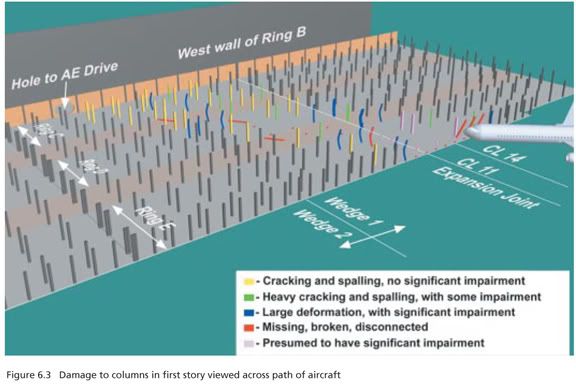
A still from the PBPR, a 3-D model by the ASCE. The three red slants here are the columns 15-17 I have brought into question. The lavender ones are “presumed” to have suffered major or total damage – which means they were in the collapse zone, invisible in early photos, and so unknown. The red pillars are the worst damaged, “missing, broken, disconnected,” elsewhere described as "without remaining function.” Some were entirely knocked loose but found, some were disconnected but standing, and some totally obliterated, here represented by dots on the floor where they were. These red “columns” appear out of place when all those around and behind it are verified or presumed vanished. I suspect this graphic is incorrect by having the three red pillars shown as anything but dots.

Note also that some spaces aren't color-coded at all but left blank. Despite their impressive credentials, no one at ASCE had time to look up close before the collapse, and only so much could be told afterward. In the collapse zone “the team was unable to determine specifically the level and extent of impact damage,” the report notes. Left of the “CL 11/Expansion joint” line such absence was verified by on-site inspection, on the right they probably decided on their assessments by looking at the early photos as seen on this site. The spots left blank were apparently the ones not visible in photos, and so they didn't even venture a guess.

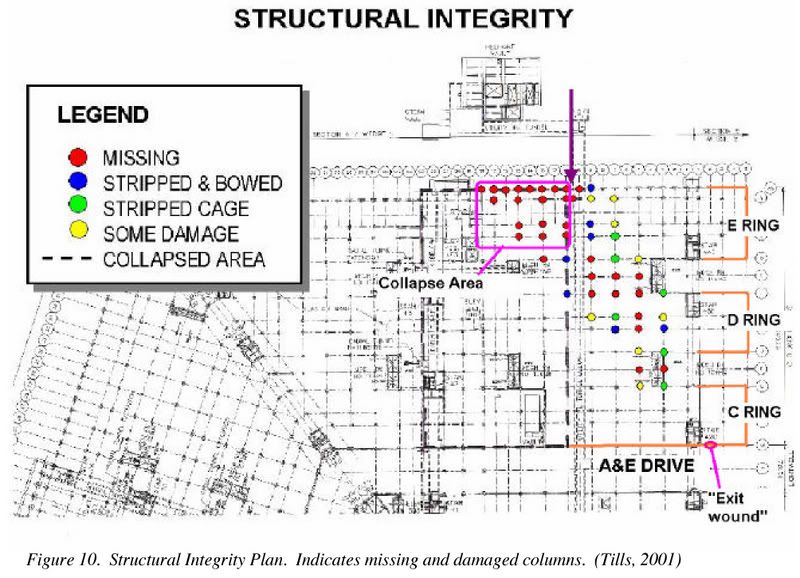
Oddly enough, another, earlier, official report disagrees with these and backs me up on this point. The Pentagon’s own Renovation Program included a slide of “structural damage” for a News Briefing in March 2002. [3] The slide showed columns #15-17, along with the entire outer row between columns 9 and 19 uniformly listed as missing. This graphic is condensed from their original – column numbering was as unreadable on theirs, but the expansion joint on column line 11 was the cut-off line for the collapse area. counting right to left from column 10, we see they have column 18 missing as well, which is odd considering the photos I’ve seen shows that one at least at standing proud even after the collapse.
The same graphic as reproduced in FEMA Urban Search and Rescue's Pentagon Shoring Report.


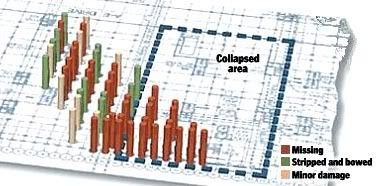
And another, earlier yet report in the Washington Post (9/23/01) employed the graphic above, likewise showing columns 10-17 on the front line listed as "missing," as well as 18 and in this case column 9 as well. This columns was in fact intact (post forthcoming). It seems they've removed two columns I see as standing. Note the other side of their collapse zone is way over there at about column 23, which is clearly not the case - as we see below, colum 18 both marks the cutoff line of the collapse zone and remained standing afterwards.

Here is a montage centered on the damaged expanse between columns 18A and 19A. The first shots are lined up with the ASCE's report of the non-columns 15-17, as well as their identification of #18. All sources agree that CL 23 represented the edge of the 23 column-wide pronounced facade section, so I measured out the area in question before and after the collapse. Note column 18 is standing at all times, though damaged, and 19 remains in good shape.

So one school of official reports thought insist wrongly that columns 15-17 are present and rightly that 18 and 19 are intact, whie the other rightly asserts that columns 15-17 are gone, but wrongly classes columns 9 and/or 18 as missing too. Should it be that hard for any one source get it all right at the same time?

Sources:
[1] American Society of Civil Engineers. “The Pentagon Building Performance Report.” January 2003. PDF version. www.fire.nist.gov/bfrlpubs/build03/PDF/b03017.pdf
[2] http://911research.wtc7.net/pentagon/official/index.html
[3] “Structural Damage (.JPG 77 KB) (020307-D-6570C-008.jpg)” Graphic used for: DoD News Briefing, Thursday, 07 Mar 2002 - 11:00 am http://www.defenselink.mil/news/Mar2002/g020307-D-6570C.html
[4] Washington Post. "Rebuilding the Pentagon." Graphic. Publisheed September 23 2001. http://www.washingtonpost.com/wp-srv/nation/graphics/attack/pentagon_7.html