Tuesday, February 12, 2008

C-130 FLIGHT PATH VIDEO

C-130 FLIGHT PATH VIDEO:
NO CONTRADICTION EXCEPT WITH CIT
Adam Larson / Caustic Logic
The Frustrating Fraud
February 12 2008
update 9/8/08


I posted this at Youtube a wile back, my most ambitious video yet, almost a mini-documentary in itself. I've been hazy on the details of the C-130 at the Pentagon, but now that Citizen Investigation Team is pushing an interpretation of it to bolster their overflight path construct, I felt a need to dig in to the available data to see what truly contradicted what. Craig and Aldo believe pilot Steve O'Brien's verbal accounts contradict the radar data (fraudulent, of course) and support their witness-compilation flight path for 77, as explained at this LCF thread (comments from "Deleted User" are from me - I asked to have my LCF account closed, not realizing how drastic it would look). To understand my reasons for assembling this, it might help to read the CIT link at top and/or this post at my blog. See also this attempted discussion thread at Above Top Secret.com.

This is the result so far: a collage of all the mutually-supporting evidence of where that plane flew and where and how it interacted with Flight 77 on its way to its fate and in its pass near the Pentagon after that. I'm able to incorporate on-the-ground witness accounts, on-site video, radar animation, and O'Brien's own words and gestures, as well as some of Aldo's own spoken words. Nothing in this video contradicts the other parts.

Online Videos by Veoh.com
Page link - Veoh

To understand the video itself, especially regarding its lower-than-hoped resolution, refer to these graphics and additional notes:
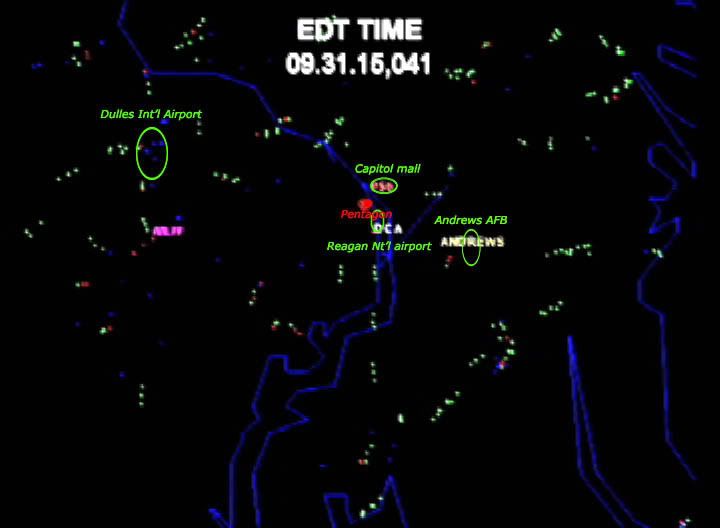
This is the radar screen labeled, which is unreadable in the video. The raw radar data was released to US researcher John Farmer, and this animation created by Italian researcher Marco Bolletino, downloaded from Farmer's AAL77.com.
first frames of Anthony Tribby's amateur video of the post-attack scene, taken almost due south of impact. The smoke has not reached the top of the screen, putting this at somewhere from, say, 10-30 seconds after impact. The "UFO" I think is the C-130 emerges from behind the plume one minute and 45 seconds after this frame. It barely comes through at all in my video, and doesn't even look too good in the higher res original. The frame below is the clearest of the object, zooming in on it as 2:04.

The object is filmed from a moving position in the range shown below, ESE of the impact point, judging by passing landmarks. After being visible for 23 seconds, it disappears again behind the plume. Its overall direction of movement seems to be left-to-right (S-N) at first, curving away and departing along the rough line of sight from there (WNW). The red arc below shows the rough direction of flight, but does not attempt to re-create the exact placement or scale of the flight path. [update: any idiot who takes this as evidence of the location of the plane or the size of the arc is... an idiot. The ANC witnesses are READ as placing it right over the cemetery doing the same curve the radar shows but a few hundred feet off, and that this coincides with my curve here means nothing. I wasn't even trying to decide what it was over.
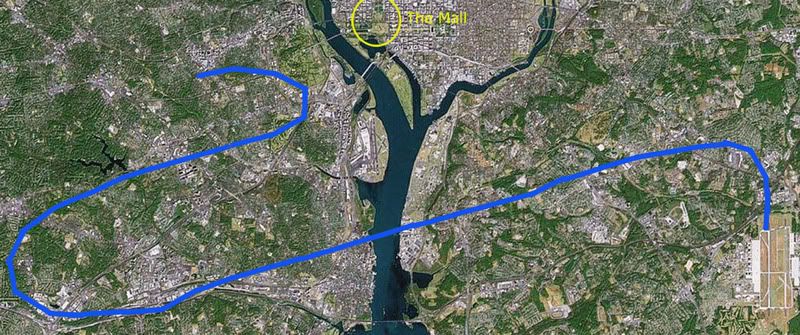
I haven't bothered downloading the special software and figuring out the raw data, but by Bolletino's animation, this is about what radar shows the C-130 doing approximately two minutes after the attack.

The departure from Andrews shown on radar is said by CIT to fatally contradict what O'Brien himself says; he flew "north and west" and had "a beautiful view" of the Capitol Mall as they crossed the Potomac on "the south side of the mall." [see links above] The departure on radar has him taking off north and then nearly west, crossing the river well south of but probably within visual range of the mall. Close enough for me. The departure shown is also a match for one of the standard patterns used at Andrews, the "Camp Springs One" departure. [explained by Boondoggled]

That wasn't even in the video, nor was this bonus, for folks marveling over the mystery plane (left) with lopsided engines captured in a photo from 9/11 and previously passed off as the C-130. Here is that plane compared to a 4-engine C-130. Like a low-resolution mirror.

Sunday, February 10, 2008

SGT BROOKS DRAWS A LINE

SGT BROOKS DRAWS A LINE
Adam Larson / Caustic Logic
The Frustrating Fraud
February 10 2008
edits Feb 11 3pm


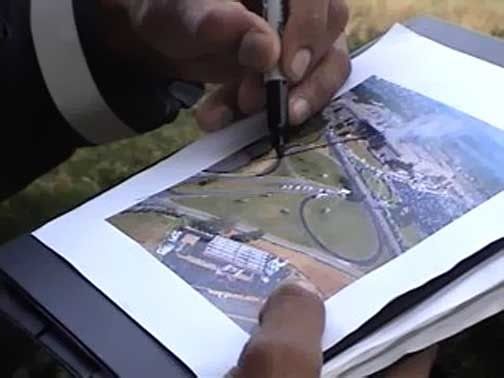
Brooks carefully surveying the scenery before committing his “memory” to paper
The Path He Describes
It was a chilly November morning in Arlington, not long after sunrise, when Defense Protective Services Sgt. Chadwick Brooks met with Craig Ranke of Citizen Investigation Team at the Navy Exchange/former Citgo station just west of the Pentagon. After some initial discussion next to two bright yellow traffic barriers at the station’s northwest corner interviewer Craig Ranke asks Brooks to move the interview to the location he was actually at when he saw “Flight 77” fly over or near the station just 62 months earlier.

At 34:20 in the video they are at the spot, and Ranke has Brooks confirm “this is exactly where you were standing when you got out of the car.” As Ranke later explained for those who take this too literally, “there is no reason to expect Brooks himself to remember the exact parking space," but I think all are in agreement he picked the right general area. "From that vantage point," Ranke feels, "north or south of the Citgo would be clear as day.” Indeed, it would be as clear as left or right.

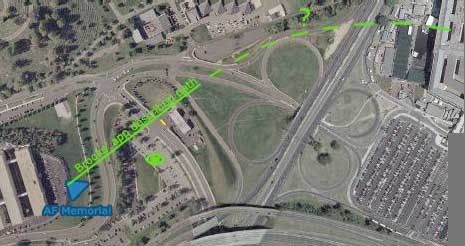
Brooks said at 34:50 “we were able to see everything” indicating the plane coming from above, ahead, and to the right. At right here is the area Brooks first saw the plane passing from, over ("the middle") of some trees at the lot’s west edge. I’ve identified the fork-like structure in that space as an Air Force Memorial just finished before the interview was given.

His path description is fragmentary, but it seems that from over these trees, the plane passed via “the front of the station” over the ‘Jersey barriers’ where the interview started. But Brooks is also clear when questioned that it was not actually over the canopy - or the barriers - but more to the left, and entirely north of the station. “It was going on a straight line, a straight line towards the Pentagon,” he says at one point, and emphasizes again “it was a straight line” on which it “flew directly in front of the building” followed by “a great ball of fire [that] just goes straight up in the air.”

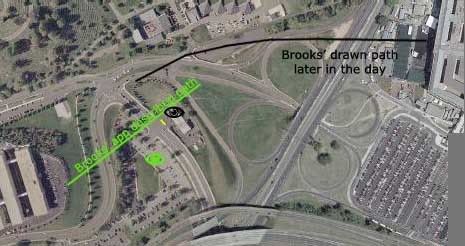
So he describes a straight path that came over the trees and the barrier, visual clues he recalls and has now had a chance to see, that takes it just north of the north canopy. Therefore his path described is something quite like this:

Note that a straight line between those points comes nowhere near matching a straight line to the impact point; a severe right turn would be required. In comparison, Lagasse's path originated further north and took a much straighter line to the impact/flyover point. This is shown in the video after Brooks’ description but before Brooks drew his own path. I had to re-construct this one from the video interview, since he wasn’t asked to draw out this path right after he described it. When asked by Loose Change Forum member bileduct, Ranke explained “I simply forgot to get him to draw the flight path” at that time, which is perhaps understandable, with so many aspects to keep track of when doing this kind of work.

Back But with a Sharpie
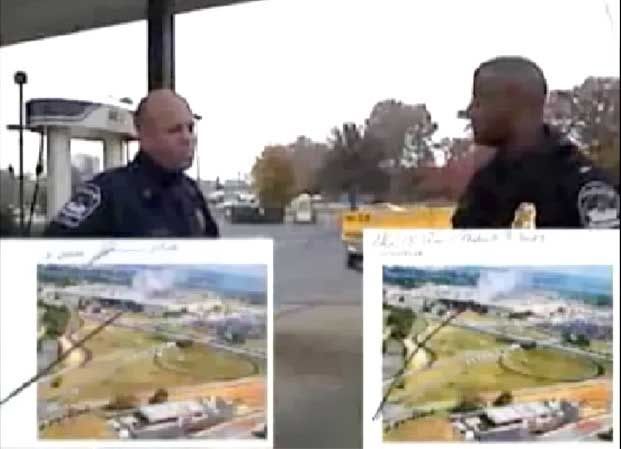
Luckily, however, Ranke “had both officers [Brooks and Lagasse] booked on the same morning.” So after Brooks finished and left, he interviewed Lagasse, and apparently seeing his flight path reminded him; “after Lagasse's interview I realized that I forgot to ask Brooks to draw the flight path and called him on his cell phone. He agreed to come back and draw it so Lagasse stuck around to see what he would draw out of pure curiosity. That is what led to the segment with both of them.” [source] Some might wonder if this dynamic introduced some distortion to Brooks’ second recollection. “I suppose I should have taken Brooks across the street again,” Craig confessed, “but to be honest it didn't cross my mind as I knew he had already explained in detail how he saw the plane on the north side.” So he stayed on with Lagasse watching nearby.

At 58:43 in the video Brooks is back, pad in hand, under the north canopy again. Craig announces “okay, Sgt. Brooks is gonna draw for me on the image where he saw the plane fly.” As the subject faces north and scans left right perhaps over-much, Ranke explains “now he’s trying to assess the area again, recollect where he saw it, and then draw right there on that piece of paper for me.” At 59:07 Brooks decides he’s not in the right spot to draw it and walks north, with Craig commenting “he’s going over here to the north side from where he remembers it flying.” The camera follows with a calming “no pressure, no pressure.” and films the drawing action. Funky music fades in oddly repeating the word “time,” as Ranke urges the Sgt. To “make that nice and thick for me.”
At about 1:01:30, Sgt. Lagasse walks over and peeks at it, and exclaims

Lagasse: “That's damn near perfect from what I saw. And we've never -- for the record we never talked to each other about this.”
Brooks: “Yeah, for the record, we never -- we've never discussed it at all.”
Ranke: “So you guys, neither of you guys have really talked about this with each other? Never in all these five years, and you both independently drew the flight path line pretty much exact.”
Lagasse: “I know, I was -- the way this has been going -- who knew what he was going to put down there because he was in a different location. But it's right there, which makes me feel good about the way I remembered it.”
Ranke: “So you're both pretty much 100% certain that that's what you remember the flight path being?”
Brooks: “But from different locations, yes.”

About a minute later they both chuckle strangely when asked if there was any chance it was south of the station. Of course not; however it happened, they both drew the same flight path, so it’s pretty well 100% proven. “Again,” Brooks affirms, “we never discussed this, that’s what I seen with my own eyes [...] "I know what I've seen with my own eyes. I know I was here, and I don't have to go around saying I was here.”

LCF member Bileduct (who was banned right after me) asked Ranke, after confirming the original described path and comparing it to the later drawn one, “is it fair to say that there is an inconsistency with what Sgt Brooks said he saw, and what he drew?” “No,” Ranke responded, “unless you expect humans to be computers. They only need to be correct about the approximate placement of the plane and this is all we should expect them to be correct about.” As Craig pointed out “You can't forget how these guys are all at the Navy Exchange/former citgo EVERY DAY […] They know the area.” So he happened to draw Lagasse’s flight path despite his own recalled memory and a visual review of an area he’s very familiar with, and CIT somehow feels this makes the discrepancy less suspicious.

An Ace or a Joker?
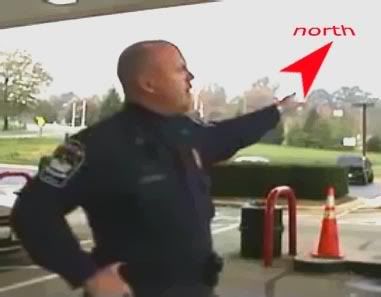
The chuckles might be telling; Brooks’ account Is studded with clues the he might just be having fun with these guys. While discussing the altitude, he directs Ranke’s view to the left; “you see where that telephone pole is?” pointing. The camera follows and zooms in expectantly just before he yoinks the point, saying “it was up higher – it was up way higher than that. It was just – it was just unbelievable.” Sounding confused and with muted disappointment, Ranke responds “oh, okay.” At another time, he points to “the Pentagon, which is currently located over there.” Not so much ha-ha funny is where, while facing west, he indicates a flight path to his right, or north, whereas his previous account from 2001 had the plane coming up on his left. This means either a south of the Citgo path, or a 2006 interview done with him standing backwards in the scene, switching his directions to compensate. This is silly witness behavior; he may as well have been wearing his uniform backwards to flesh out the discrepancy.

But perhaps the biggest prank of them all, one with once fatal-seeming implications, has been brilliantly capitalized on by CIT. He described a “United Airlines” 737, with blue lettering on a white (actually ‘champagne’) paint job. United didn’t even use a blue-on-white standard until 2004, at the time using white letters on gray and dark blue. It almost seems Brooks did a quick Google image search just before the 2006 interview in order to yank his interviewers around, or to sabotage his account. Brooks at first seemed the odd man out compared to Lagasse’s clear description of a silver AA 757 with red letters, matching the most the widely reported clues, Turcios’ gray then silver plane with unsure markings, and Paik’s ‘black wings’ seen from below. Obviously he didn’t really see a UA plane, but CIT later turned the tables, making Brooks’ account a pivotal point of the ‘white plane’ construct, which they feel is pretty well proven. He saw a white drone airliner with a single blue stripe, and simply morphed it in his memory to something familiar. Now this leaves Lagasse’s, Turcios’, and Paik’s descriptions - and much of the rest of the body of evidence - the odd men out.

Likewise, it can’t be ruled out that Brooks was simply amusing himself when he later told the Citizen researchers that their documentary based on his testimony was an “eye-opener.” I’ve still not seen the direct quote from Brooks to this effect, but am relying on CIT’s insistence, first aired when Aldo Marquis asked Arabesque at the LCF on August 9 2007 “did you know that Sgt. Brooks already said our film was an "eye-opener" and "anything is possible" when it came to him being fooled? […] He said it was possible he was fooled, are you saying that you know for a fact that he wasn't?” [source] He repeated the same paragraph word-for-word in the same forum two days later, and Craig pasted it another two days later at JREF, again repeating Aldo’s awkward sentences; “is it possible he missed the impact because he too went to radio it in. Did Sgt. Brooks detail the impact? Or did he say "and what seemed to be a quick second the plane went in front of the building and a big boom, fireball explosion went off.". He said it was possible he was fooled, are you saying that you know for a fact that he wasn't?”

Sure, anything is possible, including that he was fooled by the fakery. It's also at least as possible that he saw what actually happened and rather than being fooled, was just fooling around when he talked to the camera in 2006.

THE LADIES OF 13th AND POE

CIT WITNESS VERIFICATION PART II: THE LADIES OF 13th AND POE
Adam Larson / Caustic Logic
The Frustrating Fraud
February 3 2008
update 2/11 2am


Note: Thanks to LCF member bileduct for starting me seeing these patterns. This here is the “Convoluted manipulative disinfo” version of the article, which explains all my points adequately. For those with less patience, see also my “despicable scumbag” summary version.

Northern Redezvous / Southern Anchor
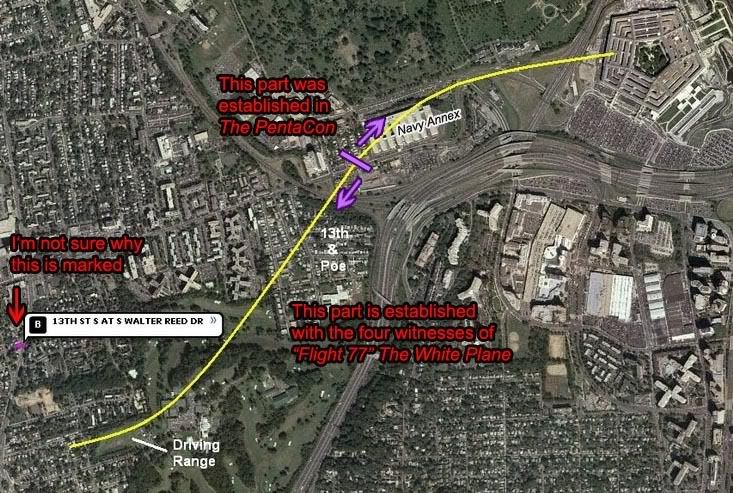
Craig Ranke, the argumentative co-founder of Citizen Investigation Team (CIT) announced back on December 10 2007 the release of their new video "Flight 77" The White Plane: “CIT further exposes the mainstream media cover-up with this extremely important new 37 minute short revealing what the people of Arlington REALLY saw on 9/11.” [source] Their early 2007 video The PentaCon had already set the damning flight path from the Pentagon, north of the Citgo, and back to the Navy Annex (see graphic below). This follow up is centered on four witnesses further back along the flight path, and their main finding, as the title implies, is that “the plane people saw tree top level over Arlington timed perfectly with the explosion at the Pentagon was white.” They speak of a “media cover-up of this white jet” to be confused with and erased by the E4B that circled the capitol shortly afterwards. [source] The PentaCon witnesses had disagreed on the color but that didn’t matter; it was all about the flight path then. Now that four people used the word 'white,' this is reported as the most significant aspect and the flight path clues are ignored. For this reason I will first, in this piece, ignore the color issue and focus on what CIT has downplayed – what the plane was remembere to have actually done with its whiteness, according to these witnesses.

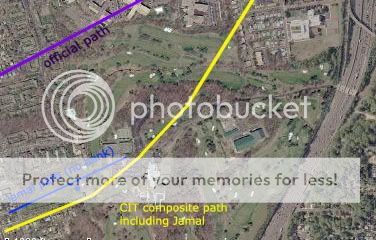
This new eyewitness data, in addition to the old, gave CIT as an inescapable reality this yellow swerve (red labels and arrows mine), what Craig has elsewhere described as “the flight path that has been getting established for us by the people of Arlington.” While the curves are extreme for an aircraft that size, I’d guess this path is entirely possible for a 757. However I cannot visualize it happening without two very sharp turns with accompanying steep wing banks - one turn left, with right wing pointed up towards the sun, a rapid leveling and straightening on a more northerly heading, then an even sharper turn to the right, during which its right wing would need to be dipped quite low over the Navy Annex. Keep this in mind when looking at this as it has been re-created in the graphics below, yellow each time. The southern portion of this path, from the Navy Annex down, is what The White Plane and its witnesses are said to illustrate.

Here is the video itself for reference: If you want to watch the whole thing, I recommend reading this full piece first.

The White Plane begins with Jamal El Kournayti, a caddy or something at the Army Navy Country Club on 9/11; as narrator A. Marquis puts it, “Jamal’s account gives us a strong starting point for our flight path.” This it does, by placing the plane well south of the previous accounts, which might seem ironic, since their original path was north of the official one. But this is also the only account of the four that, on its own considered merits, even seems to contradict the official path. El Kournayti's is the most specifically illustrated stretch, referenced to specific trees at either end of the range, which he says the plane flew directly over. The path and location they draw for their video is accurate to what El Kournayti describes and is the better part of a half-mile off the ‘official path,’ but with about the same heading.
So if we’re starting out well south of the North-of-Citgo path, the attack plane had to connect to PentaCon witness Edward Paik, at the west end of the Navy Annex NNE of the end of the driving range. Both men would be near the hinge points where heading changed and should have reported a turn or at least the accompanying bank. However Paik was never asked about any turn, and gave clues only indicating a straight path. Likewise El Kournayti is never asked about and never mentions any bank of the wings or turn in the flight path. His gestures indicate a straight sweep across the sky on a bearing I map out at approximately 65°. So somewhere between Jamal and Edward the plane would need to shift to the north and do all its remarkable turning, banking, and leveling; it’s clear at this point that a lot was riding on the witnesses of south Arlington who occupied that span.

Canvassing / Mrs. Hubbard
In between Jamal and Edward there were neighborhoods to screen for “additional previously unknown witnesses,” neighborhoods like the one they call 13th and Poe, which is probably what the locals call it too, since it has such an uncanny – if unlucky - ring to it. Canvassing the few long streets of this mini-borough Nestled between I-395 and Washington Blvd, south of the Navy Annex, and north of Hoffman Boston Elementary School, Ranke found it, “painfully clear that the people on the street report something different than the suspect witness accounts reported by the mainstream media.” The PentaCon’s four North-of-Citgo witnesses had their four flight paths, hand drawn over aerial images of the attack; here again we have four witnesses but oddly not a single drawn flight path among them. Craig explained to me “I didn't have images prepared for people I did not know I would randomly find from canvassing. Only for the pre-arranged interviews.” Granted, aerial long-views of every possible POV cannot be prepared, but a satellite map the witness could read relative to their view might work. Something could have, should have, been improvised to get some graphic confirmation. And wouldn’t you know it… Jamal and then at least three new witnesses found and interviewed around 13th and Poe, all supporting the logical extension of their previous groundbreaking findings we’re told, but not a pen-stroke of that good stuff to show for it.

The first witness presented after Jamal is Mrs. Hubbard, who was interviewed on the porch of her home on the west side of S Poe st just off 13th. Ranke did confirm for me that her window points on Poe street, which would offer a view to the east. Not only is there no flight path drawn by her, but no visual clues shared whatsoever; she declined to be videotaped and talks unseen, mentioning ‘numerous clues indicating some flight path:

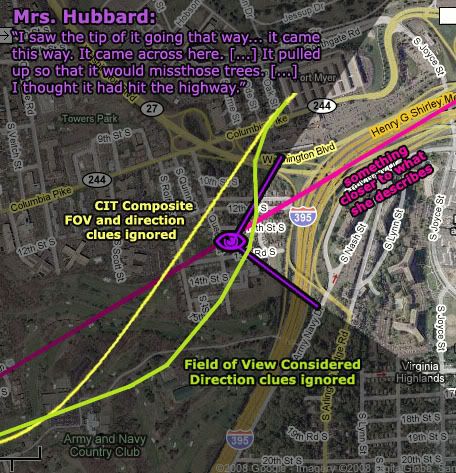
“It came right between these two houses […] I saw the tip of it going that way [...] It came this way. It came across here. And it went between the house with the gray roof […] and the big house. It pulled up so that it would miss those trees and then the next thing I saw was the puff of smoke.”

Which houses? Which trees? I’ve scanned satellite photos for what she might mean but don’t feel comfortable settling on a path and with CIT being and helpful as they have with their verification, the best I have to go on is the facts that she saw it, and “I thought it had hit the highway,” meaning the raised curving portion of I-395 northeast of her east-facing den window. But CIT’s yellow composite squiggle passes entirely behind her house and out of view. She’s included as a witness to this path’s middle stretch, but for Mrs. Hubbard to have actually seen this path, it would have to curve at least somewhat to the east of her den window, then almost due north to the corner of the Navy Annex, complicating the required turn to the right to rendezvous with Ed Paik’s line. I think I know why they fudged it back behind her, (see below) but it’s just fudging, CIT would say, and probably not a sign that she’s a plant. She clearly, literally “saw the "tail" of the plane,” Craig explains, “headed towards Edward Paik coming from Jamal.” In reality, she never mentioned either man in her account and it’s not even clear if the three know each other.

Before we can go any further then we must revise the middle portion – to pass in front of her house, which will in turn effect the remaining two witnesses. To connect the accounts of El Kourtayni and Paik while offering Hubbard a view, it would have to fly a bit further east than CIT shows, then turn near north, a heading of about 15-20° from true north, running entirely parallel to I-395. While her directional clues are still vague, I would offer the magenta line as at least better fitted to her thinking it crashed into the freeway somewhere in the distance. This is very different from what CIT decided she saw, even once it’s adjusted to be possible.


The Cousins With A Bathroom View

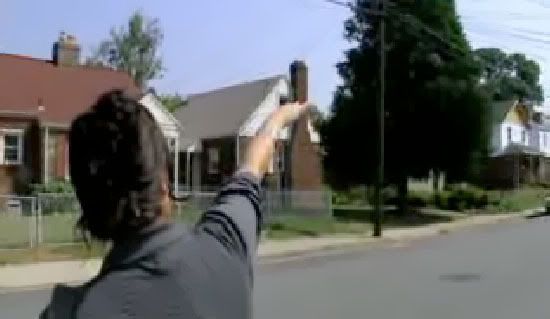
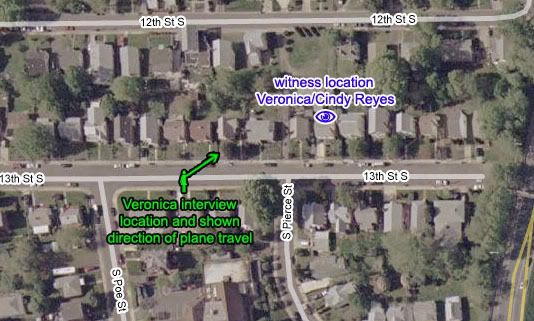
Veronica (first name only) was interviewed apparently in the August 2006 elite research foray, since Russell Pickering is visible and actually doing most of the questioning. She seems to be standing on 13th street, between S Poe and S Pierce streets, facing north and away from the camera for her entire interview. The segment starts out with her pointing out the plane’s flight path, having been apparently asked about it right before. She also points about the same direction to her location at the time, her cousin’s house on the north side of the street, from a window in the back facing north. “We were at my cousin’s house over here; she’s got a window in the back ‘cause she was in the bathroom,” Veronica explained. This makes it sound as if she herself didn’t see it, but was merely passing along her cousin’s account. But the rest of her account makes it indeed seem that she herself, if unclearly, saw "the white go by." However she learned of it, she seems pretty sure of the plane’s general trajectory, her repeated arm gestures clearly indicating east-northeast, inconsistent with CIT’s yellow composite path and far inconsistent with my corrected yellow-green path from east of Mrs. Hubbard’s window. She also describes no kind of turn or associated wing bank of a plane swooping north and arcing east over the Navy Annex, repeatedly tracing a straight line across the sky, the only conclusive visual clue offered by any of the ladies of 13th and Poe that actually got through to the viewers of The White Plane.
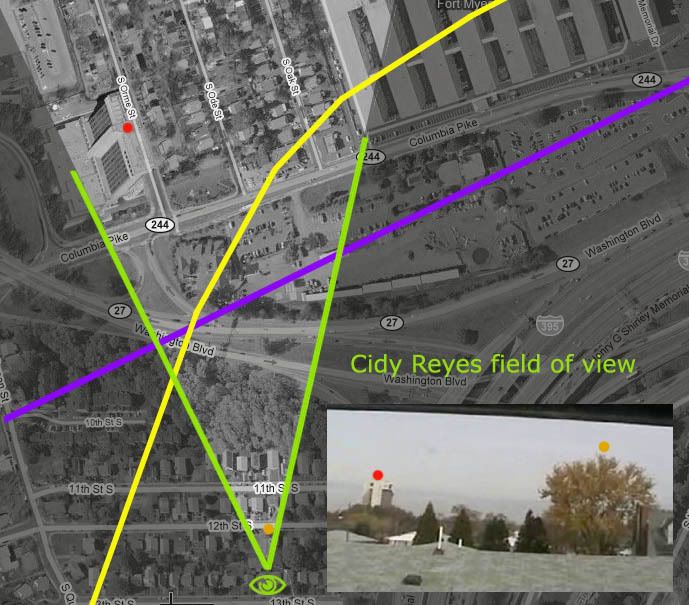
All this is ignored by CIT, and Veronica’s account is used primarily to corroborate the plane as white, and as an introduction to her cousin, Cindy Reyes, “who got a better look at the airplane” and did an even better job with setting the color trend. Reyes showed her face and spoke candidly after letting the interviewers in to stand in her bathroom and see what her view was like, a panoramic one looking almost due north, revealing the Sheraton hotel in the distance and the Navy Annex just out of view to the northeast. Her descriptions and gestures against that window indicate a descent to what seemed treetop level. For its lateral direction, she gestures from left to right, but it’s unclear if she’s trying to indicate three-dimensional movement, or just tracing across the window pane like one might a TV screen. There is some obvious confusion in the interview about left vs. behind (her left then or their behind now?), which leaves her directional and perspective clues vague.

When challenged, CIT has refused to draw the path they think she saw on a map anywhere, so I decided to try my own from clues she freely offered. There was a predominantly left-right (west-to-east) motion, but it was not purely seen from the side but “at an angle.” I’d like to emphasize an angle, as in singular. Nowhere does she mention or is she asked about seeing any change of angle, any turn of the airplane. Whether they knew it at the time or not, this is the spot where it would have to turn sharply to a more easterly heading. And of course such a sharp turn, coming in from Mrs. Hubbard’s FoV, would require a pronounced wing bank, which she also does not mention and is not asked about.

In attempting a guess of her flight path, remember that she and Veronica supposedly saw the same thing from about the same location, and that Veronica’s gestures seemed to indicate ENE. Both paths in the graphic above agree on general distance from the window, but angle and turn are in question. This double-corroborated testimony of Cindy and Veronica seems to more strongly support the purple line, which is in fact the precise “official path” of Flight 77, or something quite similar.

Constructing the Flight Path
Among the 13th and Poe witnesses there are clearly no direct clues for the middle stretch of the yellow CIT squiggle, and in fact some serious points against it. The Citizen Investigators tacitly admit this in discussions by downplaying flight path evidence altogether. After the revolutionary flight path up north, it's all about the color and the location of - something. The issue of plane direction is clearly back-burner now:

“We KNOW that none of their accounts are perfect. […] They only need to be approximately correct. […] there is no need to determine the exact placement of the plane or a flight path at all. […] It is unreasonable to suggest that it is even possible to determine the exact placement of the plane from witness statements.” [source]

Craig in fact started a whole new thread at the new LCF in response to this piece, titled "No witness can accurately depict a flight path (The plane moved too fast)." This is a bad sign; they never admit something if there isn’t a way to twist it into appearing to support the thesis. Instead they fall back on presenting false dichotomies, like this one, that are getting falser the deeper I look:

“If you believe the official story you have to accept that virtually all of them are completely lying. […] So do you trust real people or do you trust the government? Is it more likely that they have a reasonable margin of error in their accounts or is it more likely that they are all completely lying and that the drastically different official story is true? That is pretty much your choice here.” [source - emph mine]

Clearly CIT doesn’t trust ‘their own’ people, taking the approach to flight path construction of “Draw a line from where Jamal saw the plane to where the citgo witnesses saw the plane. […] That's what we did. That is scientific, logical, and the most accurate way to interpret this data.” So long as both placements are truly accurate and there’s supporting data in between, or at least no contradictory facts, this is certainly true. Unfortunately that is not the case here.

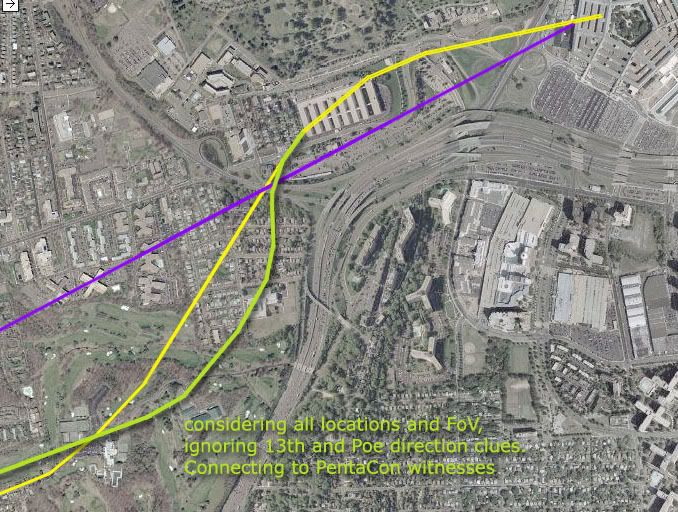
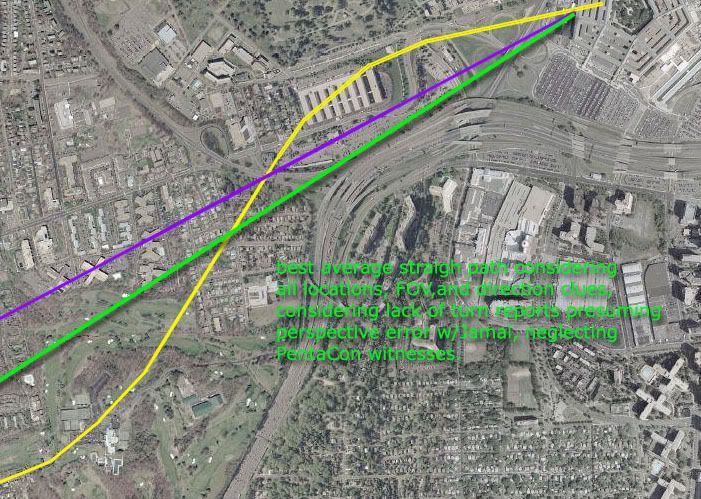
The explanation was also a challenge; “draw a line from where Jamal saw the plane to where the citgo witnesses saw the plane. […] Think of all of their placements as being approximate and create the best estimation you can using ALL of their accounts. Go ahead, do it and show me what you come up with.” Okay so here are some versions: CIT’s scientifical yellow swerve and the ‘official’ path, more or less, in purple for reference in each: and my readings of the White Plane witnesses read with three different sets of assumptions explained on each:


”Flight 77” The White Plane”, an “extremely important “ video “revealing what the people of Arlington REALLY saw on 9/11.” Hardly. As Asshole Marquis recently asked a fellow LCF member, and as I now deflect back to them:

“Are you so sick and demented that [the Ladies of 13th and Poe] are just values in a logic equation? Do they represent actual witnesses and human beings who are scared about what they saw or are they just names and statements that you can play circle games with because you think you understand "logic"?”

Friday, February 8, 2008

RIGHT WING DAMAGE CONTINUITY

RIGHT WING DAMAGE CONTINUITY
Adam Larson / Caustic Logic
The Frustrating Fraud
February 10 2008


Citizen Investigative Team’s number one claim to fame is of course their trailblazing eyewitness account verification, proving a north-of-the-Citgo flyover of the Pentagon. But garnering less attention is their groundbreaking work on exploring the ‘smoking gun’ physical evidence there was no impact from any airliner. Besides the witnesses, and before they were known of at all, CIT felt they had a strong anti-crash case, based on research into the ‘anomolous’ physical evidence at the site of the anomalous (alleged) impact of a 757 into the Pentagon.

Among the prime points they have made and that I’ve so far addressed is the presence of Column 14AA on the second floor, and the lack of foundation damage. The next claim I will examine and answer to the best of my ability is “why is there no continuity to the "wing damage" when it tilted up its right wing? It looks as if the facade simply fell off in this section.” This question was posted along with the two above and several others at Above Top Secret.com, and illustrated with these two high-res Jason Ingersoll photos:
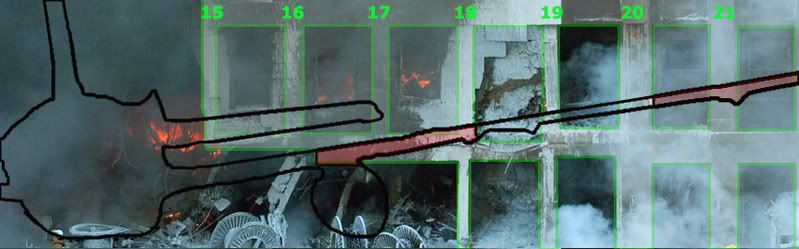
The area shown here is just south of the main impact hole, the first and second floors of the section just upgraded to withstand bomb blasts. In the middle span there is much visible damage: a windowless panel recently backed with 10” of steel-reinforce concrete, intact but missing most facing and partially scooped-out. Perhaps most odd is another panel of presumably the same type right below it entirely gone, along with two weaker window/door panels just to the right of these. Some limestone facing is removed from the frame to the right of that, but at the left and right are areas of little or no visible damage, labeled in red “no wing.” On first blush this might seem like pretty anomalous damage, considering the alleged wing impact angle (see below); put simply, there’s too much damage on the first floor, and apparently not enough on the second.

The photo below is overlaid with a light grid representing the intact structural frame. Intact panels within the grid are lightened as well, whereas removed or intensely damaged panels are left un-tinted. The partial plane outline is based on the ASCE’s graphics, layered to scale and outlined. Areas shaded red are where the problem is, those marked ‘no wing’ above.
Considering how much continuity of damage there should be, we need to consider many factors, like these:
1) The strength of the wing at various point in optimal conditions
2) Actual wings strength/integrity after impacting light poles, generator, etc.
3) The mass and speed behind the wing (with the fuselage already shredding inside)
4) By the alleged impact angle, the entire right wing would have impacted near-simultaneously
4) Portions of the building impacted – horizontal resistance (floor slab) vs. vertical resistance (columns, wall panels, windows)
5) The possibility of other projectiles (cargo trailers, equipment, etc) and/or the deflagration plume of a pre-impact wing explosion contributing to the extra damage on the ground floor.

Considering these, one red area is near the wing’s mid-point just over and south of the engine. This is a very strong part of the wing, but it met the floor slab at a shallow angle – near parallel - with at least ten feet of it hitting edgewise either the slab or the very bases of the columns anchored to it above. At this point, the building wins and shows no immediately visible scars. The other problem area is nearer the wing’s tip, a weaker point, meeting ordinary columns and façade, if the outer wing was even still attached at that point. The wall south of CL 20 shows nary a sign of impact, so apparently building wins there as well, which somehow doesn’t surprise me.

But further in on the wing, which was after all attached to a barreling 90-ton jetliner at about 460 kts, there should have been some instant damage to the frame. Countering this CIT point at the forums, I’ve previously used the following two images of the damaged panel between columns 18 and 19, cropped from Jocelyn Agustino hish-res photos taken – yes, I’m aware - about a week after the event: The missing brick has a linear edge with a certain slope relative to horizontal. The concrete backing damage has its own similar overall slope. The slab and column damage as well exhibit a similar but shallower slope. The damage is manifested at different heights due to the nature of the materials, their order in layering, etc., but all share a moderate right-high slope that is consistent with the alleged wing tilt of the 757 at impact.
Seen from something of a side view, as above, it’s clearly visible that the columns are disjointed, with the upper floor’s lower ends apparently buckled inward, or the lower ones outward, it’s not entirely clear. Referring to this area of damage, the ASCE’s Pentagon Building Performance Report noted:

“Just above the second-floor slab, the exterior columns on column lines 18 and 19 exhibited aligning gashes that seem to indicate impact by the right wing of the aircraft [...] An area of broken limestone of the facade over the exterior column on column line 20 also aligned with these gashes.” [p 27/28 - emph mine]

Referring to these photos presented as evidence, and apparently missing the majority of information in them, Ranke said “the damage does NOT match a "wing". […] A single broken column does not match a "wing" and does not have to have been fabricated on purpose to match a wing.” He decided I was “incorrectly or deceptively trying to attribute damage to the "plane" that did not exist immediately after the violent event,” rather than to the collapse or some other later event. [source]

In fact, noting the lack of all this damage visible before the collapse, I attribute it to a chain of events unlocked by the plane’s impact. Let’s look at a different kind of continuity of wing damage - continuity through time. At impact the initial damage would be done in a tiny fraction of a second. Some of this – the missing and damaged panels - was externally visible. There would also be damage, especially along the stronger frame, that would be internal and less visible.

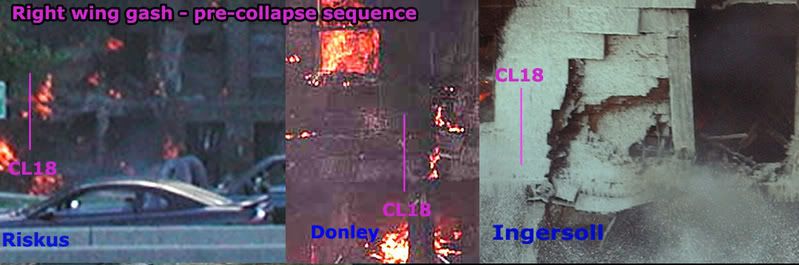
Considering both obvious and possibly latent damage, let’s look at a sequence of pictures from the morning of 9/11, at different points between 9:38 and 10:15 or so. In Steve Riskus’ photo at left, taken about one minute after impact, CL18 is framed by magenta markers and a line of fire just to its right. This long-shot is too unclear on its own, but compared to the Darryl Donley photo at center and taken at least five minutes after, it shows a flaming seam at its far right that matches, if more dimly. The Ingersoll shot at right was taken several minutes later and after a coating of fire retardant foam. While the facing is broken fairly clean on the column edge, the “no plane” damage area to the left of that remains unchanged; the column and its facing remain - counter-intuitively - intact.

At lower left in the top photo below, note a major crack in the horizontal frame just to the left of column 18. I speculate that at this point, the area there is holding together by weight and habit, but ready to shear, crumble, and scatter along the fault lines introduced by the big thud at 9:38, waiting for a further violent event to trigger the fractures into rifts.
Then the collapse, immediately after which the bottom shot was taken. The facing around the damaged panel has fallen away, but the brick and concrete backing remain about the same. Below that, something has left the whole corner of the frame above and left of column 18 missing, presumably in the pile large of rubble that formed at the foot of the collapsed zone. Perhaps it was some massive pressure that has stripped away the top of that column, exposing re-bar. Although the separation came after the collapse, the point of give is right about there in the red zone of ‘no plane damage.’ And I’m pretty sure column 19 on the right also shows its later damage at this point, and even before collapse, though that’s less clear. Coincidence? If there was no continuity of wing damage, then why is there no continuity of the column here?


Referring to Augustino's post-shoring photos of the alleged wing gash, Ranke told Above Top Secret.com member Dark Blue Sky, in no uncertain terms:

“You can't use a post collapse photo if you are trying to assert it was from the alleged impact. Catherder used the same image for the same reason and it's deceived many 10's of thousands of people. Please don't help. There is nothing possible about the damage to the Pentagon in relation to a 757 impact.” [source]

Referring to a blurrier version of the bottom post-collapse shot above that clearly shows the breach of column 18, Ranke furter explained “it's quite clear that even after the collapse the left column was not completely breeched as it was after supports were added days later.” [source] Wrong. It might have been worse by the time of Augustino's photos, but it could only be less clear here due to being a head-on shot. The top of the column’s casing is gone, the corner of the frame is gone, lengths of rebar are exposed, and column 19 seems to have its damage as well, visible even before the collapse.

In summary then, all things considered, the answer to CIT’s original question is that there is about as much continuity to the right wing damage as there should be, which is little that was plainly visible after impact, but more that revealed itself after the collapse. And again I'm only left wondering if they really misread the evidence this wrong or are just pretending to have done so.

WILLIAM LAGASSE, 2001

WILLIAM LAGASSE, 2001
Adam Larson / Caustic Logic
The Frustrating Fraud
February 8 2008 11pm


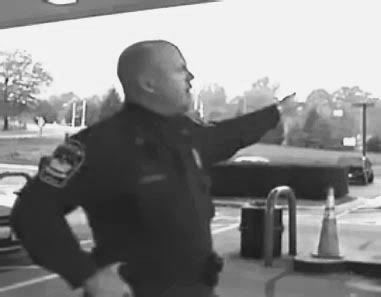
My recent analysis of Chad Brooks’ 2001 Library of Congress interview, in the spirit of fairness, deserves a counterpart analysis for Sgt. William Lagasse. Both officers who would later agree on a north-of-the-Citgo flight path were also audio-taped for the LoC about their experiences in late 2001; Lagasse’s eight-minute-long account was recorded on December 4, about two weeks after Brooks’. [MP3 Listen/Download Link] Like Brooks, he gave the same basic location he did for his videotaped 2006 interview: “I was refueling my police cruiser at the Barracks K gas station,” also known as the Citgo and the Navy Exchange, “approximately 1/8 of a mile from the heliport side of the Pentagon.” But unlike Brooks, whose 2001/06 accounts seem to conflict, Lagasse seems probably consistent on the core point of the plane’s placement relative to the station.

At 4:42 he describes his sense of security as largely unchanged by the attack: “We all kind of knew that something like that was going to happen eventually. […] we knew there was a potential for an aircraft to hit the building,” he said, and added “I’ve never felt entirely safe at the building because it is such a target.” A skeptic might wonder if this previous talk about inevitable plane impacts helped condition him to see an impact instead of the flyover that would have to happen if it were north of the Citgo. But he is and always has been a clear impact witness: “The image of the airplane flying into the building has not ever left me.”

He describes briefly helping people out of construction area before he pulled back due to the smoke, and with his supervisor began a “methodical search and recovery of evidence from the aircraft.” He apparently didn’t think the debris seemed planted in any way. Oddly, at 7:18 he said “I remember being on the scene and seeing a chunk of the plane that just said “Ameri” on it.” This doesn’t sound familiar from the photos I’ve seen from as early as one minute after the crash. He also said “I remember seeing the light poles that the plane hit. That knocked it down. It’s absolutely surreal.” Indeed, especially considering he saw them on location, and in 2006 had shifted the location he remembers seeing them – and Lloyd’s taxi – to a point further north to match the flight path he was giving then.

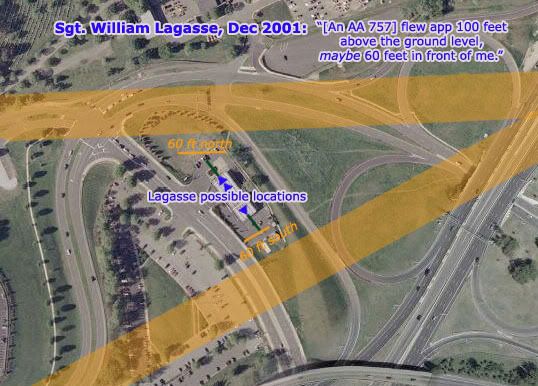
And what flight path did he imply in 2001? It was a beautiful, clear day. He was standing outside his car with a great view, filling the tank. At first he didn't hear anything, but watched as "an American Airlines 757 flew approximately 100 feet above the ground level maybe 60 feet in front of me.” That’s as specific as it gets. The interview alone is inconclusive and vague and on its own it can’t tell us much. With pumps on both ends of the station, if we didn’t know which way he was facing, we’d have this scenario [orange swathes just over 60 feet north or south represent a 757 wingspan set along the basic NoC path and along the official/damage path]:
But of all people Sgt. Lagasse has been verified and verified as at the north end of the station and facing north. In 2003 he explained to Dick Eastman how he saw the right side of the plane, then described its flight path as north of the station. In September 2006 the Citgo station's security video was released showing perhaps Lagasse under the north canopy (and apparently no one under the south). In November CIT interviewed Lagasse and was able to record him remembering details to match the video, and got a further very detailed description of the trajectory and placement with visual cues.

Lagasse + North Path = uber-corroborated, perhaps over-corroborated. Score one for CIT. While the interview itself is inconclusive, their arguably star witness has no apparent discrepancies between 2001 and 2006.

Side-note of unknown relevance: I’m not sure who he’s referring to when Lagasse says at 6:25 “We have one officer who’s been recognized perhaps too much, and then we’ve got several officers who haven’t been recognized at all. And that’s – it’s disheartening.”

Tuesday, February 5, 2008

A FORK IN THE ROAD

A FORK IN THE ROAD: THE ANOMALOUS MEMORIAL
Adam Larson / Caustic Logic
The Frustrating Fraud
February 4 2008 3am


Looking at the testimony of Sgt. Chadwick Brooks as presented in The PentaCon, I found this sideline that, the more I look, gets more and more interesting. When asked where the plane he saw came in from, the Defense Protective Services officer pointed back to some trees and an oddly looming three-pronged structure in the near distance behind them. This curious form is seen above relative to the Citgo’s north canopy, with Brooks seeming to wear it like a crown and Lagasse looking back towards it almost as if noticing it for the first time and wondering ‘what is that thing?’ That’s what I was thinking anyway. It could serve almost no practical purpose, and looked like a work of art or monument of some sort, and right next to Arlington National Cemetery. So I dug in and found matching images for “memorial” + “Arlington” + “three spires.”

I quickly found that it was a recently-completed memorial to Air Force airmen who have died in the service of their country. MSNBC ran an Associated Press article about its dedication on October 14 2006 (less than a month prior to the Lagasse-Brooks interview). Just south of the cemetery, on a hill overlooking the Pentagon’s west side, roughly 30,000 people attended and listened to the keynote address by President Bush:

"Under these magnificent spires, we pay tribute to the men and women of the Air Force who stand ready to give all to their country. And looking from this promontory to a place once filled with smoke and flames, we remember why we need them." [1] [Youtube video of dedication ceremony]

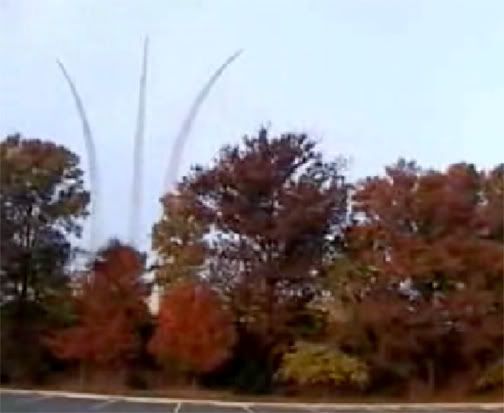
A squadron of Thunderbirds then buzzed the area, executing the famous “bomb burst’ maneuver the memorial was meant to evoke. Usually done with four jets, the monument’s three upward arcs are based on the “missing man formation” traditionally flown at Air Force funerals. The first official ceremony was held the next day when the Secretary of the Air Force laid a memorial wreath at the base of the spires, capping the completion of a 30 million dollar, fifteen-year struggle to get them erected. [2]

The Air Force Memorial Foundation (AFMF) was formed and given 501(c)(3) status in 1992 to pursue a memorial, led by a five-man advisory committee including Ross Perot Jr. [2] The foundation was mostly funded by private contributions; Wayne Madsen wrote about how the project was funded “largely […] with donations from Lockheed Martin, Boeing, Northrop Grumman, Raytheon, United Technologies, and even the United Arab Emirates Air Force.” [3] The original plan was to place the memorial at Arlington Ridge, near the Marines’ Iwo Jima memorial, but all through the 1990s the AFMF remained locked in extended legal battles with the Marine Corps over this plan. In October 2000 President Clinton signed legislation to give them more time, and the DoD offered an alternate site at the east end of the Navy Annex, near the intersection of Columbia Pike and South Joyce Street. This offered the foundation a way around more costly litigation and the opposition of Congressional ex-Marines, but planning for the Arlington Ridge location continued.

The board members were still weighing their options when the 9/11 attacks occurred, including a near fly-by [see below] of the alternate site by Flight 77 on its way into the Pentagon. Some time in October 2001, the AMFM chronology states, the board of directors “acknowledges realization for relocation” to the Annex grounds. Over the next two months as the nation dealt with Afghans and Anthrax, Congress worked to include the site change as a rider on the 2002 Defense Authorization Bill, which President Bush signed on December 28, officially giving the Foundation up to three acres of the Naval Annex property on which to build. [2]

In 2002 the AFMF gathered its funds, solidified the site, and selected Pei Cobb Freed & Partners to design the memorial. It would be the final project for architect James Freed, previously responsible for the US Holocaust Memorial Museum. [4] In 2003 they got the paperwork lined up; in February the FAA decided the giant arcs would not be a "hazard to air navigation."” [2] Formal groundbreaking of the site was held in September 2004, foundation work done in 2005, and construction of the spires began in February 2006. On September 22 the last of fifteen spire segments was installed and the monument essentially completed, three weeks before the dedication ceremonies. [2]

Not everyone is a fan; Wayne Madsen wrote of how the monument sits “jutting into the sky and dominating the Washington, Dc skyline […] reminiscent of something Nikita Khrushchev would have built honoring the Soviet space program in a Soviet Potemkin city.” [3]

I’m not sure yet of the relevance of this memorial to my study of the Pentagon attack and those studying it, but a few oddities are at least worthy of note:
First, obviously, is its location; Madsen noted the spires jut out of a spot “right on the Pentagon crash flight path.” Can this be pure coincidence? It must be, most would think, since the site was selected a year before 9/11. And it’s not exactly on the path anyway; to be more precise, it’s placed along the line of a right-over-the-Citgo-flight path, between the CIT-crafted North path and the official one on which tons of damage happened five years before the spires went up, one year after the site was offered, and a few weeks before it was accepted.

Looking across the Annex from the west, I’m reminded of Edward Paik’s drawn flight paths that, oddly enough, point almost right to the monument, which was being assembled at the time he drew them.
Seen from this view it seems almost like a giant pitchfork they wish had been there to stop the plane that day, a symbolic retroactive warding-off of evil spirits. It is placed just a bit too far to the north, but even if they had truly meant to mark the very spot (presumably a post-9/11 decision to shift it a bit), this is the closest they could get without tearing out the curve of Columbia Pike. Even the most dedicated symbolism must sometimes yield to necessity.

A second oddity that stands out to me is its height – the highest of the three spires rises 270 feet above “the 3-acre elevated promontory site.” [2] This number sticks to me because of the radar altimeter reading in the last recorded frame of Flight 77’s FDR; 273 feet above ground level. This was probably not recorded adjacent to the memorial site, but rather a ways back. Nonetheless, it almost seems someone was trying to place those spears right at the belly of that plane if it should ever come back and try the same thing. However, it seems by looking at a few photos that the tallest spike is pointing northwest, which is not where the FDR shows it coming from, and it becomes clear I’m probably just reading too much into this.

Thirdly, the timing of its construction with CIT’s 2006 research trips means there was a brand new, gaudy, overwhelming structure being built right in the zone people were remembering their flight paths from. With the monument often cited as being ‘right on the flight path,’ it can’t be ruled out that it could have inserted some distortion into their recollections of where the flight path was.

Finally, I’m astonished that I’m just now learning about this. I may’ve heard a mention here or there, but had never been specifically aware of this mammoth trident amongst the contended flight paths. For one thing, it’s not shown in the supposedly current satellite views at Google Maps I’ve been looking at regularly for the last year and a half (hence the graphic I made, above). So now I’m aware of it and up-to-date, and would like to close on a poignant note speaking back to the subject of memorials to those who’ve given their all for whatever they’re calling ‘freedom’ these days, Wikipedia’s entry notes: “Although the current [memorial] design is somewhat overshadowed by the Navy Annex at Fort Myer, that facility is slated for demolition by 2010 with the site to be used for the southward expansion of Arlington National Cemetery.” [4]

Sources:
[1] Long-awaited Air Force Memorial dedicated
Arlington monument honors the memory of those fallen in youngest service. Associated Press. updated 8:12 p.m. ET, Sat., Oct. 14, 2006 http://www.msnbc.msn.com/id/15264524/
[2] http://www.airforcememorial.org/memorial/chronology.asp
[3] http://www.disgrunt.com/blog/2006/12/05/weird-horns-statue-dominates-washington-skyline/
[4] http://en.wikipedia.org/wiki/United_States_Air_Force_Memorial

Monday, February 4, 2008

FRAUD VID DOUBLE FEATURE: COMEDY & TRAGEDY


This video was posted at Youtube in August 2007 by "giftmitch" with the following explanation:
Now what is presented here in its short form has got to be more than satisfactory to any reasonably clear headed thinker to deduce on their own that in fact there was "no Boeing 757, 767, 737, 707 or 747 near, on or about the general premises of the Pentagon on September 11th 2001.

Sounds pretty serious. Glen Stanish, Jim Marrs, Jim Fetzer, Fred Fox (new to me), Al Stubblebine (Ol' Stubby), and Russ Wittenberg spew more sophistry about their fifty million experdiot opinions about WHY no plane hit the Pentagon. I don't mind if anyone watching this thinks it seems overwhelmingly logical, but I challenge anyone to dig in to the reasoning behind any of these claims and find one that's actually well-founded and actually proves what it's claimed to prove. Just one. Comments selection below is open.
Page link w/lively discussion

Then watch this later discussion in the parliament hall of the great nation of Japan: Presenter: Councilor Yukihisa Fujita of Democratic Party of Japan, the main opposition party, on January 10, 2008.

I challenge anyone to find one claim in here that wasn't first fraudulently offered by the experdiots in the video above and their ilk. I believe it's Wittenberg who is referred to as "a U.S. airforce official," cited in what seems to be heartfelt attempt by Fujita to question Japan's role in the US "War on Terror." It's always disheartening to see legitimate goals supported by fraudulent reasoning, like seeing a beautiful house you'd love to live in, built on the worst eroding slope around, and you just know it'll be in the river within a week...
Page link w/additional info and lively discussion

Sunday, February 3, 2008

EASTMAN AND THE DECOY THEORY

LAGASSE AND EASTMAN PART 1: EASTMAN AND THE DECOY THEORY
Adam Larson / Caustic Logic
The Frustrating Fraud
January 12 2008
Last update 2/25/08


Update 2/13: I’ve made numerous edits for flow, tightened of parts that rambled, improved grammar and spelling to compensate for limited English proficiency of Lagasse, Eastmann, Desmoulins, and myself.

Intro: The North Path Star Witness
The purpose of this ambitious three-part series is to explore the roots of Sergeant William Lagasse, a Pentagon Force Protection Service dog handler, as a witness to the Pentagon attack. For those who don’t know, Lagasse is arguably the star witness of the flyover-theory-promoting video The PentaCon, produced by Citizen Investigation Team (CIT) and released early 2007. Lagasse is the most convincing of their four witnesses of the north-of-the-Citgo flight path that proves, no matter what Lagasse himself says, that the silver 757 he saw must have flown over the building instead of into it. Among their growing cast of witnesses, the good Sergeant is also the longest-running and in many ways most perplexing player of the north-path tragicomedy. He was brought to their attention, if not directly funneled to them, by controversial 9/11 researcher Dick Eastman. It was Eastman who discovered the officer in 2003 and publicized his north-of-the-Citgo account. This is a curious episode worth looking at in some detail and in context, which is where this story will begin.

The Only Way?
Yakima, Washington-based e-mail warrior and 9/11 researcher Richard “Dick” Eastman is trained in economics, and is apparently a religious man; an acquaintance has described him as a "fool in Christ" and notes his “high cost of Christian discipleship standards.” [link] Adopting a fiercely populist, libertarian, anti-N.W.O. stance, he seems excitable and is said to have gotten rather belligerent and confrontational with fellow 9/11 researchers, quickly dismissing them as complicit in the cover-up if they happen to disagree with him. Eastman is well-known to be staunchly ‘anti-Zionist,’ and sometimes accused of anti-Semitism; he’s wondered aloud, as many have, if 9/11 were a Mossad operation, but for the woes of the world he doesn’t blame all Jews, just the ‘86%’ who support Zionism [source]

I suspect there’s at least some truth to some of Eastman's broader concerns, or the ones he appeals to, and I appreciate his emphasis on grassroots, de-centralized action to fundamentally alter the way things work. But then I disagree strongly again with his ideas on waking up the masses; in a supposed farewell letter issued early 2004, he summed up 9/11 in context of his world view. What was needed was to:

“...discredit the entire ruling elite in government, big business, big finance, big law, big media, big organized crime, big defense - and there is only one way to do that to the degree necessary, only one way to discredit the entire structure so as to bring it down by instant popular demand - and that way is to expose the truth about the 9-11 black-op false-flag inside-job mass-murder frame-up - and the only way to expose the frame-up is with the evidence that shows beyond all possibility of doubt that the Pentagon was not hit by a Boeing airliner.” [emphases mine]

By this definition we’re all screwed. Luckily I also feel his assessment of our global options was wrong and there’s still hope even though an airliner did crash itself into the Pentagon. Either way, he feels his no-757 case was a serious boon to the cause of Truth and global justice – if not its only salvation.

In early 2003 evidence was more scant than it is now, and mystery flourished with Meyssan and others insisting on a missile or small drone strike. Amid the gathering din, one research piece by Eastman rose above for its ambition (three parts!) and apparent sophistication of info-mulching: What convinced me that Flight 77 was not the Killer Jet, published by the equally concerned American Patriot Friends Network. As with other no-757 impact theories, Eastman’s analysis rests heavily on the physical evidence that ‘disproves’ a 757 impact; he found the entry hole "too small to accommodate a Boeing 757 [with] a width of no more than 10 feet.” (90 feet wide in reality) He marveled at the unmarked lawn, and decided the debris evidence available at the time was ‘portable’ and so probably planted.

He also found that the famous security camera stills showed a blackish missile hidden from view but trailed by white missile exhaust (based on a common mix of errors I’ve explained here). But the key problem with the missile theories then purporting to explain these same misread ‘oddities’ was the widespread awareness of dozens of eyewitness reports of a 757 flying in that way and even impacting. Eastman was among the first to find a way to (apparently) acknowledge this class of evidence with bizarre treatment that still allowed a non-impact scenario, and the Flyover theory was born.

The Killer Jet, the Light Poles, and the Decoy
In essence his theory, at least as it stood at that point, is this: the decoy he insists on calling Flight 77, a large two-engine silver airliner painted with American Airlines standards as seen by many, flew in from the west, while a drone ‘killer jet’ came in synched, below it and from a similar angle, fired a missile, and then itself impacted the Pentagon as Flight 77 passed over and disappeared. Eastman offered “a profile of the remote-controlled killer jet,” in essence a "‘non-standard’ General Dynamics F-16 aircraft.” There were no eyewitness reports of an F-16, just one ear-witness (whom Eastman doesn’t even cite) who thought the jet sounded like one. An F-16 has a single engine centered in the rear compared to the two massive RB-211 engines under a 757’s wings. “Only one engine broke through the C-ring,” Eastman states based on something or other (actually neither engine seems to have made it that far); “The one engine is on a line from the downed lamp posts to the entry hole to the last exit hole -- indicating a single engine jet.” A Boeing as said to have done all damage and widely reported as impacting low is three times as long as an F-16 and at least thrice as massive, and thus seems a better match for the damage necessary to reach the exit hole. But if the entry hole were only ten feet across, no Boeing could have entered, so F-16 it must be.

Also take note that the five downed light poles match a 757’s wingspan of 124 feet, and know that an F-16’s wingspan is 33 feet. The accused killer doesn’t seem a candidate to take down the poles, and at first Eastman denied any were downed; “Ron Harvey says that 5 poles were downed. Ever hear that from any other source? […]I have not seen a picture of five downed poles. If there is one I would like to ask whether it was faked […] you will notice that in the picture Harvey does send that the downed poles are not shown with the Pentagon wreckage in the background. ” [link]Later he clarified “I have long acknowledged the existence of the poles as soon as I finally got my hands on an actual picture of one (Ron Harvey was not forthcoming with me at the time)" [link]

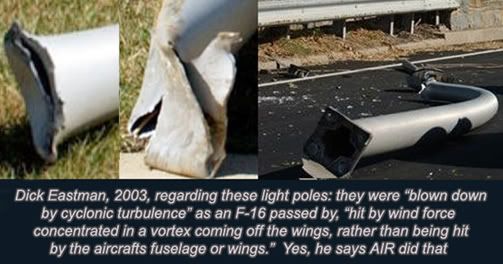
“In fact it was the pole data in contrast to the witness accounts.” Eastman continued, “that first suggested the presence of two converging aircraft paths.” In this construct, the impact/pole damage path still is attributed to the killer F-16 by the time of his 2003 piece, which explains “the light poles […were] hit by wind force concentrated in a vortex coming off the wings, rather than being hit by the aircrafts fuselage or wings, denting and fallen forward.” Yes, he thought (or said he did) that air was responsible for bending, cutting, and crimping these aluminum poles so acutely.
So his conclusion, based in part on the light poles, was of two converging flight paths, with the implausible F-16 doing the damage “while Flight 77 […] in fact flew over the building, concealed immediately from most witnesses by fire and smoke rising to the rear and by the "blend-in" environment of Reagan National [Airport],” where it ten landed. With that airstrip just a couple thousand feet behind the Pentagon, the incredibly tight loop required to reach it, according to French researcher Jean-Pierre Desmoulins, “shows how imagination can bring somebody who doesn't know physics and laws of flight to propose nonsense.” [link]

Riskus Dyslexia and the ‘South’ Path
Attack witness and skateboarding enthusiast Steve Riskus, according to his own account, was “traveling on route 27 towards 395,” which means he was headed south with the Pentagon to his left, when the airliner “crossed my path from the right,” or west, “about 100ft in front of me and crashed into the pentagon.” Within seconds he was out of his car and taking photos of the scene, revealing his excellent view. “I could see the "American Airlines" logo on the tail as it headed towards the building,“ his seminal account clarifies, and Eastman is quite sure Riskus saw the Boeing decoy, but he also clearly states “I saw the plane hit the building,” even though it was the killer jet that did that. “From where Riskus was, the low and level approach of the killer jet was camouflaged by the "busy" background,” Eastman concluded, so he simply presumed the flyover jet is what caused the explosion. That’s it. The core assertion of this account is disposed of quickly, the remainder free to pilfer.

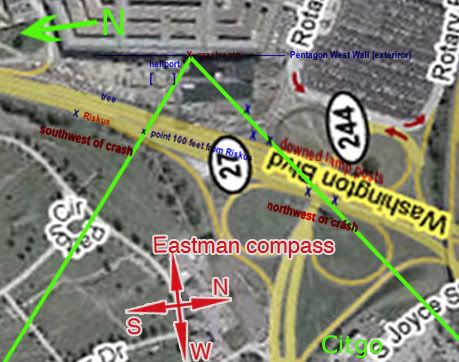
Riskus’ scene photos reveal his approximate location, across from the heliport tower just north of the impact point. The graphic at left is from the text-graphic Dick Eastman used to convey his position, which looks about right except one thing – at the bottom in red are labels southwest and northwest of crash, which do not line up with his description or the evidence. The poles were south of the impact, not north, and if Riskus were south, the Pentagon would be to his right, not left. Eastman clarifies that he thinks “Witness Steve Riskus was headed north on the turnpike, south of the crash site, when he saw Flight 77 pass by.” Just imagine for a moment this guy’s compass: east is to the left of north? He has the whole area half-backwards, and it carries through into his analysis of the killer jet’s “straight northwest to southeast line” taking out the light poles “north” of Riskus, “to that final hole where the bare engine of the plane exited.”

Eastman caught the error eventually (see part II), and it does not really effect his overall findings, anyway; if we re-orient his N-S axis while keeping the E-W, the decoy would fly north of the killer jet’s path, given Riskus’ standing 100-foot measurement. This roughly gives us a flight path very north of the Citgo, over the middle of Arlington National Cemetery. This is in no way a candidate for the light pole or building damage, and would have had to have flown over. If not for the dyslexia that has him reading north as south, this is the best evidence yet for a north path and flyover, an issue that will clarify itself and come into play in the next installment. By my measurements, the official 77 path/Killer Jet path would have crossed Route 27 roughly 1,000 feet ahead of Riskus, which leaves me wondering if 100 was a typo, a grossly imprecise estimate, or whatever Eastman took it for when he noted "there is no feasible path by which the killer jet could have hit those lamp posts, flown to within 100 feet of Riskus and then returned to the northwest to be able to enter at the crash point at an angle that would enable it to rendevous with the exit hole in the C-ring. No jet could do it, and especially no Boeing 757 airliner could do it." When J.P. Desmoulins looked at Riskus’ account he found that Eastman “developed this "100 ft" statement, making it one of the bases of his theory," while it seemed more likely that this number was "just an irrelevant statement" on Riskus' part, a casual and far-off estimate of an unprecedented sight.

Dividing One Plane Into Two
At one point Eastman confidently summarizes “all evidence and witness testimony presented in this paper are consistent with the [killer jet] thesis.” It’s in the use of eyewitnesses that the piece shines. It seems it was no simple task to see the patterns, and some careful prep work had to go into the process. To make 77 appear the over-passing decoy, he set about Minimizing impact accounts associated with it, as we’ve seen he dismissed Riskus as visually fooled but took a different tack with Tim Timmerman, following his cited account, which was clearly describing Flight 77, with the comment: “most significantly, he actually states that the plane he was watching "didn't appear to crash into the building"!!!!” [bold mine]. Really he said “it didn't appear to crash into the building; most of the energy was dissipated in hitting the ground, but I saw the nose break up, I saw the wings fly forward, and then the conflagration engulfed everything in flames. […] it was right before impact, and I saw the airplane just disintegrate and blow up into a huge ball of flames.” Sounds like an account he shouldn’t have cited – a ground impact and then into the building is about the opposite of a flyover Eastman feels happened, which would make this witness a liar, which would leave one wondering why he’s quoting liars. In fact, Eastman once called Timmerman and Penny Elgas “two witnesses that I believe have lied about their experience.” [source]

In all Eastman analyzes sixteen witness accounts of the plane(s), not all verified by me as free of the selectivity shown with Timmerman’s, and divides all but three of them into “two distinct groups, each seeing a different plane, on a different path, at different altitude, with different sound, at different speeds.” Some saw “an airliner, shiny, red and blue markings, with two engines, in a dive, and flying "low" in terms of one or two hundred feet, and silent (engines idle)” Others saw “a plane that came in at tree-top level, at "20 feet" all the way, hitting lamp posts in perfect low level flight […] engines roaring; pouring on speed; smaller than a mid-sized airliner.”

If we combine the two descriptions we get a composite of the one plane official story. Conversely, by fragmenting the descriptors and creating two piles he creates two jets. Here is the roster: Timmerman, Campo, Munsey, Peterson, Riskus, Robbins, and one anonymous witness saw both the decoy Flight 77 and the impact of same, but either the part where they saw it hit was removed and ignored, or they were tricked. (Robbins “saw the Boeing that did not crash and the explosion and smoke made by the killer plane that did.”). O’Keefe saw the decoy Flight 77 and heard the killer. Vaughn saw the decoy but no impact. The account Eastman shares has Joel Sucherman seeing a “large plane” that was “not going to make it across the river to National Airport” as it passed too fast for him to see “any of the horror- struck faces inside.” Yep, Sucherman saw the F-16, since it “was 20 feet off the ground” and he actually re-prints “the plane slammed into the west wall of the Pentagon.” Gaskins gives nothing Eastman uses besides altitude clues (making it 77 he saw), while Liebner’s is inconclusive for lack of altitude clues. One anonymous “falls between the two categories,” using adjectives that could describe either decoy of F-16.

That’s 14 of the 16, and the final two comprise Eastman’s third category, seeing both planes; He reports that Kelly Knowles saw “two planes moving toward the Pentagon, one veering away as the other crashed.” Actually she was miles away, and saw only the tail of one plane pass and then another also disappeared to the east “a few seconds later.” This is almost certainly the C-130 cargo transport sent to examine the scene, passing over the Pentagon about two minutes after the crash. [source] Keith Wheelhouse was at Arlington National Cemetery when, as Eastman states, he "saw another plane flying near the jet that crashed." As widely reported, one article from three days after 9/11 implied they passed at the same time; “[Wheelhouse] believes it flew directly above the American Airlines jet, as if to prevent two planes from appearing on radar, while at the same time guiding the jet toward the Pentagon.” While another article published the next day clarifies that Wheelhouse says the second plane was probably a C-130 [source, Eastman decided he saw the killer jet and the decoy.

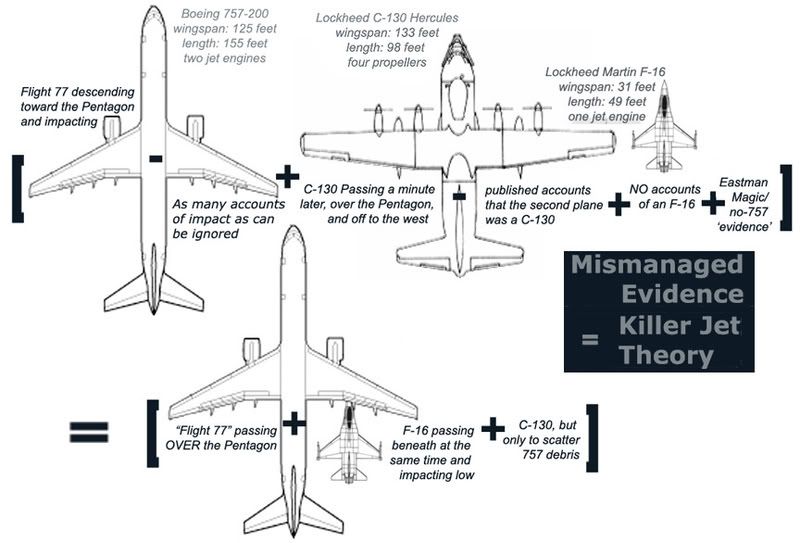
Even as he dropped the known ID to bolster his two-plane theory, Eastman was aware of the C-130, and mentioned it once in the paper. He noted the cargo plane could have aerially planted the 757 debris indicating impact, especially the “wheel in the parking lot," as it passed "just 30 seconds later.” It is never mentioned in connection with two-planes accounts despite at least one that was quite clear on being a C-130 witness. Therefore, this graphic pretty well sums up how the killer jet theory works: [r-click, new window for full-size]

A Killer Theory… NOT
Here we have a proposition that Eastman calls “the only way” to “discredit the entire ruling elite […] to the degree necessary.” And this way, this bridge to victory offered up to support the weight of the world, is strewn with wrecked logic and supported by a teetering tower of poorly piled debris. As I have shown, the Killer Jet Theory is a laughable construct slapped together from misquoted quotes, vague words turned to hard geometry, and that geometry to ‘proof’ of something trumping hard, consistent facts. Its architecture is almost entirely of ‘errors’ too egregious to be accidental or to even be mistaken for such. Perhaps each one is a little tip-off to those paying attention that this theorizing isn’t meant to be taken seriously, a wink as he fleeces the less vigilant. A series of winks. A prolonged seizure of the eyelid.

But there are only so many so dumb, and Eastman must have been left a bit embarrassed by his own piece. The bridge was too rickety. Rescue, however, was just a few e-mails away. Already hinting at a decoy north path (if called a south path at the time) based on nearly nothing, out of nowhere a self-appointed debunker gives the only solid, clear, undeniable north path account yet – Enter William Lagasse and the next post in the series.