Monday, August 6, 2007

THE OUTER WALL: HOW MANY INCHES OF WHAT?

THE OUTER WALL: HOW MANY INCHES OF WHAT?
Adam Larson / Caustic Logic
The Frustrating Fraud
Updated August 5 2007


Many questions have been raised about whether a Boeing 757 could have breached the imposing “steel-reinforced,” and just-upgraded, walls of the Pentagon. As 911 In Plane Site and others have explained, each wall of the five-floor, five-side bunker of five nested rings was 18” of solid steel-reinforced concrete, giving 9 feet total the plane would’ve had to pierce to plow through three rings as alleged. Of course this is ridiculous, but in fact, besides the inner C ring wall where the small and odd punch-out hole occurred, a majority of the plane only passed through one major external wall, on the outer E ring where the plane entered through a gaping 90-foot-wide hole. So I set to figuring out how that wall was constructed - how many inches of what?

Wedge one, the southwest fifth of the building, had just been renovated against terrorist attack, with work one day away from completion when Flight 77 plowed into the ground floor of the strengthened zone. This curious fact has attracted much attention among skeptics, but the ASCE’s Pentagon Building Performance Report notes “structurally the renovation was not major,” and makes little mention of the changes other than to note “the exterior walls and windows were upgraded to provide a measure of resistance to extreme lateral pressures.” [1] There was also the addition of a new fire suppressing sprinkler system, which did little good; [separate link], new windows (to which we’ll return), and several less noteworthy upgrades. But the main issue here is the outer wall of the massive office-bunker that was breached.

According to the Performance Report, “the original structural system, including the roof, was entirely cast-in-place reinforced concrete using normal-weight aggregate." [2] This frame is comprised of columns supporting beams, girders, and floor slabs. The report illustrated "the typical members" in the impact area (left). The reinforcements in these columns are vertical bars, typically six, wrapped with a welded rebar that spirals from top to bottom. This cage is filled and covered with concrete, all told measuring 21” square. [3]

Spanning between these sturdy columns, the impacted exterior wall of the E ring was “mostly non-load-bearing masonry infilled in a concrete frame.” This consisted of “5 in. thick limestone […] backed by 8 in. unreinforced brick.” [4] Apparently most of the surface area encountered was only masonry, just over a foot of it. This is not too imposing. But just after noting the weakness of the outer walls, the report mentions that “in some areas the backing is a cast-in-place concrete wall.” [5] I had been looking at a photograph that looked like that to me, and became confused as to how much concrete structure there really was in the wall that the 757 slammed into. I’m now in agreement with Russell Pickering, who decided:

“The exterior columns were 21 inch square steel reinforced concrete covered with 6 inches of limestone facade. In panels with windows it had the 6 inch limestone facade and 8 inches of brick backed with Kevlar mesh. In panels without windows it was 8 inches of brick and 10 inches of concrete.” [6]

This sounds good, and I see evidence for this distinction. As an article passed on by Jim Hoffman noted:

“The idea of supporting the brick infill walls with a reinforced concrete wall "backing" was rejected as a "typical" approach because of the Pentagon's extensive fenestration (although this design was accepted for "blank" wall panels with no window openings).” [7]

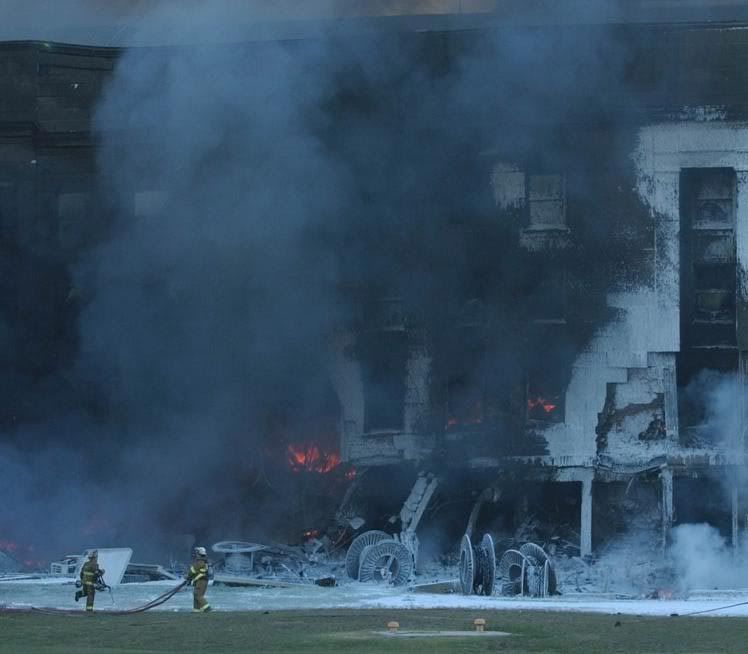
The one place I was seeing concrete backing was a damaged non-window panel on the second floor, thought to be the impact point for part of the right wing. Note what seems a third layer of brick is actually stained on the concrete, which fades to gray at the bottom where the backing was smashed to cobble exposing the 2-layer rebar.

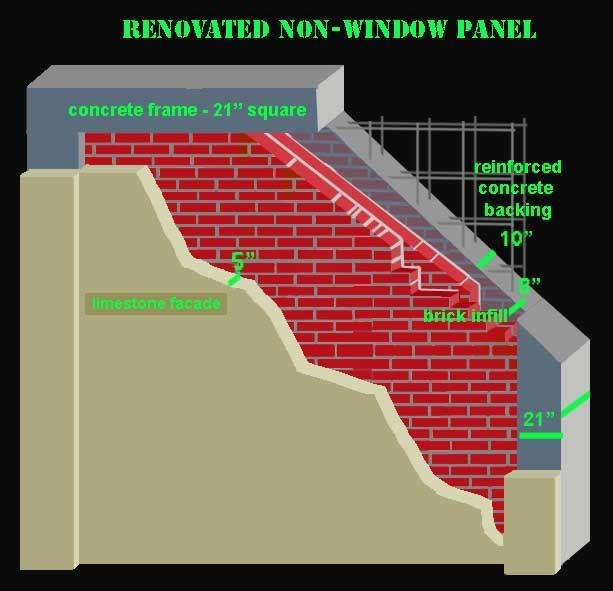
I felt like making a model of the solid slab as seen above. I’m going with the Performance Report’s limestone width of 5,” making the sturdy non-window panel 23” thick. 10” of concrete backing 13” of masonry.

[right click - open in new window to enlarge]
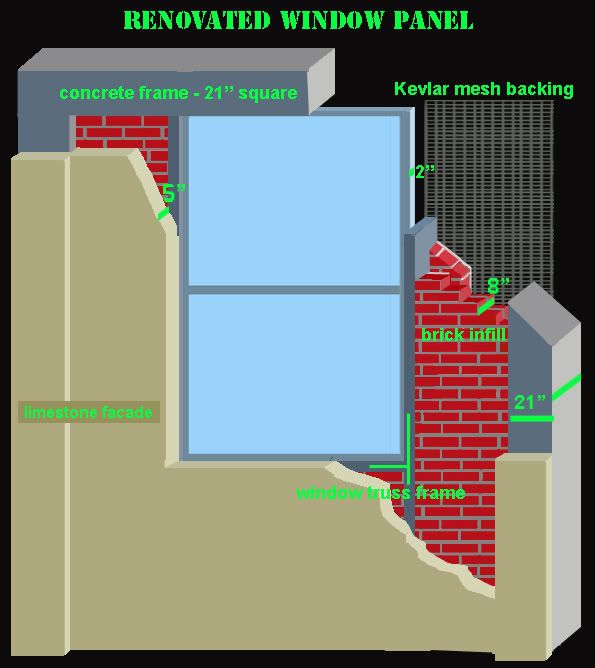


In general, however, this is not the type of wall the 757 impacted. “In panels with windows it had the 6 inch limestone facade and 8 inches of brick backed with Kevlar mesh.” Another part of the renovation was the Kevlar cloth, the material in bullet-proof vests, stretched between the columns along the back side of the unreinforced spans of outer wall. This sturdy netting didn’t add any real strength, and was in fact an admission of the very weakness of this panel type; Architecture Week reported the idea as being “holding together building materials so they wouldn't become deadly projectiles in an explosion.” [8] The Kevlar did little good, however, when the bricks were followed in by an exploding, full speed, Boeing 757 that took out the very columns the mesh was anchored to.
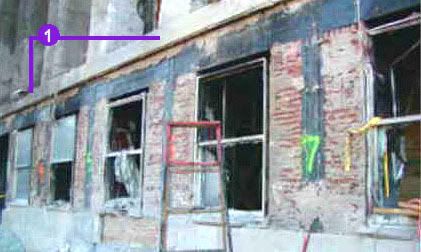
As a side note and because I numbered it in my graphic below (area 1), here is a portion of the unrenovated first floor just north of impact, with the old windows and no Kevlar backing. These panels are missing the window panes and limestone facade from the sills up, exposing the frame and unreinforced brick infill. (note the numbering – Columns 7, 6, and 5.)

Straddling the renovation line, the damage would have presented an excellent before-and-after comparison for future study, but for the collapse, twenty mintes after impact, of the upgraded half of the picture. The majority of façade damage as the worst of the structural impairment was in the renovated section, from column line 11 south. Right on that dividing line, briefly, one of the more interesting aspects of the renovation was made visible. One article explained how the window frames actually added structural integrity, according to a renovation plan for “erecting structural reinforcements around the windows, anchoring at the top and bottom to structural concrete floor slabs [which] accepts blast forces from the walls themselves and transfers both window and wall loads into the horizontal slab diaphragms.” [9] Here are two panels exposed on the second floor, between columns 11 and 13, directly over the northern half of the worst of the airliner damage. Facade, brick, and presumably Kevlar seem to be removed, while the columns, window truss framing, and even the glass panes are intact. (the number 2 refers to placement on the graphic at bottom of page)
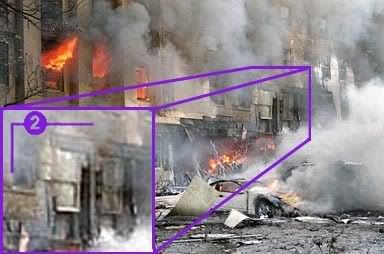
At the risk of dropping free advertising to the makers of these windows, all sides seem in agreement over how well they held up after the attack. Architecture Week noted “the blast-resistant windows […] remain remarkably intact and in place adjacent the point of impact. Some were popped out of their frames by the force of the exploding jet fuel, but they fell without breaking or splintering.” [10] Ralph Omholt noted “the general good condition of the windows,” correctly deducing “this wasn’t a major impact zone of a B-757.” [11] The "major impact zone" is in fact just beneath that, where there are no windows at all or wall panels for over 100 feet.

Here is a graphic I just finished showing what was encountered and destroyed. For the most part, it seems quite plausible for a 757 with its massive, bullet-shaped fuselage and dense, speeding engines, and hardy wing roots to have done all this. Weaker window panel removal accounts for most of the missing outer wall, while intervening column removal was more uniform, in my analysis, than widely believed. Notably on columns 15-17, I’m in disagreement with the ASCE who listed these as present but impaired.
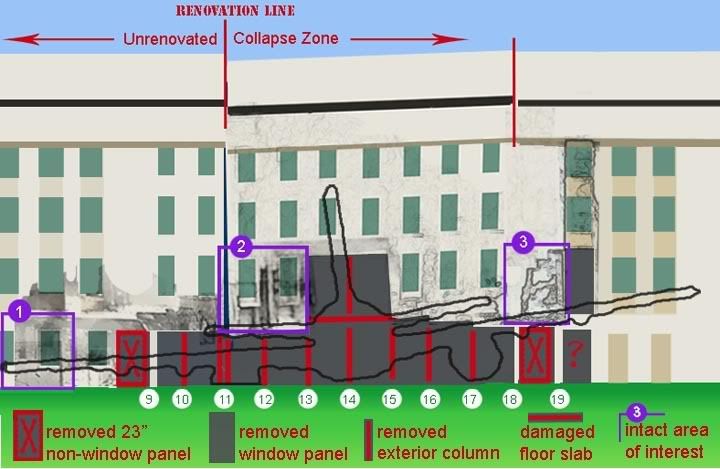
The big “X” panels were the strongest – backed with 10” of concrete - and yet were removed, despite being hit by neither fuselage nor engines. This is one of the things that I’d classify as counter-intuitive about the Pentagon evidence. Take the one on left; a non-window panel – not renovated, so perhaps not 23 inches of material, totally destroyed by one of the weakest parts of the plane – its outer wing. And to its immediate left, a much weaker panel totally intact but for its lost facing and windowpane.
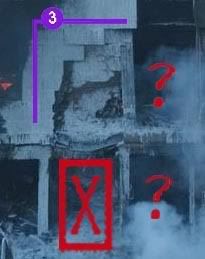
The X on the right is even stranger. The question mark to the right of this mystery spot seems to be one of three doorway, somehow enlarged, and above that, a final weak window panel removed. But the “X” marks the mystery I can’t answer yet. It’s immediately beneath my highlighted area 3, and presumably the same panel type as analyzed above – again, totally missing. What hit this panel, concrete backed, and removed the whole thing? The wing itself hit higher it seems, looking at that line of second floor damage. The under-hanging engine was a ways to the left, and yet this first floor panel was apparently removed completely by nothing in particular.

It might help to recall the wings hitting objects like light poles and a large generator on the way in. Some accounts imply that the wings were possibly exploding even before impact, with parts flying in on the blast cloud only approximating a plane’s profile. Maybe a major wing element impacted here at just the wrong angle and took out the masonry and all its reinforced concrete backing, uniformly.

In summary, let me revisit an old question raised by Dave Von Kleist in 911 IPS and passed on in Loose Change and elsewhere; “Question – Could a 757 have pierced 9 feet of steel reinforced concrete, and left a 14 to 16 foot hole, and no wreckage?" The answer is that it didn’t need to. Most of the “bunker” surface it pierced was 13 inches of brick reinforced limestone, explaining the 110-foot span of eliminated panels (and 90 feet of removed columns) it created and into which the vast majority of wreckage “disappeared” on its own inertia. But I guess the answer he was looking for was more like “of course not – only a missile could do that.”

sources:
[1] Mlakar, Paul F., Donald O. Dusenberry, James R. Harris, Gerald Haynes, Long T. Phan, and Mete Sozen. “The Pentagon Building Performance Report.” American Society of Civil Engineers. January 2003. ISBN 0-7844-0638-3. PDF download link. pp 3.
[2], [3] Ibid. Text pp 5, graphic pp 6.
[4], [5] Ibid. pp 11.
[6] Russell Pickering. "Exit Hole." Pentagon Research. http://www.pentagonresearch.com/exit.html
[7], [9] Biscotte, Michael N., P.E., and Keith A. Almoney “Retrofitting the Pentagon for Blast Resistance.” Structure magazine. July/August, 2001. http://911research.wtc7.net/mirrors/guardian2/pentagon/pentagon-retrofit.htm
[8], [10] Novitski, B. J. "Pentagon Battered but Firm." Architecture Week. Undated. http://www.architectureweek.com/2001/1003/news_1-2.html
[11] Omholt, Ralph. “9-11 and the IMPOSSIBLE: The Pentagon. Part One of An Online Journal of 9-11.” Physics 911. Undated. http://physics911.net/omholt

PUNCH-OUT HOLE “EXPLAINED” BY OFFICIAL ACCOUNTS

PUNCH-OUT HOLE “EXPLAINED” BY OFFICIAL ACCOUNTS
Adam Larson / Caustic Logic
The Frustrating Fraud
July 22 2007
Last updated/edited July 25


Official Dodginess:
How exactly Flight 77's trajectory through the building wound up giving us the exit hole we’ve seen is left a bit vague in the official record. The American Society of Civil Engineers' Pentagon Building Performance Report shows a photo of the hole but gives no adequate explanation. Its terse summary: "there was a hole in the east wall of Ring C, emerging into AE Drive, between column lines 5 and 7 in Wedge 2. The wall failure was approximately 310 ft from where the fuselage of the aircraft entered the west wall of the building," [1] The Arlington County After Action Report noted “the damage extended all the way through the inner wall of the C Ring, a distance of approximately 285 feet,” and showed a photo of the hole captioned “penetration through the inner wall of the Pentagon’s C Ring.” [2] An account of FEMA Urban Search and Rescue shoring/bracing of the building is the most detailed of these three reports. It explains that "a nine foot diameter exit hole was created in the wall of C ring and the remainder of the debris from the impact ended up in the alley between C ring and B ring known as A & E Drive," and elsewhere shows a photo of the "'exit wound' where the plane debris exited the C ring." [3]

These three reports, a few early press conferences, published eyewitness accounts, and a handful of photos constitutes the body of evidence on this hole. While it’s been widely seen and commented on, it has not yet been explained with any useful precision, and contradictory theories dominate to an unsettling degree.

Impact Energy Waves?
In October 2004, the National Geographic Channel program Seconds from Disaster proposed a novel theory by which shockwave pressure from the impact cause the punch-out hole. By this model, plane debris and heavy, exploding jet fuel, perhaps along with explosions of things in the building, gave off shockwaves that reverberated and crossed through the building’s first floor. Having no other exit point, these somehow directed themselves and whatever was in front of them to focus on that precise spot, punching the neat 9x11’ hole we’ve seen. [4] While this explains both the improvised exit and the lack of any major evident airplane parts, the official story has generally maintained it was physically caused by the plane, or some part of it, though which part has been widely contested.

Engine?
Military District of Washington’s news service reported two weeks after the attack, mentioning that “an aircraft engine punched the hole out […] on the inside wall of the second ring of the Pentagon." [5] Though the quote has been widely republished, no other official sources support this claim. No debris seen there looks like engine debris.The piece’s author got the “second ring” part wrong (whether one counts A-E or E-A, C is the third ring), so maybe identifying an engine was an error as well.

Fuselage/Nosecone?
As widely noted, Pentagon renovation spokesman Lee Evey explained implausibly during a September 15 press conference “the nose of the plane just barely broke through the inside of the C ring, so it was extending into A-E Drive a little bit. So that's the extent of penetration of the aircraft." [6] As Killtown wondered “how could the fragile nose of Flight 77 penetrate all the way through 3 reinforced concrete/steel hardened rings and punched out a hole through the inside wall of Ring C and leave no evidence of itself outside the punch-out hole?” [7] This seems unlikely, even given that the “hardened” walls from impact to exit really totaled only 22” of unreinforced brick and limestone [link forthcoming], but spanned between by about fifty damaged support columns and only one plane fuselage to absorb the other end of these blows.

What survived this was not precisely the nose cone, but more likely some element(s) of the nosecone assembly – landing gear, landing gear door, cockpit panel or cargo door – some tattered portion of the forward fuselage. As Jim Hoffman explained, in such an impact, “only the parts of the aircraft with the greatest density and total mass, such as the lower third of the fuselage, could be expected to penetrate far into the building. That part also has a small frontal profile - approximately the size of the punch-out hole.” [8] Of course there is no piece of debris anywhere near the size of the hole seen in any of the available photos, but the illustration is helpful. The fuselage had a lot of mass, tens of tons, and though it was under great stress, it didn’t simply disappear on impact.

Landing Gear?
It stands to reason that as the plane disintegrated, the densest parts of aircraft wound up at the deepest point of penetration. For example, the flight data recorder from the tail end of the plane was reportedly found just inside the punch-out hole. [9] The heavier elements from the front end would also come to rest around this point. The book Debunking 9/11 Myths identified the landing gear. The book cited Paul F. Mlakar, ASCE team leader and lead author of the Performance Report, who “saw the landing gear with his own eyes” during his early onsite inspections, for its explanation that:

“The hole was not made by an engine or the nose of Flight 77 pushing through the building’s interior - or a missile - but by the crashing jet’s landing gear, which was ejected beyond the bulk of the wreckage. […] As one of the heaviest and most dense parts of the plane, the landing gear flew farther than any other item in the wreckage and was responsible for puncturing the wall in Ring C.” [10]

Other photos and accounts seem to back this up by recalling or even showing a wheel, a tire, and even a massive landing gear strut, near the hole. But there are some serious problems with this theory as well, like the ASCE’s own Performance Report not identifying this alleged hole-puncher as such, which noted that "the landing gear" (all three sets?) were in fact found inside the building, hardly the best place to be after exiting through the hole into the AE Drive. [13] These questions will be summarized more fully in a [separate post].

ASCE and FBI Secrecy
Mlakar's ASCE study team “went to great lengths of detail down to individual columns” in the plane’s path, Russell Pickering noted, providing their own photos and personal damage assessment of nearly all of them. Yet they danced around the cause of the punch-out, as Pickering wrote, offering “not a single explanation for the exit hole.” [14] The three columns nearest the breeched wall - 1N-North, 3N-North, and 5N-North - remained un-photographed and listed in the report as “damaged per FBI.” [15] Pickering suspects falsification of the status of these three columns to hide inexplicably severe impairment. [16]

He speculated that “the building team […] weren't allowed back at the exit hole for some reason," and noted how "they indicated in the report why they didn't have photos of those columns and who gave them the damage report on the columns - the FBI.” The one photo they published of the exit hole itself was not one of their own, but also credited to the FBI, further indicating this area had special investigative significance to the bureau, although this could have many possible reasons. [17]photo of the hole used by the ASCE, credited to the FBI (lower right, very small print.) [18]
---
Sources: forthcoming
[1] Mlakar, Paul F., Donald O. Dusenberry, James R. Harris, Gerald Haynes, Long T. Phan, and Mete Sozen. “The Pentagon Building Performance Report.” American Society of Civil Engineers. January 2003. ISBN 0-7844-0638-3. Page 28. PDF download link
[2] Arlington County After-Action Report. on the Response to the September 11 Terrorist Attack on the Pentagon. PDF downloaded from http://www.arlingtonva.us/Departments/Fire/edu/about/FireEduAboutAfterReport.aspx. The report bears no publisher or copyright info – it was compiled by Arlington County and Titan Systems Corporation, and released July 2002 according to this story: Weiger, Pam. “Pentagon report: After-action.” NFPA Journal. Nov/Dec 2002. http://findarticles.com/p/articles/mi_qa3737/is_200211/ai_n9114927/pg_1
[3] Titus, Leo J. Jr., P.E./Virginia Task Force One Urban Search & Rescue Team. “A Review of the Temporary Shoring Used to Stabilize the Pentagon After the Terrorist Attacks of September 11th, 2001.” May 3, 2002. Pages 9, 12. PDF download link: http://www.aesvn.org/resources/Pentagon-Shoring.pdf
[4] Seconds From Disaster – season one episode 12 “Pentagon 9-11.” National Geographic Channel. First Aired October 26 2004 http://en.wikipedia.org/wiki/Seconds_From_Disaster
http://channel.nationalgeographic.com/channel/seconds/episodes.html
[5] Military District of Washington. Press Release. (9/26/01) original url: http://www.mdw.army.mil/news/Commentary-Remembering_the_honored_dead.html. Accessed at: http://www.snopes.com/rumors/pentagon.htm
[6]

Saturday, August 4, 2007

THE CSV FILE

THE CSV FILE
Adam Larson / Caustic Logic
The Frustrating Fraud
August 4 2007
rough draft


Released by the NTSB via FOIA request to Pilots for 9/11 Truth member Undertow in August 2006, the “csv file” is one of the more widely-cited sources of Flight 77 FDR information. It’s a huge file – offered by the Pilots for download:

The CSV file, AAL77_tabular.csv (zipped): dowload link

A text list of the parameters plotted: dowload link

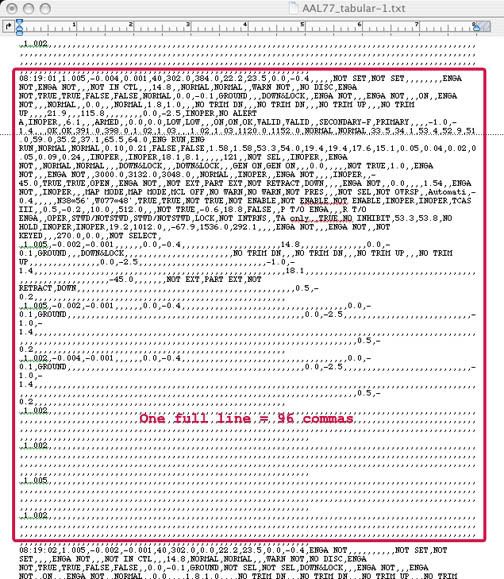
It’s a bitch to read. I had initially only been able to open the file as simple text file, with well over 300 values (I stopped counting) each represented in packed clusters for each second of the hour-and-a-half doomed flight, a total of nearly 4,700 frames. A single frame looks like this (highlighted in red is the data for the first frame at 8:19:00 am - the last frame is 9:37:44, ending as the animation does one second early):


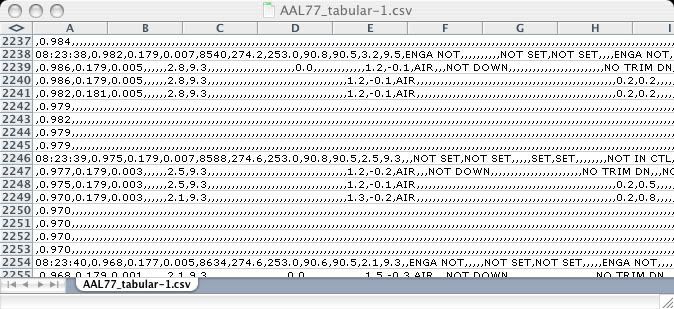
Opening it in Excel, once I figured that out, helped little, as it doesn’t really organize the data into readable columns.


Each comma separates one of the myriad values from the next (hence the file type CSV, or “comma separated value”). Many many of them, where there are commas in a row, are blank or inoperative; the NTSB’s SFRI noted that even though “the recorder operated normally,” that report, and the CSV as well, included “only validated parameters.” The blank values, including the radio altimeter, “either were not recorded properly or were not confirmed to have been recorded properly.”

Most remain readable, but with so many values presented this way, the only way I can find anything is to have a good guess of the value I’m looking for (29.92, latitude, etc.) and do a search ‘till I find it. Out of this mess and my relative ignorance (and sporadic, stumbling tenacity), I’ve been able to verify a few oddities proposed by Undertow and his cohorts at P49T: the pressure altitude reset said to place the plane too high for impact, and the 20-mile longitudinal offset, which seems odd but irrelevant.
- I had misread the initial pressure altitude recorded and concluded the csv and animation altitudes in fact matched at the beginning, which they don't. Initial altitude reading: 40 ft msl, 250 feet underground at Dulles, 260 below the animation readout. A mess of a post... and a graph
- The numbers in the tabular csv file match the official story's flight path in latitude/longitude plots (once corrected) and timeline. Nothing new but another verification and a nifty new graphic.
- There seems to be a slight north offset as well, depending on if I'm reading this right. At any rate, the graphing of the csv final plots that helped me see this is interesting for its own reasons.

20 MINUTES AND 20 MILES FROM TRUE

20 MINUTES AND 20 MILES FROM TRUE
CSV LONGITUDE READINGS
Adam Larson / Caustic Logic
The Frustrating Fraud
August 4 2007


A recent anonymous comment left under my post Pentagon NTSB Animation is Wrong! said:

“Funny stuff watching a bunch of half witted pilots and so called experts run around making up ideas on something they do not understand but have been told about. Take a look at the FDR data please. Now tell me where is Flight 77 at takeoff, and at the last data point. Come on experts like Snowy, tell me where Flight 77 is. Any point in time will do. Bet you can not place it better than 1000 to 3000 feet. Too bad we did not have GPS to knock that down to 100 to 300 feet. Sad thing is, after reading the posts around the internet, the FDR was found in the Pentagon as were all the bodies from77. The people who make up stuff about Flight 77 are sick people.” [1]

I remembered some comments from the “experts” at Pilots for 9/11 Truth about positional problems in this data, so I took the challenge and found – ironically enough – the debunker had pointed to an interesting anomaly that it seems places the plane’s final resting place twenty miles west of the Pentagon. I duly note the irony that this gives me something to agree with the Pilots over, as core member Undertow had just alerted me of “the CSV Lat/Lon data screw up,” wherein “it is off by 20 Minutes.” [2]

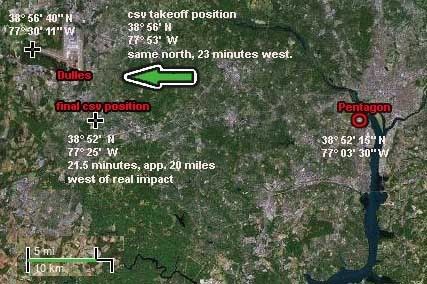
It’s somewhat daunting to look into the CSV file, but this time it only took a few minutes to ascertain the final recorded position: N38°52',W077°25'. There are no seconds reading to pinpoint (60 seconds make a minute, 60 minutes a degree), but it appears about right for north placement, but far off for the longitudinal (east-west) placement. It should read 77°3’30” Indeed, it’s off by 21.5 minutes, in this case a discrepancy of roughly 20 miles, or directly over Chantilly.

Where does this discrepancy enter the picture? I feared it would take a while to track it back, but again, no problem. Location at takeoff (from frame 08:21:27: N38°56',W077°53' The map I looked at places the end of the runway at 38° 56' 40" N, 77° 30' 11" W. Again the same northern position, but 23 minutes to the west. The discrepancy is there the whole time. The slight difference is probably due to the lack of seconds data that would tell just where in each zone it was for sure, introducing a small fudge factor of inevitable imprecision.
Pilots ally John Farmer has analyzed the data closely and found it "unreliable," and now I see clearly what means when he says the csv file "has the plane taking off from a field west of Dulles and crashing somewhere well west of the Pentagon (look at the coordinates stupid).” [3] In fact, as seen in the map above, its data ended just south of Dulles where it was supposed to have begun. The data set gets curiouser and curiouser. But why? And to what net effect?

The difference runs across the board and so is almost as easy to correct as the animation's four-hour-ahead time stamp. Simply add about 21-23 minutes to the west readings. That and realize there’s no real precision possible with the csv’s numbers other than that it took off just as Flight 77 departed Dulles, and ended just about 20 miles east of this origin just at nearly the second that Flight 77 is said to have hit the Pentagon 20 miles east of it's origin. I can’t say for sure but this FDR anomaly seems massive, inexplicable, and totally irrelevant.

Sources:
[1] http://frustratingfraud.blogspot.com/2007/05/ntsb-animation-is-flat-wrong.html - comment left 7/27/07, 7:56 pm
[2] Undertow. Posted July 26 2007, 9:36 am. Above Top Secret.com -> 9/11 Conspiracies -> "Pentagon NTSB animation – three Cds."
http://www.abovetopsecret.com/forum/thread291782/pg1#pid3383439
[3] Farmer, John. "There is Always a Skeptic." 911files.info. June 5 2007. http://911files.info/blog/?p=230

Friday, July 20, 2007

FINAL ALTITUDE: EIGHT READINGS

FINAL ALTITUDE: EIGHT READINGS
Adam Larson / Caustic Logic
The Frustrating Fraud
July 19 2007
updated 8/12


Note1: I’m not precisely certain on ground level altitude at the Pentagon, but it seems to be in the range of about 35-40 feet above mean Sea level (ft msl), so to keep the math simple I’ve rounded it to 40. The discrepancy should be no more than five feet from reality.

Note 2: Possible explanation for pressure altitude errors: airspeed at least has been known to effect this reading, and from what I hear, errors in the range of 100 feet or more are not uncommon. This consideration is relevant for the different pressure altimeter readings in possibilities 2, 3, 5, 6, and 7.

1) Official story/physical evidence/eyewitness reports of impact: these multi-corroborated sources indicate the Pentagon attack plane’s belly was about 5 feet above ground, or about 45 ft msl. A majority of the fuselage impacted just beneath the second floor slab, with left engine and perhaps wingtip in fact hitting objects at ground level. (Source: reality or mind-boggling fakery)

2) Specialist’s Factual Report of Investigation (SFRI): Final alt is unsure – seems near zero but the graph resolution is not high enough to read precisely. In general contours it matches perfectly the more detailed Flight Path Study. (Source: straight from NTSB)

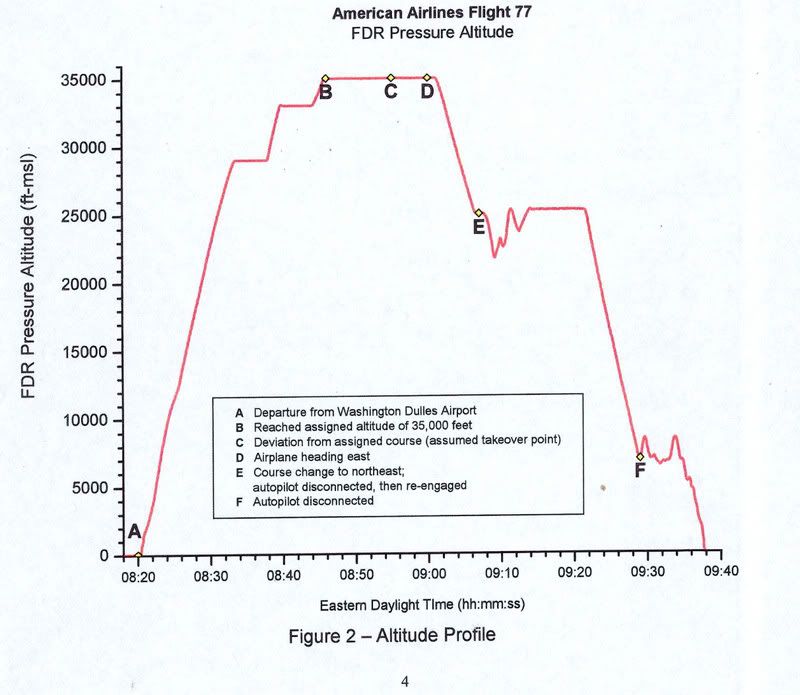
3) Flight Path Study graphing: Still not precisely clear - FDR pressure altitude measured in ft-msl. Lowest graph division is 1,000 feet – Pentagon impact seems to be about zero feet MSL, close to its actual elevation of 40 ft msl. However the Dulles takeoff at about 300 msl, 260 feet higher than the Pentagon, also charts out at what seems zero ft msl, or 300 feet underground? (Source: straight from NTSB - click to enlarge graphic)

4) The PentaCon reading of their eyewitnesses: 100% of their witnesses colse enough to see were convinced of an impact, but various clues indicate a flyover, At least 74 feet above ground level (agl), or 114 ft msl, or the lowest possible level above the roof. The range above that is theoretically limitless, but the lower the altitude, the more likely it could be mistaken by witnesses as an impact with the 73-foot-high building. The higher the altitude, the less sense the flyover theory makes. (Source: Citizen’s Investigative Team)

5) AAl_77.tab, tabular CSV file: final frame altitude of 173 msl, again pressure altitude - sixty feet over the buildin'g roofline. Takeoff alt was at correct elevation for Dulles airport of 300. The CSV file also shows a manual reset of the pressure altimeter at 18,000 feet on descent into the attack, as per FAA regulations, with no apparent effect on recorded pressure alt settings. (Source: NTSB via P49T member Undertow - I need to post my analysis on this soon)

6) The animation, uncorrected, has it 140 feet above ground at the end, somewhat lower at “impact point” if the trends were to continue, but certainly too high to have clipped the poles, hit the generator, or impacted the building. The closeness of this to the CSV indicates the animation was based on pressure altitude – especially with no operative radio altimeter. (source: NTSB via Snowygrouch, then SLOB, Mitch Harrison, etc. – link coming)

7) Read Out 2: An anonymous and irreproducable decoding of the unreadable L3 raw file reveals the nonexistent radio altimeter shows a 270 foot altitude above ground level (agl) at the end. This reading is based on signals bounced from the ground and not subject to pressure alt errors. Radio altimeter is listed in SFRI as inoperative and left blank. Snowygrouch says the reading “had been omitted by the NTSB […] for reasons known only to themselves,” even though it was “precisely the same as the pressure altitude.” It isn’t. (See readings 2, 3, 5, 6) (Source: it’s complicated – the story is here.)

8) John Doe X corrected: When the animation’s final altitude is adjusted to reflect the pressure reset not shown in the animation, the plane is 480 ft msl, 440 ft agl, and 367 ft above the Pentagon’s roof. This is probably too high to have been seen by witnesses at all, and far too high to have been mistaken for an impact. (Source: Animation plus JDX calculations)

Clearly not all of these six altitudes can be correct, though it’s not right to say only one is. Some may corroborate each other, like the animation and CSV, or official and CSV if the alt error was high enough. But to corroborate the PentaCon witness reading, it’d have to be just above the Pentagon roof, and well below that to support the official impact story; there was no high-impact “near-flyover.” It hit low or it didn’t hit.

But this is the only altitude of the eight that also allows the plane to strike the building - matching the (faked?) CCTV video footage, the (fooled?) closest eyewitnesses, the PentaCon’s own (duped?) witnesses, the (planted?) clipped poles and (engineered?) lawn-area damage, the (faked?) 300-foot deep damage to the Pentagon, the (planted?) 757 parts, etc. All these, taken collectively as reality (a leap some are unwilling to take), rule out any altitude higher than the official one. Readings 2, 3, 5, and 6 all could possibly correspond with this, due to the common errors of pressure altimeters, but certainly NTSB data seeming to place the plane well above the roof is problematic.

The higher readings each rule out all of this evidence and each other, and are supported precisely by themselves; another reading with no other backing. There may be more readings yet to come – say, 375 ft msl, or 30,000. That’d be new.

Monday, July 16, 2007

A SLOW ZOOM ON THE FINAL LOOP

A SLOW ZOOM ON THE FINAL LOOP
Adam Larson / Caustic Logic
The Frustrating Fraud
July 16 2007
last updated July 19


Connecting the Dots
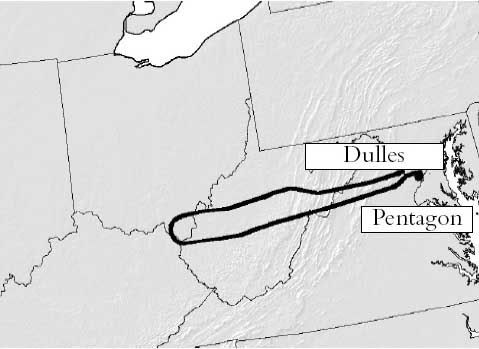
The initial flight path of hijacked Flight 77, as published in the days after the attacks, was largely a connect-the-dots approach. With no transponder after the terrorist takeover, and, we were told, “limited primary radar coverage” along the attack route, the return flight was not seen for a half-hour until it entered Washington airspace with its own radar. [1] The dotted line estimations published at this point sowed among the first seeds of suspicion over the attack. Was there a swap out there in the blind spot? As more evidence comes to light, all these paths have proven broadly accurate in that the 757 headed west, turned south over the WV-KY-OH border area, lost transponder, and returned, heading East straight to the Pentagon. Of the three maps above, Newsweek’s is the most accurate. USA Today’s path has a pronounced hump giving it a submarine profile, and Time’s map has the plane swooping north on its way back, crossing its outbound flight path, twisting the loop into an infinity symbol.

The final line of the journey as it passed east of its origin at Dulles, seems from here uneventful. But in these same early days reports surfaced of a tight, controlled, implausible loop over eastern Virginia, thought by many beyond the reported skills of the alleged hijacker Hani Hanjour. Facing the west wall, Flight 77 was said to have turned 270°-360° to hit - the west wall – oddly enough, the side just renovated to withstand bombs and impacts, largely empty, and across the building from the Defense Secretary’s Office. [more on the radar blind spot and the impact location in "From the blind spot to the empty side."]

Few if any eyewitness accounts seem to address the grand loop, since it was simply too big to have been seen by any one person – the first part of it was perhaps too high to attract much attention, but as it approached the Navy Annex and continued to lose altitude, it attracted more witnesses in its last several seconds, by which time it was going straight towards the Pentagon’s west wall. With such published accounts as the early cornerstone of our awareness of the attack, this magical loop remained largely invisible, possibly another government lie.

The overall uncertainty over 77’s approach lead many to accept this flight path as plausible to explain the final loop. It has Flight 77 flying south through DC’s restricted airspace with no White House defensive fire, headed towards Rumsfeld’s office before turning to hit the opposite side of the Pentagon, giving us the 270° turn so often cited. This map is quite wrong, understating the actual degree of turn by 60° and grossly misreading the original heading. [How this old map was arrived at and what’s wrong with it is explained separately in "the "old" 270° loop explained."]

The Radar Record
Among the too-vague early report was this from the ever-unbelievable Vice President Cheney, five days after the attack: "it entered the danger zone and looked like it was headed for the White House [...] Didn't circle it, but was headed on a track into it. [...] It turned away and, we think, flew a circle and came back in and then hit the Pentagon. And that's what the radar track looks like." [2] Five days later CBS News reported “radar shows Flight 77 did a downward spiral, turning almost a complete circle,” after which “the jetliner disappeared from radar at 9:37 and less than a minute later it clipped the tops of street lights and plowed into the Pentagon at 460 mph.” [3]

It was another month before radar specialist Danielle O’Brien, on duty at the Dulles ATC tower on 9/11, told ABC News’ 20/20 “it was an unidentified plane to the southwest of Dulles, moving at a very high rate of speed [...] I had literally a blip and nothing more.” As it headed towards the Pentagon, “it was just a countdown. Ten miles west. Nine miles west […] And it went six, five, four. And I had it in my mouth to say, three, and all of a sudden the plane turned away. In the room, it was almost a sense of relief.” But the turn continued until it was much lower and facing the same direction, after which O’Brien tersely summed up "we lost radar contact with that aircraft [...] and then the Washington National controllers came over our speakers [saying] The Pentagon's been hit.” [4]

O’Brien’s interview, aired in late October 2001, was accompanied by a radar screen graphic with a south loop of near 360 degrees off the east-bound flight as seen on radar screens. Seen briefly by millions, perhaps many thought this arc of dots just a guess or irrelevant, but in fact this same path would prove accurate and come back to bite them in the butt five years later. [Other than the red lettering, this picture is a direct screenshot from the program, viewable here.]

Official Reports: Zooming the Lump
We were only allowed a slow zoom in on what that loop actually looked like in the chain of official reports. Initial NTSB studies were kept behind closed doors, being in the FBI’s jusrisdiction and exempt from FOIA requirements. But the correct loop is there in a map from the 9/11 Commission’s Final Report, released mid-2004. Note its general agreement with early reports, and also the little lump of ink on the south side of the terminal tip – that’s the final loop, unreadable in this bold line on an unnecessarily zoomed back map. This line is apparently taken from the NTSB’s Flight Path Study, made from FDR and radar data in February 2002, classified at the time but available to the commission and cited in the endnotes. The report explained how at "5 miles west-southwest of the Pentagon," Flight 77 "began a 330 degree turn." [5]

That document was finally released via numerous FOIA requests in August 2006 and posted online from numerous angles. Finally we see a zoom in on the mysterious grand loop [see below]. First we see their overall flight path, printed big enough to show a silly little loop at the end [blue box], and also a detail of the loop all on its own page, faded yellow on a pale orange topo map [red box]. This is labeled in the report as “DC area flight path,” so possibly from ATC radar track, while the overall flight path above it is said to be from the matching FDR/radar data. [6]

The Black Box
Additional Flight Data Recorder information further verifies this loop. The Specilaist’s Factual Report of Investigation (SFRI), is an NTSB documented drawing exclusively on the full Black Box readings, also released in the 2006 rush. It has all functioning parameters graphed out for the duration of the flight, spread out over 17 pages; The basics -altitude, airspeed, and magnetic heading - are reproduced on each page. Here is the clearest extraction I've taken of this, edited to show a zoomed-in final minutes reading. All lines and values are accurate according to the bars at right and left. [7]
The story it tells is that at 9:34 Flight 77 began a remarkable thhree-minute turn just short of the Pentagon. The change in magnetic heading is graphed - as it approached DC with a general heading of about 95-100° magnetic –after a slight adjustment to the north and back at 9:31-32, the plane begins its loop at 9:34 – for about three minutes it turns south and then near-full circle to the west, north, and finally settling, at about 9:37, on a northeast heading of 70° magnetic, after completing the 330° turn and descending about 4,000 feet in the process, the last 45 seconds were a straight shot at that heading and a steady descent to roughly zero altitude at 9:37:45.

Here is how to read the headings on a map - apologies for the fruit-flavored style if that offends anyone’s sensibilities. The angle and color tells headingat a given mement, tehe direction the nose is pointing. Magnetic heading, which the FDR works with, are just about 10° higher compared to headings based on geographic north, since the magnetic north pole at that time was about ten degrees west of the true north. Read zero also as 360, due north, green. Here the plane starts out deep blue – due east, roughly 90° from north, 100 mag on the FDR - and its final heading is about 60°. Add ten to get magnetic, and this is what the FDR says – 70°.

The erred NTSB working copy animation, used by Pilots for 9/11 Truth, matches as well the official loop; their “final maneuver” video starts out at 9:34:03, turn just starting, and straightening out from 9:36:45-9:37:15 The onscreen mag heading dial roughly matches the other FDR data, settling on 70 after the loop – but of course the on-screen animation somehow ends up twenty degrees off from that, which is what places it “too far to the left” to have impacted the Pentagon, as the Pilots discovered…

Sources and editing: Coming
[1] Phillips, Don. “Pentagon Crash Highlights a Radar Gap.” Washington Post. November 3, 2001. Page A06. http://www.washingtonpost.com/ac2/wp-dyn?pagename=article&contentId=A32597-2001Nov2¬Found=true
[2] "The Vice President appears on Meet the Press with Tim Russert." Camp David, Maryland. September 16 2001. http://www.whitehouse.gov/vicepresident/news-speeches/speeches/vp20010916.html
[3] "Primary Target - THE PENTAGON." CBS News. September 21 2001. http://www.cbsnews.com/stories/2001/09/11/national/main310721.shtml
[4] "`Get These Planes on the Ground' - Air Traffic Controllers Recall Sept. 11," ABC News, October 24 2001. http://web.archive.org/web/20011024150915/http://abcnews.go.com/sections/2020/2020/2020_011024_atc_feature.html
[5] National Commission on Terrorist Attacks Upon the United States. The 9/11 Commission Report. map: p. 33. Citation of Flight Path Study: Page 459, source 59 for chapter 1. Explanation of the loop on page 9.
[6] FPS
[7] Specialist’s Factual Report of Investigation: Digital Flight Data Recorder . NTSB document number: DCA01MA064 National Transportation Safety Board, Vehicle Records Division. January 31 2002. PDF download link: http://www.ntsb.gov/info/AAL77_fdr.pdf

Friday, July 13, 2007

A PUNCH-OUT FOR CARLSON’S BACKHOE THEORY

A PUNCH-OUT FOR CARLSON’S BACKHOE THEORY
Adam Larson / Caustic Logic
The Frustrating Fraud
July 13 2007


The “punch-out hole” in the C Ring is a true mystery of the Pentagon attack, addressed by an anarchy of theories both in the conspiracy world and in the official story. Official reports fail to clearly explain the near-perfect “wall failure” at the end of the damage path through the building, though they tie it in one way or another to the airliner impact. [location, basics, and official explanations here.]

Some researchers have often seen the possibility that this hole was made on purpose, to some specification for an unknown reason. It’s been wondered if this was related to one of the secondary explosions reported by some. I had wondered on first seeing the hole’s near-perfect form and its size if it wasn’t made by emergency workers [see picture]. It's perfect for human entry, almost a doorway really.

One novel notion to this effect that I feel deserves its own brief post was proposed in 2005 by perennial no-planer clown Jon Carlson.” IT IS CRYSTAL-CLEAR,” he announced at Rense.com, “that this wall opening was made by contruction workers needing to access the inner Pentagon [and] NOT by a landing gear as claimed by Popular Mechanics. “ He presented “the evidence that the WALL OPENING next to the road that runs inside the Pentagon was actually made by a backhoe.” [1]

Carlson noted the symbols that look like upside down anarchy signs, bracketing the spray-painted words “punch out” to the right of the hole. Now, from what I know (a quick internet search) of construction terminology, a “punch list” is “a list of discrepancies that need to be corrected by the contractor,” while a “punch out” is a process of inspecting a site and making a punch-list. [2] In this case, it seems to be a directive to assess the damage inside, or an acknowledgement that the erea had been punched-out. But Carlson gets mixed up and explained “in CONSTRUCTION TERMINOLOGY 'punch-out' refers to making an opening in a wall to access the inside contents of the wall or the inner room.” [3] Oops. Better run a punch-out on Carlson’s wrecked research for any discrepancies to bill him for.

First, let’s look at the Pentagon Renovation press conference from just after the attack that Carlson took as the “FINAL WORD” that this hole was made intentionally. Presenter Terry Mitchell said on September 15:

“this pile here is all Pentagon metal. None of that is aircraft whatsoever. As you can see, they've punched a hole in here. This was punched by the rescue workers to clean it out. You can see this is the -- some of the unrenovated areas where the windows have blown out.” [4]

While it’s not clear which photo(s) he’s really referring to here, Carlson joined this quote with the photo below and for good reason. Note the markings, the flat/straight/square metal scraps (building debris), and the clear view through the gutted building to the (unrenovated) outer E Ring wall north of the impact point. It seems likely, as Carlson decided, that this is the photo referred to.


This must not be the case however – according to Russel Pickering of Pentagonresearch.com anyway, this photo was taken by a FEMA photographer on September 20, nine days after the attack, and five days after Mitchell’s presentation. [5]

Whatever he was really talking about, Mitchell’s “FINAL WORD” is not as useful as Carlson pretends; just before this quote he also said “there was a punch-out. They suspect that this was where a part of the aircraft came through this hole, although I didn't see any evidence of the aircraft down there.” [6] There certainly were parts that seem to be from the plane at the punch-out [link coming], so if he’s talking about the same location, it would appear Mitchell got confused – calling it first a punch-out and then a punch-in. Or perhaps he was showing two different areas. Whatever the case, no other official sources I’ve seen mention a manmade punch-in - they all say the plane did it but can’t agree exactly how.

Carlson then looked at the photo above with its “orange circled 'V's [which] directed the backhoe operator to make the opening within the V's.” He also drew attention to “the orange arrow on left edge of the opening,” just beneath the “no-parking” sign. [7] This he seems to take as the “dig here” mark, but it was clearly painted on after the brick damage.

In fact in the first photos showing the hole there on 9/11, the wall bears no spray-painted “directions” at all to guide the operator, thus nullifying Carlson’s evidence here. This was all done after the fact. The purple backhoe directive to “punch out” the area with its bucket did not appear on the wall until September 14, just in time to be misread by Mitchell the next day. [8] The Vs and the arrow appeared earlier, late on the 12th. As for these symbols, they seem to stand for “victim,” as Pickering explained in his rebuttal to Carlson’s piece:

“[T]he markings on the wall to which Jon refers are international rescue symbols, not backhoe directions. The "V" indicates a victim has been located. If there is a line through the V (an upside down "A") that indicates the victim is deceased. If there is a circle around it, that means the victim has been removed.” [9]

Pickering’s chronological study of hole photos shows that the markings were not there by mid-day Tuesday, but the Vs had been placed, crossed, and circled by photos from that night. [10] Given the devastation inside, I’d find it curious that all bodies in that zone were cleared in less than a day before the morning of 9/13. This could be another clue, but I don't understand the procedures and it's a bit of an aside...

Despite Carlson’s transparently silly analysis, Pickering noted in his rebuttal “the exit hole is very important evidence to indicate a government cover-up because it can't be explained by an aircraft hitting the building.” [11] His worthy analyses of the hole can be found compiled here: http://www.pentagonresearch.com/exit.html Though I cannot agree with his certainty that this is something intentional, I must admit his theory makes at least as much sense as the vague official stories.

Sources:
[1], [3]. [7], [9], [11] Carlson, Jon. “PM Claims Landing Gear Made Pentagon 12 Foot Hole.” With responses from Russell Pickering. March 9 2005. Rense.com. http://www.rense.com/general63/pmm.htm
[2] Home Building Manual. Glossary. http://www.homebuildingmanual.com/Glossary.htm
[4], [6] Lee Evey, Pentagon Renovation Manager, Rear Adm. Craig Quigley, Deputy Asst. Sec. of Def. for Public Affairs, and Terry Mitchell, chief, Audiovisual Division, Office of ASD PA. The Pentagon, Arlington, Virginia. September 15, 2001. 11:00 A.M. EDT http://www.defenselink.mil/transcripts/transcript.aspx?transcriptid=1636
[5], [8], [10] Pickering, Russell. “Exit Hole chronology.” Pentagonresearch.com. http://www.pentagonresearch.com/062.html

Sunday, July 8, 2007

EXTERNAL RESEARCH LINKS {MASTERLIST}

EXTERNAL PENTAGON ATTACK / FRAUD RESEARCH LINKS
Adam Larson / Caustic Logic
The Frustrating Fraud
in assembly... July 27 2007


Please feel free to submit useful links in the comments section below.
------- -------
>> Best General Pro-757 “Truther” Sites:
- Russell Pickering's EXCELLENT Pentagon Research site (Currently down but will return)
- Jean Pierre Desmoulins' "Pentagon 2001 / 9 / 11 : the fraud !"
- 9-11 Research - Pentagon Attack main page
911 Files.info - John Farmer's blog
AAL77.com - John Farmer's invaluable file download page of Pentagon-related media files for fellow researchers.
------- -------
>> Flight 77
- Center for Cooperative Research – Flight 77 timeline.
- Official Passenger List
- Whatreallyhappened: Official hijackers with questions
- Olmstead – no hijackers? (2002 - at least partly debunked by now)
------- -------
Pentagon “honeypot” theorists:
- Jim Hoffman, Oct 2004: "The Pentagon No-757-Crash Theory: Booby Trap for 9/11 Skeptics"
- Oil Empire: "Rumsfeld's "missile" hoax debunked by 9/11 truth activists"
- John Judge's early Fraud warning, Oct. 2002: "Flight of Fantasy: Flight 77 Didn't Hit the Pentagon."
- Mike Rivero: "The "Pod People" And The Plane That Crashed Into the Pentagon"
- New American article: Pentagon 9/11: Getting the Facts Straight
- Joël van der Reijden: "Why the No-757 Crowd is Making an Ass out of Itself"
- Jean-Pierre Desmoulins: "Lies against lies."
- Break For News.com forum: Pentagon - Overview.
- Mark Robinowitz: "Bad Jokes Hidden In Plain Sight"
- Infowars - Video release Designed to Frame The Debate
- Prison Planet: Judicial Watch as honey pot “water carriers”
- Jeff Wells: The Flying Wedge
------- -------
Prime Old-School Fraud Examples:
- Raphael Meyssan: Hunt The Boeing: The 2002 site that started it all...
- Killtown's "Did Flight 77 Really Crash Into the Pentagon?"
- 7th Fire: A Missile, Not Flight 77, hit the Pentagon
- Killtown's Incredibly Useful Flight 77 links page
- Dick Eastman’s “You Decide” Flyover theory
- AmericanPatriotFriends: Where is the Plane, Flight 77?
- 911Lies.org: Missile Damage to Pentagon
------- -------
>> Official Story Explained
- 9/11 Commission, Final Report (pdf)
- Purdue University's 2002 crash simulation
- ASCE's Pentagon Building Performance Report (pdf)
- Pentagon Renovation Program – Phoenix Project
- Arlington County After Action Report – pdf download page
- Flight Path Study (pdf)
- Air traffic control report
------- -------
Debunkers / hitmen for strawmen:
- Screw Loose Change
- Mark Roberts' Loose Change Guide, Pentagon section

- 9/11 Myths: Pentagon page
- Ian Goddard: Pentagon Crash Analysis
------- -------
Physical Evidence: Plane Parts
- Sarah Roberts, Rense.com, 2002: Photo collection of possible 757 parts inside the Pentagon.
- Jim Hoffman/9-11 Research engine page
- Jerry Russell/Richard Stanley – good page on engine
Aerospaceweb: Wheel rim identified - precise style used on Flight 77
------- -------
Video and Analysis:
- Flight 77.info – At the forefront of getting video of the Pentagon attack released
- Henry 62: "Why Don't the Pentagon videos clearly show a plane?"
- John Farmer/BCR Gate cam analysis (9 posts)
- John Farmer/BCR analysis of the Citgo video (32 posts)
- John Farmer/BCR analysis of the Doubletree video (19 posts)
- An analysis of the 9/11 Pentagon videos released by the U.S. Department of Defence on May 16, 2006
- Parody: “Pentagon hit by flying grilled cheese sandwich, video frames show.”
- Michael Moore’s Pentagon camera questions
------- -------
Eyewitnesses/PentaCon
Eric Bart's classic list of eyewitness accounts of the Pentagon crash
The PentaCon/CIT main site
Arabesque - A Critical Review of ‘The PentaCon - Smoking Gun Version’
PentaCon spoof/hit page
------- -------
Flight Data Recorder
JREF Forums: "AA77 FDR Data, Explained"
Flight77 FDR Research: ATS thread I started
NTSB Study of Flight 77's Flight Data Recorder - (PDF download) - released Aug 06
AA77FDR.com - run by Undertow, collecting the known sources said to come from the black box, notably the odd readout 2

Monday, July 2, 2007

NEWS: FRUITS OF A WILD JUNE

THE FRUITS OF A WILD JUNE: NEW STUFF THAT'S UP
Adam Larson / Caustic Logic
The Frustrating Fraud
July 2 2007


Well, things had been slowing down with the site here (and certainly with my other Caustic Logic sites) as I focused energies on two outside fronts. A while back the Center for Cooperative Research, whose seminal Complete 9/11 Timeline I had greatly admired since 2002, approached me to help flesh out some details on the Pentagon attack, which they were still short on. I’m deeply honored to have my first two entries there, dealing with the ASCE’s Pentagon investigation, now up on the 9/11 Investigations Timeline:
ASCE investigation: timeline, players, mandate
Report released, general findings: how the Pentagon responded to the impact of a Boeing 757.

Before and during this time, there was the drama at Above Top Secret.com, which oozed steadily from a the thread I started in late May called ”Pentagon “NTSB” Animation is WRONG!”. Besides the technical considerations by which the animation does not represent the Black Box data, I passed on my doubts over the its authenticity as an “NTSB report” (this will require its own post soon), with often overzealous assistance from another member [Nick7261, to whom I am greatly indebted for making things so interesting]. This triggered Pilots for 911 Truth co-founder John Doe X/Rob Balsamo to pop in with links, insults, a passing threat of lawsuit against Nick and I, and talk of “big-boy” phone interviews and their boundless expertise. In addition he showed me enough new information – corroborating releases of the same animation to different people and with better documentation than what I had previously seen - that I changed course and have since called this an NTSB animation and then set on the path to get a copy myself.

Over the course of June this episode also dragged me into renewed wrangles with The PentaCon producer Craig Ranke/Lyte Trip/Jack Tripper along now with his cohort and Pentagon evidence “expert” Aldo Marquis/Merc. Over the course of two threads, there were some interesting moments, including an invite to a phone discussion with Marquis I seriously considered doing. It’d be wasted breath, I finally decided, about the time Marquis told me I was “dangerous” to the Truth Movement. But as a peace offering I took down my old PentaCon review, to be replaced in time by a series of pieces critiquing the video inside and out.

Now that the first CCR entries are up and the drama at ATS has died down, it’s been a busy few weeks of updating here and July is now a reality, with the site full of new and fascinating things:
NTSB FOIA letter received – no discs included: My first attempt at using the Freedom of Information Act yields instant irony. Damn, that’s what I should’ve called the post…

Litmus test for Rationality? Rebuttal to James Fetzer: The Scholars for 9/11 Truth co-founder and space-beam/TV fakery proponent has laid it down, with Pilots for 911 Truth’s wrong NTSB animation as a final proof that no 757 possibly hit the Pentagon, and people like me are either ignorant of “the evidence,” mentally challenged, or misleading deceitfully. He’s drawn a line in the sand, and I have kicked that sand back in his face.

Michael Moore’s recent 9/11 public questions – his strongest yet towards the inside job paradigm – center on Pentagon video secrecy. I applaud his coming forward, but had to offer an opinion on the issue for what it's worth, and certainly look forward to seeing how he approaches the issue.
Citgo video analysis: I at least started posting things on this, including a graphic chronology of the canopy flash just before impact. More on the way…

On the physical evidence front, recalling Aldo Marquis calling me “dangerous” to the Truth Movement; this was right after I solidly debunked one of the PentaCon’s main “smoking guns” for no 757 impact for all to see. That’s got a post here now too, along with his terse, I sense pained responses to my simple enough case. And just the other day I finally did a basic post on the Punch-out hole, with another on the way.

I’ve also updated various old posts and masterlists, and a new, usable, links section is in the works. There’s no denying the evidence this Summer, folks. Persistent fraudbots got you down? Try the many lines of repellents available here.

COLUMNS 15-17: STILL ATTACHED?

STILL ATTACHED?
BEING A FASCINATING STUDY OF FIRST-FLOOR COLUMNS 15AA-17AA
Adam Larson/Caustic Logic
The Frustrating Fraud
Split-off July 3 2007 from Support Columns masterlist


This photograph by James Ingersoll was used as figure 3.9 in the ASCE’s Pentagon Building Performance Report. It shows exterior support columns 15AA, 16AA, and 17AA, which the report described as “severely distorted but still attached at least at their top ends to the second-floor framing.” [1] This is what I originally saw as well, as have most others. But being just to the immediate left of the main fuselage impact point at column line 14, this should have been the entry point for the right engine and wing root; it stands to reason then they should have been just as removed as the columns to the left of 14.

Despite their distortion, many have taken these columns’ existence at all after the crash as a sign that the no plane the size of a 757 could have entered.For example, Dick Eastman noted these in his piece "You Decide: Fighter Jet? Or 757?" His second proof of a fighter strike, as illustrated by the government graphic at right, is that “the starboard engine would have hit on the first floor at pillar #16. Except that it didn't." He cites their status: "Pillar #15 has been blasted near ground level […] Pillar # 16 is still there, albeit blasted so that it inclines to the right; and pillar #17 is also present and accounted for.” Eastman concluded “clearly there was no starboard engine. An explosion occurring to the left of pillar #15 caused damage to the pillars to the right of it and brought down some outer wall on the first floor wall, but a large turbofan engine of a Boeing 757 never penetrated here. Thus we know that the killer jet was a single-engine aircraft.” [2]

This is classic fraud logic. “there was no 757 because the hole is too small. The “extra damage” is because of explosions to make it look like a bigger 757 hole. But just looking at that hole, you can see it’s too small…" (rinse and repeat).

However, looking at that diagram and noting that everyone agrees that the outermost columns on the left and center of the entry space (10-14AA) were uniformly removed, #15 and 16 indeed should have been nearly vaporized. This never seemed a big enough problem for me to dismiss the 757 hypothesis; I figured the displacement was enough to let an engine pass, but I found it odd that 16 would just "tip over" in straight form rather than being bowed. When I realized the high-right banking angle as well, it became clear this column would have been hit near the top, not the bottom, which makes no sense given the pictured slant of this big, square-sided "damaged column." And I was at least half-aware that the columns the ASCE and I were seeing looked different from each other and from the other pillars we can see, and weren’t quite properly spaced.

In retrospect it was also a bit sloppy of me – and perhaps the ASCE - to be certain these were "support columns" at all. In fact, despite their impressive credentials, no one at ASCE had time to look up close before the collapse, and only so much could be told afterward. in the collapse zone “the team was unable to determine specifically the level and extent of impact damage.” [3] They probably decided on the pillars by looking at these photos – but Jim Hoffman has looked at the same ones and decided “some or all of these objects may in fact be broken portions of the second floor slab that collapsed after the impact,” and came to rest at an angle close enough to vertical to be mistaken for columns. [4] Note also the lowest edge of the 2nd floor façade between 15 and 16 missing a segment of limestone about the size of “column 16.”

Another shot, above, from before the area's blanketing in foam reveals the burning hell a Pentagon doused in jet fuel becomes, as well as better detail on the possible pillars. Here it seems #15 and #17 are just narrow bits of something dangling down nearly to the ground, but these could be battered pillars, reduced to rebar netting. #16 looks most like a solid pillar on first blush, but much burlier than #18 or the other suspects, and I doubt it would look this clean and square if it’d been hit by an airliner at it's "still attached" top end.

Therefore this is actually the weakest candidate for support column and likeliest for second-floor portion –slab, girder, façade, Idon’t know exactly what was there – perhaps something like the chunk missing from the shot above, taken days later and I believe of columns 18, 19 and 20. Perhaps #16 is the sister of the broken slab there, and #17 is the sister of the metal girder beneath it.

Note: “Column 16” appears wider in the original photo, but I noted a light line running down the middle of it, indicating it had a square cross-section, and had somehow rotated about 45 degrees from the camera. When placing it above I “turned it around” by cropping off one side, but then failed to stretch it back out to cancel the perspective. I’ll have to correct this. But anyway, I still say whatever horizontal member this might’ve been, it makes more sense than a column that had been hit by any part of a barreling 757.

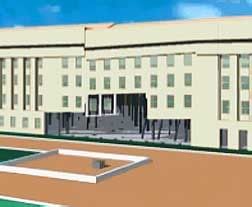
A still from the PBPR, a 3-D model by the ASCE. The three red slants here are columns 15-17. Among the worst damaged, these are listed in the Performance Report as “missing, broken, disconnected,” elsewhere described as "without remaining function.” Some were entirely knocked loose but found, some were disconnected but standing, and some totally obliterated, here represented by dots on the floor where they were. These red “columns” appear out of place when all those around and behind it are verified or presumed vanished. I suspect this graphic is incorrect by having the three red pillars shown as anything but dots.

If these three mystery slants are indeed something other than columns 15-17, then we are left with a roughly 90 foot-wide area in which all supports were obliterated on the ground floor, front line - leaving plenty of room for the engine-fuselage-engine penetrating core of a 757, whose deeper but less even damage further in would explain the collapse of everything above that twenty minutes later. While some confusion about this has encouraged speculation and no-757 theories, a little research would show that in either analysis, red is red; missing or in place but non-functional, these columns are no longer functioning support columns because something heavy and fast has traumatized them.

Sources:
[1], [3] Mlakar, Paul et al. “The Pentagon Building Performance Report.” American Society of Civil Engineers. January 2003. PDF version. www.fire.nist.gov/bfrlpubs/build03/PDF/b03017.pdf
[2] Eastman, Dick. "You Decide: Fighter Jet? Or 757? 911 Pentagon Crash Evidence proves False-Flag Frame-up." http://www.bedoper.com/eastman/
[4] Hoffman, Jim. “ERROR: 'Surviving Columns Preclude 757 Crash'” 811 Review.com http://911review.com/errors/pentagon/columns.html

Tuesday, June 26, 2007

NEWS: MICHAEL MOORE, 9/11, AND THE PENTAGON CAMERAS

MICHAEL MOORE, 9/11, AND THE PENTAGON CAMERAS
Adam Larson / Caustic Logic
The Frustrating Fraud
6/26/07


Previously having shied away from the issue directly, superstar documentarian Michael Moore recently gave a video interview to 9/11 Truth activists that expressed support for their inside job beliefs. Two reporters from We Are Change.org and Infowars.com captured the interview and published it on June 20. This interview is big news on the internet in 9/11 circles for what the Infowars-affiliated Jones Report called Moore's “clear departure from the 'government negligence' picture he painted in his film Fahrenheit 9/11.” Since he made that film about three years ago, Moore told his interviewers, he’s had firefighters tell him of “explosions” at the World Trade center. He remarked that official investigations thus far “haven’t even told us HALF the truth,” and expressed hope for a new investigation.
Google video link to interview

Then he said “lemme just give you one thing that I’ve asked for for a long time,” and turned to and lingered on the Pentagon attack. Noting the well-surveilled nature of the area, he told the interviewer “I wanna see the video, I wanna see a hundred videos that exist of this. Why don’t they want us to see that plane coming in to the building?” This is of course the prime driver of suspicions over that strike – the fact that we haven’t seen it, except two low-res and dubious frames and trace only in another of the four videos released so far. Video masterlist Moore is aware of the other lines of questioning as well – the precision approach that we’re told took the plane into the Pentagon’s ground floor but without marking the lawn: “to hit a building that’s only five stories high that expertly uhh, I believe that there will be answers in that videotape and we should demand that tape.”
Moore talks animatedly about Pentagon video secrecy

The usual implication of video secrecy opponents is that they must be hiding something contrary or embarrassing. Personally I’m not so sure the tape would show us much other than what the witnesses and building damage have been saying so far. Even a precision guided 757 looks the same on video. But Moore is too vague on this to be called a fraudster just yet and to his credit, he neither agreed nor disagreed with the interviewers about another major no-757 issue - the ever-shrinking entry wound. When asked if he was aware the “the [impact] hole is about eight feet wide,” he said “I’m not very good at the physics [inaudible], but believe me, I intend in my own way to find some answers. Thank you for whatever you’re doing.”

This could prove interesting. If Moore adds his weight to the cameras issue, we may just finally see better what they’re hiding. Now taking bets! Oddly enough, Scott Bingham at Flight77.info, a pioneer in the video release field, is not terribly sanguine about this development:

Michael Moore wants to see the the 100 or so videos from cameras that ring the Pentagon. In our original lawsuit we asked for every video the government has. If there are indeed 100 or so videos with some of those showing the plane in flight as Moore suggests, I don't know how a person can (working within the system) get those videos if the government states they don't exist (as they have stated within our lawsuit). Again, I think the "9/11 Truth Movement" should focus its efforts away from the soup that is the 9/11 Pentagon story.
Source: http://www.flight77.info/
---

Thursday, June 21, 2007

NTSB FOIA RESPONSE LETTER RECEIVED

NTSB FOIA RESPONSE LETTER RECEIVED
NO DISCS ENCLOSED!
Adam Larson/Caustic Logic
The Frustrating Fraud
June 21 2007
Updated 6/26


[Note: This investigation is done under terms of the Freedom of Information Act, requesting documents from the National Transportation Safety Board (NTSB). I was spurrred to it by my suspicions over previous FOIA-obtained NTSB data published by Pilots for 911 Truth. ]

Before I even went the normal FOIA route, I first tried a different strategy, contacting the Public Affairs Department. This effort proved interesting but came to naught. I will write a post about that soon. I followed this up with a Freedom of Information Act request via the online form at the NTSB site:

I am lodging a request for items regarding aircraft no. N644AA American Airlines Flight 77 that crashed on September 11 2001. Items I would like to have sent to me:

1) any and all animations/reconstructions of the FDR data from Flight 77
- a working copy that others have received, including a erroneously-labeled time stamp. (this is available online for visual reference)
- If possible any other animations, like the one presented by the 9/11 Commission in a mid-2004 presentation, aired on C-Span, but for which I can find no information. If this was NTSB-produced and is releasable it would be very useful.

2) electronic attachments listed for the Specialist's Factual report (doc ID DCA01MAO64)
- DCA01MAO64_tabular.csv
- D226A101-3G.pdf
- 757-3b_1.txt

3) Other files:
- AAL77_tabular.csv (if different from CSV listed above)
- Original L3 compressed raw AA77 FDR file


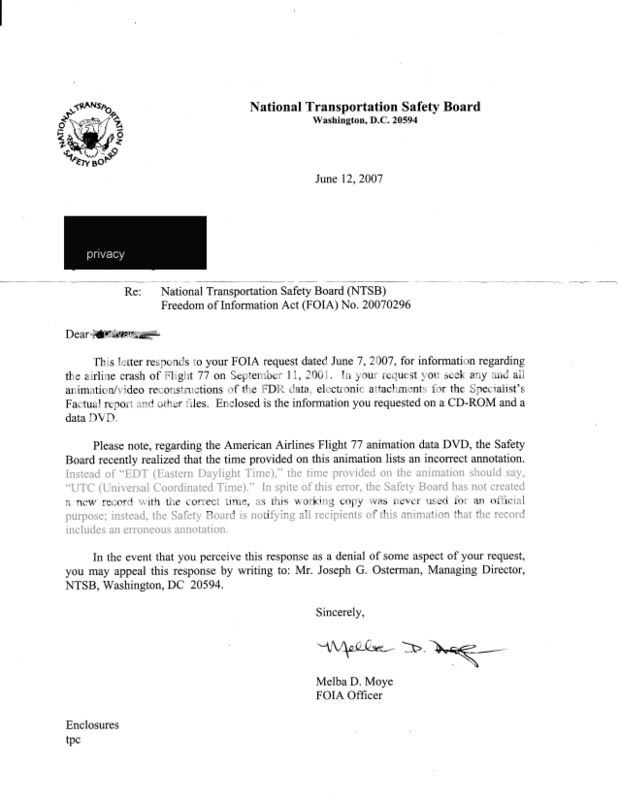
I had despaired on reading "turnaround could range from 3 weeks to 1 year or more," as I filed my request on June 7. The response is dated June 12. It was put in my mailbox on the 15th or 16th while I was out of town and I found it on Sunday the 17th. This swift response paralled two other members at Above Top Secret.com, as well as John Farmer’s receipt at around the same time. Here is the letter I recieved [ny name is redacted here even though it’s on the article header on the off-chance this jpeg gets re-posted all over – my street address is also not something everyone needs to know].

It looks like pretty much the same thing everyone else has been getting, as Rob Balsamo (John Doe X) said I'd get if I asked. The same officer that signed Undertow’s and Snowygrouch’s letters, Melba D. Moye, the same wording, the more recent apology for the wrong time stamp, etc. Sound like the one I’m looking for. It informed me of my recent query, and stated “enclosed is the information you requested on a CD-ROM and a data DVD.” At the bottom are the words “enclosures: tpc,” whatever exactly that means.

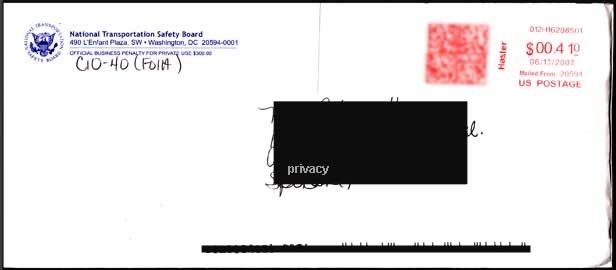
So what's on the discs? I don't know. They weren't enclosed. The letter was folded in thirds, placed in a letter-size 8.5x3.75" envelope with nothing else. The envelope was not moisture sealed but secured with clear tape. My address was handwritten, and it had a proper looking address with the warning “official business penalty for private use $300.00” and a handwritten code C10-40 (FOIA).
I guessed maybe "enclosed" means in the mail, and started presuming I'd soon have my own copy of the green and purple cartoon with the wrong altitude, wrong lat/long plot, and wrong final bearing that Pilots for 911 Truth and others have been wondering over. But now it seems it’ll be slow in coming, and I’ll have to write in to get this figured out; “In the even that you perceive this response as a denial of some aspect of your request, you may appeal this response by writing” to the NTSB’s managing director Joseph Osterman. They’re all gonna know me real well down there before all this is done.

So while the animation’s direct link to the NTSB remains to be totally verified on my end, the letter sure looks like part of the overall pattern reported so far by FOIA recipients, and it appears I was probably in error for doubting the animation's NTSB pedigree. But strangely, I've been singled out for this silent treatment, some set of factors witholding total confirmation...

COLUMN 14AA: THE SMOKING GUN THAT FELL AWAY

COLUMN 14AA: THE SMOKING GUN THAT FELL AWAY
Adam Larson / Caustic Logic
The Frustrating Fraud
Updated 6/21/07

(Split-off from the support columns masterlist)
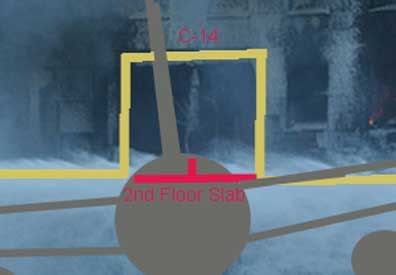
----Let’s look at the roughly 12x16 foot hole apparent on the second floor, where the Foam Fraud has wrongly attracted attention as the main fuselage entry point. The ASCE reported "on the second floor, the facade was missing between column lines 11 and 15. This was caused by the impact of the upper parts of the Boeing - mostly tailfin and horizontal stabilizers. While "windows and their reinforcing frames were still in place between column lines 11 and 13," their Performance Report listed Column 14AA as “missing,” the only one so designated on the second floor. [1]

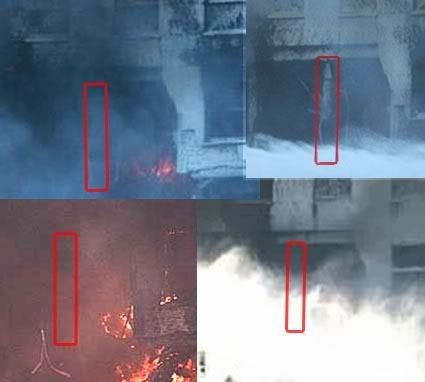
Yet through some magic, many 9/11 Truthers have found the column there and concluded no plane fuselage entered. Which is mostly true, since the main fuselage entered below that, a disconnect that pops up again and again. Here’s where it all comes back to: in the shot above, even the evident wall-removed hole between column lines 13 and 15 seems to have an intact and vertical support running down the middle of it. Ralph Omholt of Physics 911 noted this “vertical column, next to the purported entry hole on the second floor. Not even a small plane could have hit at the purported location, without destroying the column; inwardly. Note the general good condition of the windows; this wasn’t a major impact zone of a B-757.” [2]

Likewise, but more emphatically, Citizens Investigative Team, producers of the documentary The PentaCon, list this column as unequivocally present and one of their prime clues to look elsewhere for the missing 757. CIT co-founder and PentaCon narrator Aldo Marquis shared the above graphic and told me, in the Above Top secret forums:

“The biggest smoking gun besides the undamaged foundation and the no tail section damage is column 14AA. THIS reduces the size of the "fuselage hole.” It is clear that the two windows were blown out. Would it be more likely or less likely to leave a segment of column hanging in the middle of the "fuselage hole?" [3]

Again, this is not the main point of fuselage impact, but rather the tailfin hole, officially, which in a sense also discredits another of their smoking guns - hte lack of a tailfin hole. I set out to explain this to him, along with three other points. Here are the points I made, his responses in the discussion thread, and my responses to his responses (added here, after I decided it was useless to push it there):

Caustic Logic: THIS dangler is your smoking gun #2?
Marquis: “Yes. No amout of warping of the mind or rationalizing will not change that.”
(Well, that about set the tone…)

Caustic Logic: “1) Jim Hoffman: this “hanging object […] appears to consist in part of remains of the steel reinforcements that were part of column 14. […] it might have pivoted as the plane entered the building, and then fallen back into a vertical position.” [4]
Marquis: “"Might". Again, this is ridiculous. People like you and Jim Hoffman are dangerous to the truth. You will calmly suggest irrational suggestions in order that you mold the mind of the reader. I am not going to comment on Jim Hoffman's silly suggestion more than that. I may not be an expert, but neither is he. He is a software engineer. Not an aeronautical engineer or building engineer.”
(He ignored the point here, replacing defense entirely with offense. None of us are experts, but he feels he’s entitled to be right when he can’t even tell a plane’s nosecone impact from its tailfin hole.)

Caustic Logic: “2) Here’s how the plane is alleged to have entered. It doesn’t seem too odd to me that a partial column 14 might have survived the impact, attached at the top end but not the bottom.”
Marquis: “This is more deceptive artistic rendering.”
(Wrong. I only claimed it represented the official story, and it was carefully prepared to match that in all proportions. It may not be100% precise but accurate enough to make my point, which he entirely ignored, again.)

Caustic Logic: [referring to above “deceptive artistic rendering”] “3) Look at that fuselage top – it couldn’t permanently defy the 2nd floor slab plowing into it edgewise, but couldn’t help but dent it at that spot either. The ASCE agrees with me on this point that the slab shows signs of breaching there:” “The removal of the second-floor exterior column on column line 14, probably by the fuselage tail, suggests that the second-floor slab in this area was also severely damaged even before the building collapsed.” [5] I offered the shot below:
“Look at the glow in the center and notice the floor seems to start a ways in. Therefore C14 would have had no floor to anchor to.”
Marquis: “Nothing conclusive about that photo.”
(it’s one of those things you either see or don’t).

Caustic Logic: “4) Oddly enough, there is another famous shot that shows no column at all in that very spot. Pentagon photoshopping? Or dropped dangler? If this was such a mighty column that would have barred entry to a 757, then why did it disappear on its on within 20 minutes (before collapse)? Am I wrong? Did smoking gun #2 fall away of its own accord?”
Marquis: "Adam, we can not continue this dialog if you are going to be decpetive by using lower resolution photos. The column was there after the event. PERIOD."

Not period. Rather, comma, "apparently, in this one photograph." Okay, the pic I used was a little small, but is resolution really an issue when we have a span of evidence like this? Four of the clearest shots of the area I’m familiar with, which I've used above and elsewhere, and which the CIT themselves might've used: One shows column 14AA hanging in there after the fire foam was sprayed. In one (lower left), no foam has yet been sprayed and the damning column is not evident (though there may be hanging elements back in the smoke). The other two show again after the foam was applied no apparent vertical members. No sign. I’m remembering the old Sesame Street segment about which one of these things just doesn’t belong. It's the one with a column. And it’s one of their “smoking guns” no matter what, that led them to look at the eyewitnesses for an explanation of where the plane went if not into the building.

As we had started out:
Caustic Logic: Of course any realizations would be too little too late of course, and I don't expect a course change.
Marquis: Apparently I should expect the same with you.
Apparently we were both right.
-
Sources:
[1] Mlakar, Paul et al. “The Pentagon Building Performance Report.” American Society of Civil Engineers. January 2003. P 17 PDF version. www.fire.nist.gov/bfrlpubs/build03/PDF/b03017.pdf
[2]Omholt, Ralph. “9-11 and the IMPOSSIBLE: The Pentagon. Part One of An Online Journal of 9-11.” Physics 911. Undated. http://physics911.net/omholt
[3] Posted by Aldo Marquis June 9 2007, 11:36 am, at: http://www.abovetopsecret.com/forum/thread286140/pg4
(Cited responses on following pages of the thread)
[4] Hoffman, Jim. ERROR: 'Surviving Columns Preclude 757 Crash' http://911review.com/errors/pentagon/columns.html
[5] See 1 – page 37.

Monday, June 4, 2007

NEWS COMING

June 4 2007

I haven't been able to post anything new, update my old posts, or respond to new comments lately, as I've just stumbled into a major hullaballoo about the supposed NTSB flight path animation for Flight 77. In the post TEN DEGREES FROM TRUE: THE "NTSB ANIMATION" IS FLAT WRONG, first done at Above top secret.com the same night (May 27) I outlined my case as to why the animation discrepancy Pilots for 9/11 Truth had used for their video Pandora's Black Box actually worked against the Pilots. This is becuase it is internally inconsistent, showing both a 90 and a 70 degree heading at the same time, and because of it's unclear paper trail and NTSB pedigree.

Frequent references to a "new" animation that popped up during the thread turned out to be another copy of the same animation also said to be from the NTSB. This DVD was recieved May 24 and posted online May 26. Also The Pilots had just re-obtained it themselves, all the same problems and all, this time with a better cover letter and stronger NTSB linkage. The shadow possibility that this blatantly wrong animation is indeed from the officials on high is now directly the possibility I'm looking at, with all that implies or doesn't.

I had no idea all this was happening as I started that thread based on what I knew - oops - and now I'm feeling a bit overwhelmed, as Pilots founder John Doe X is calling me and my cohorts out for not knowing our stuff, and challenging us to contact the NTSB ourselves. But it's too late to turn back now, and the next step is indeed to get some information from the NTSB myself.

So nothing new right now, but this week I'll have something to report.